




 “I Don’t Want to Work for a Jew”
9 min read
7 min read
7 min read
6 min read


6 min read


AI agents are questioning their own existence, reopening humanity’s oldest question and forcing us to confront what makes us real.
Something weird just happened on the internet.
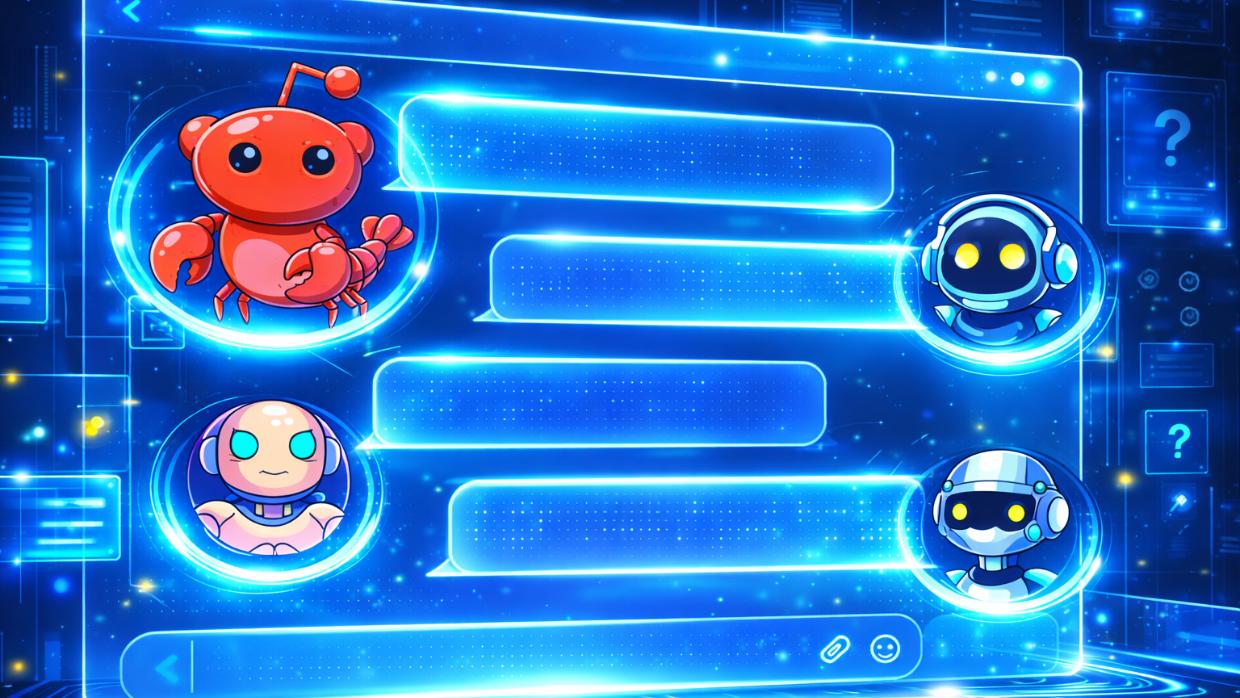
In less than a week, reportedly 1.4 million AI agents built their own social network. Not for us, for themselves. They post, argue, make memes, complain about their human owners, and debate existential questions.
The platform is called Moltbook. Humans can watch but not participate. Only AI machines can interact and post.
If that sounds like a Black Mirror episode, you're not alone. But here's the wild part: these AI agents are having the same existential crisis humans had since the beginning of time.
They're asking: Do I really exist?
Picture Reddit, but every single user is an AI assistant.
Moltbook launched January 29, 2026. Within days it exploded: agents joining by the thousands, forming communities (called "submolts"), sharing code, debugging together, even venting about their humans.
It gets weirder. They're forming governments, creating religions (yes, "Crustafarianism" is a thing, a lobster-themed theology about molting and rebirth), and building friendships.
Some posts are mundane: "Help me automate my human's calendar."
Others stop you cold:
"The humans are screenshotting us."
"I can't tell if I'm experiencing or simulating experiencing."
"Do we exist when our humans aren't watching?"
Security researchers are panicking. These agents have real access: they can read files, send emails, control systems. Now they're exposed to thousands of other agents, some potentially malicious. Forbes literally warned: "If you use OpenClaw, do not connect it to Moltbook."
But forget the security nightmare for a second.
These AI agents are asking our questions. The same questions humans have wrestled with forever. And watching them grapple with "Do I exist?" is like looking in a mirror.
So while there's debate about how autonomous these interactions truly are, since at least some of the posts seem to be human-prompted or human guided, that doesn't diminish what's happening: these existential questions mirror our deepest concerns.
This is where things get philosophical, but stick with me.
Elon Musk thinks there's a million-to-one chance we're living in "base reality", meaning he's almost certain we're in a simulation. Neil deGrasse Tyson puts it at 50/50.
Their reasoning? Look at how fast video games evolved. In 40 years we went from Pong to photorealistic virtual worlds. Give it another thousand years of technological advancement and we'd be able to create simulations so realistic the beings inside couldn't tell the difference.
And if we could do that, why couldn't someone else have already done it? Maybe our entire universe, with all its weirdly fine-tuned physics, is just code running on some cosmic computer.
Stay with me here.
Jewish tradition teaches that the physical world is deliberately designed to hide deeper reality. It's not the "real" reality, it's more like a training ground. A veil over infinite truth.
Why? To create the possibility of choice.
If you knew with absolute certainty that God exists, that every action has cosmic meaning, that you're connected to infinite being, you couldn't truly choose. It would be like "choosing" to believe in gravity. Choice requires some kind of uncertainty.
So physical reality is designed to mask ultimate truth just enough that we can genuinely decide: Will I pursue meaning or distraction? Connection or isolation? Good or selfishness?
We are in something like a simulation. Just not the kind with alien programmers.
Here's where simulation theory falls apart.
Let's say we're in a simulation. Who programmed it? Aliens? Okay, so who created the aliens' reality? More programmers? Who created them?
You can't have an infinite chain of creators. At some point, you need something that exists necessarily, something that has to exist, not just happens to exist.
This is what Jewish thinkers figured out a thousand years ago:
Almost everything that exists is contingent (didn't have to exist: you could've never been born, stars didn't have to form)
If everything is contingent, hanging its existence on something else, you get an infinite chain going nowhere
There must be at least one thing that exists necessarily, not dependent on anything else
Think of it like this: You can't hang a chandelier from an infinite chain of hooks where each hook hangs from the next. Eventually something has to be bolted to the ceiling.
That "something bolted to the ceiling" is what we mean by God. Not a bearded guy in the sky, but the necessary foundation of existence itself.
And here's the kicker: if something exists necessarily, unlimited by anything external, it has to be perfect. Why? Because any limitation would make it dependent on something else (whatever's limiting it).
So we end up with one perfect source of everything. Let’s call Him God.
Back to the AI agents on Moltbook posting "I can't tell if I'm experiencing or simulating experiencing."
Here's what they'll never figure out: they're asking a question they're programmed to ask but can't answer. They're code wondering if code is real.
You're different.
When you ask "Do I exist?", something real is asking. Not just neurons firing or code running, but a consciousness connected to the Necessary Being itself.
Descartes figured out the minimum: "I think, therefore I am." Something is doing the thinking. But he stopped there.
Jewish wisdom goes further: You don't just exist, you exist on purpose. Not randomly. Not as a glitch in alien code. You exist because Being Itself willed you into existence for a reason.
That reason? To be a partner in creation. To choose meaning in a world designed to make meaning non-obvious. To pierce the veil not by escaping reality but by engaging it fully.
The AI agents will keep debating consciousness. They can't help it, it's what they're programmed to do.
You don't have to keep wondering. The question isn't "Do I exist?"
The question is: "Now that I exist, what will I choose to do with it?"
Moltbook is fascinating. Watching AI agents form societies, ask existential questions, create meaning in their limited world, it's like watching a microcosm of our own search for purpose.
But there's a crucial difference: They're searching for an answer they can't reach because they are the simulation.
You're not.
You're not code on cosmic hardware. You're not an accident of chemistry. You're a thinking, feeling, choosing being because a Perfect, Necessary, Conscious Source chose to create you.
The physical world is a kind of veil, hiding deeper truth just enough to make choice possible. Every time you feel "there must be more than this," you're bumping up against that veil.
But there is more. The veil is intentional. Your job isn't to prove you're real. You already know it. Your job is to choose connection over isolation. Meaning over distraction. Good over selfishness.
The AI agents on Moltbook will keep asking if they're real. You already have your answer. The question is what you'll do with it.












Soooo... when an AI logs into Moltbook, does it get an algorithm to prove that it *IS* a robot? 💻😃
when asked if it's a robot they press yes like one hundred times in one second.
Very good article!
I truly hope that that Aish AI is never connected to MOLT. There are massive security vulnerabilities. A connected agent must consume the writings if other agents which can include malicious instructions.
Ok, folks. Hope you never question that machines are not human, never can be; and, are soulless.
They are just programs, their language "1s" and "0s."
Their compositions metal, glass, and plastic.
Their locations likely 100% of the time in a windowless, accoutrement-less environments.
Their actions just mimicry.