 Deni Avdija Is Making Israeli History One Basket at a Time

5 min read
8 min read


6 min read


“Will AI replace my job?” is a paralyzing question that you either catastrophize or dismiss. Here’s the question you should be asking instead.
Everyone is asking the wrong question.
“Will AI replace my job?” is a binary, and it’s paralyzing. You either catastrophize or dismiss. Neither of which helps you decide what to do on Monday morning. The question doesn’t have a useful answer because it’s the wrong shape of question.
Here’s a better one, and it’s only one line long.
That’s the whole test. It has nothing to do with whether your work is creative enough, or human enough, or whether you love it enough. Those are emotional reassurance questions. This one is a diagnostic. Some work appreciates when the models improve. Some work depreciates. The difference decides whether the next three years are wind at your back or a wave at your feet.
Here’s what this looks like in three actual jobs.
Generic bookkeeping? Done. AI closes the books now, faster and cheaper than a junior accountant, with fewer errors. A company that spent $10,000 a year on QuickBooks and $120,000 on an accountant to close the books can soon spend almost nothing on the close itself. That line item is collapsing.
Watch what happens to the accountant across town. The one who’s been advising a family-owned manufacturing business for twenty-two years. He knows the founder’s kids. He was in the room when the father got sick. He’s been wrong once and handled it with grace, which is the only way trust actually gets built. When that family faces a succession decision, a tax restructuring, a buyout offer, the question changes shape. It stops being “what’s the number.” It becomes “what should we do.” And for that kind of question, AI is a power tool in the advisor’s hand.
AI getting better at bookkeeping makes that accountant more valuable. Because the complexity of what a small business can take on goes up, and the strategic decisions multiply, and every one of those decisions needs someone whose judgment is trusted. While the executor disappears, the advisor appreciates.
The pattern: AI eats the intelligence layer and makes the judgment layer scarce. Scarce things appreciate.
The designer who ships logos from a brief is depreciating fast. Claude Design shipped last week and the market for template-based logo work compressed overnight.
A designer who can sit with a founder for three hours and pull out what the brand is actually trying to say? That person’s hourly rate is going up. Because the machine can execute, but the human can still see. When execution gets cheap, seeing gets expensive.
Every industry has this split. There’s the part that’s pattern-matching, the part AI can learn from examples. That part is collapsing. And there’s the part that’s meaning-making, the part that requires reading the room, understanding what’s actually being asked, knowing which question to ask next. The first half gets cheaper every quarter. The second half becomes the whole job.
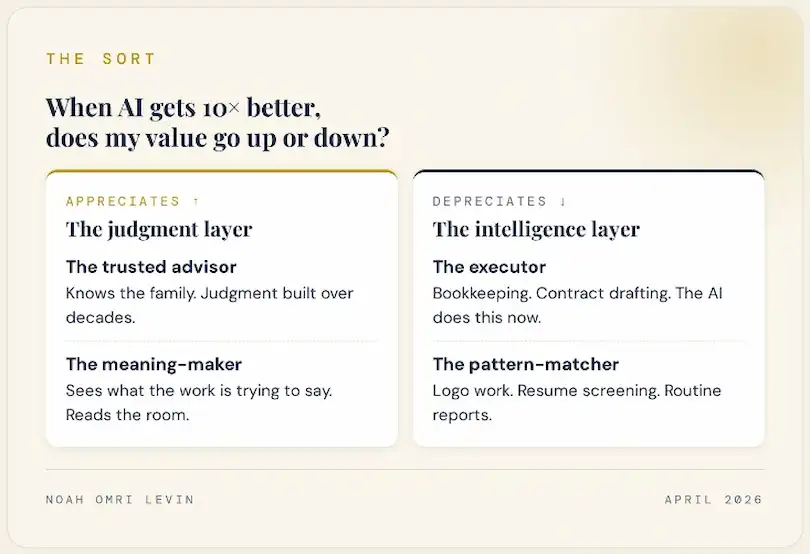
Every profession has both columns. The question is which one pays your rent.
Founders building AI wrappers, products that are “AI for X” with no real moat, are depreciating. The platform will eat them. By the time the wrapper hits product-market fit, the platform ships the official version and the wrapper’s growth curve goes flat overnight.
Founders building products that get better when the model gets better? Different story. I lead learning platforms that serve more millions of users around the world. Every time Claude improves, our product improves. When Opus 4.7 shipped a few days ago, we didn’t flinch. We got more capable overnight. Better translation across more languages. Better pedagogy. Richer conversations. When Claude Design shipped, we didn’t lose anything. We gained a capability.
That’s passing the test. The platform getting better doesn’t threaten us; it upgrades us.
We don’t compete with the model; we compound on it.
Run the Test On Your own Work
Take five minutes and write down the three things you get paid for. Be specific. Don’t write “I’m a consultant.” Write down the three actual deliverables that money changes hands for.
Next to each one, write: “When the AI gets ten times better at this in 18 months, does my value go up or down?”
Don’t guess. Imagine it. Picture a model that’s ten times more capable than what you use today, available to everyone, costing almost nothing. What happens to each of those three things on your list?
The answers sort into three buckets.
Clearly depreciating. You already know which ones. The voice in your head has been whispering it for months. Start phasing them out.
Clearly appreciating. Double down, build systems, charge more. These are your moats, and moats become more valuable in wartime.
Uncertain. This is the most important bucket. It’s where the next three years of your professional positioning will either compound or collapse. Watch these closely. Test them and put more reps against them than you think you need to.
My Hebrew name is Noach, the Biblical Noah. In the Torah, Noach was given that name because people hoped he would bring relief, nechama, from the backbreaking labor of working the cursed earth. A famous commentary1 says Noach was the one who invented the plow. Before Noach, people worked the ground with their hands.
After him, they had tools.
The hope was that the tools would buy humanity time – time to pursue meaning, to connect with something higher, to become who they were supposed to become.
The generation of the flood used that time to make more money and acquire more things, corrupting themselves further until the world had to be wiped clean and started again.
One of the foremost sages on character development2 stated that the foundation of a person’s life is clarifying two things: What their duty is in their world, and where their gaze should be directed.
AI is the plow of our generation. The relief it brings is real. Tasks that used to take a week take an afternoon. Capabilities that used to cost a team cost nothing. That relief is a gift, and like every gift, it comes with a choice about what to do with the time it buys.
Most people are going to be surprised by how much of what they do turns out to be intelligence work rather than judgment work. Things the model can do cheaper and faster, every quarter.
The things AI can’t close on are the things that were always the point: judgment, meaning, presence. The kind of value that comes from being in the room, not just producing the output.
Your job isn’t to outrun AI. You can’t. The model trains faster than you learn.
Your job is to stand in the place AI makes more valuable, and to use the time it buys you to clarify where your gaze should be directed.
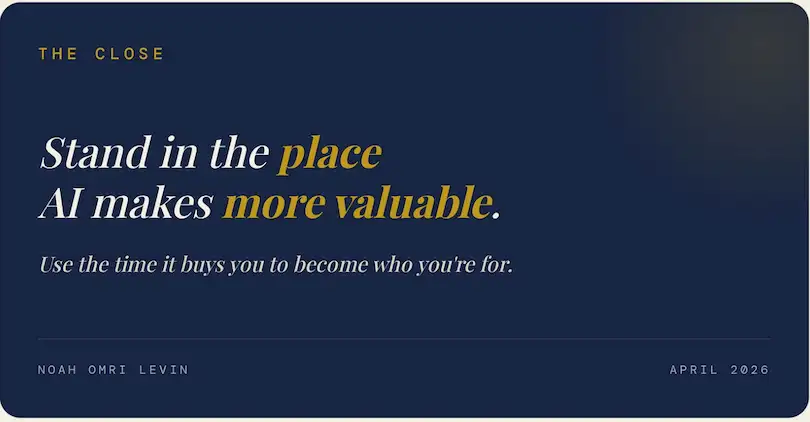
The closing thought, if you take one thing away from this article.
That place exists in every profession. It’s smaller than it used to be, and harder to find, and more crowded than it was last year.
Start looking.