







 The Red Cross’s Jewish Problem






These four Jewish scholars advanced scientific understanding and exemplified the profound synthesis of Jewish wisdom and secular knowledge.
The contributions of Jewish astronomers during the Islamic Golden Age is a fascinating, little-known chapter in Jewish history. These scholars advanced scientific understanding and exemplified the profound synthesis of Jewish wisdom and secular knowledge.
These astronomers' work reflects the deep roots of scientific inquiry within Jewish tradition, echoing the Talmudic dictum: "One who knows how to calculate the cycles and planetary courses but does not do so, of him Scripture says: 'They do not regard the work of the Lord, nor have they considered the operation of His hands'" (Shabbat 75a). This dictum suggests that those who have the ability to study the heavens but choose not to are neglecting to appreciate God's creation. It implies that understanding the natural world, particularly astronomy, is a way of honoring God and fulfilling our religious duties.
Here are four remarkable Jewish astronomers who left an indelible mark on both science and Jewish thought.
Our story begins in 8th century Baghdad, where Masha'allah ibn Athari, a Persian Jew, rose to prominence as one of the earliest and most influential astronomers of the Abbasid Caliphate. His name, meaning "What God has willed" in Arabic, reflects the cultural fusion characteristic of this era.
Masha'allah's expertise in celestial matters was so renowned that he was chosen to select the auspicious date for founding the city of Baghdad in 762 CE. This anecdote illustrates the high esteem in which Jewish scholars were held in the early Islamic world, a testament to the religious tolerance and intellectual openness of the time.
Masha'allah's most significant contribution was his work on the astrolabe, an ancient astronomical instrument used to measure the positions of celestial bodies. His treatises on this complex device were translated into Latin and Hebrew, forming the basis for European understanding of the astrolabe for centuries to come.
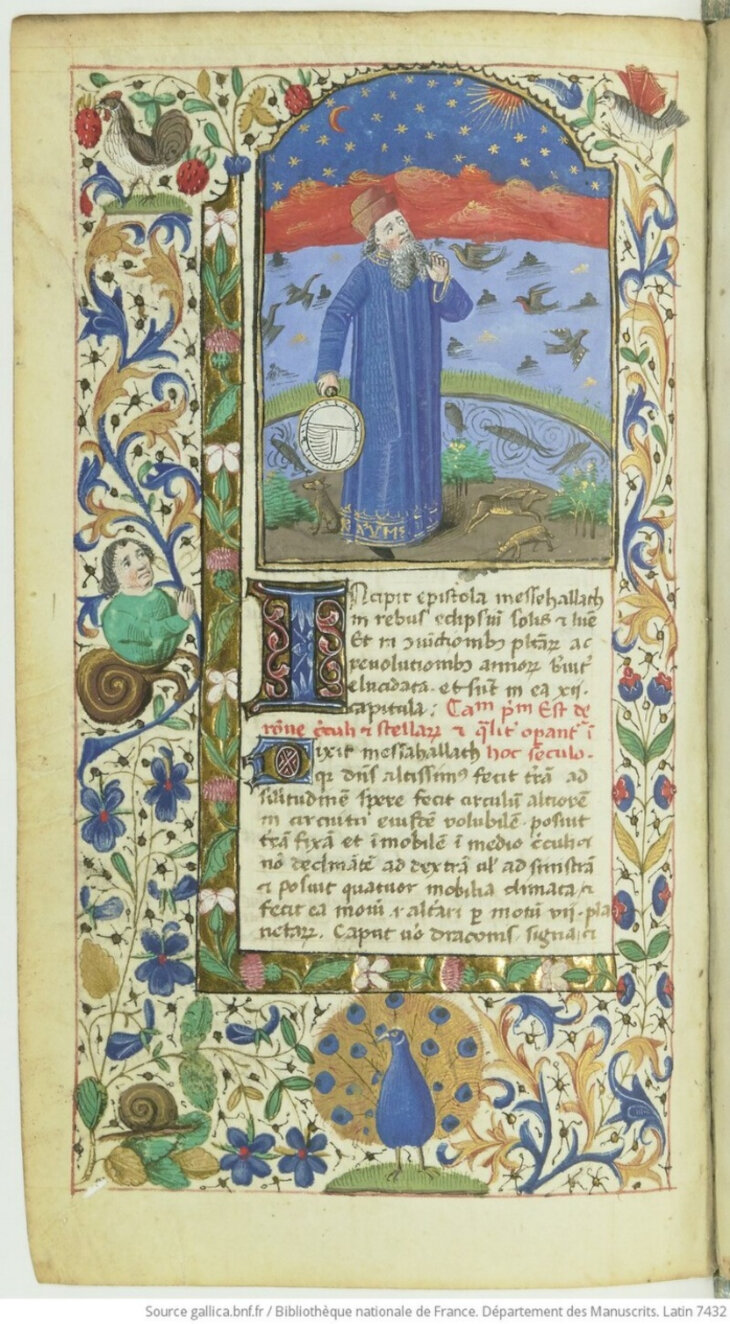 Illuminated 15th century manuscript, depicting Masha'allah gazing at the sky.
As we move into the 11th century, we encounter Abraham bar Hiyya, also known by his Latin name Savasorda. Living in Barcelona during the twilight of Islamic rule in Spain, bar Hiyya exemplified the role of Jews as cultural and intellectual intermediaries between the Islamic and Christian worlds.
Bar Hiyya's magnum opus, "Tzurat Ha'aretz" (The Form of the Earth), was the first comprehensive work on astronomy written in Hebrew. This groundbreaking text explained complex astronomical concepts, including the spherical shape of the Earth and the cycles of celestial bodies, in accessible Hebrew prose.
But bar Hiyya's genius lay not just in translation but in innovation. He drew novel connections between astronomy and Halakha (Jewish law), demonstrating how scientific knowledge could enhance religious observance. For instance, he applied astronomical calculations to determine the precise times for prayer and the start of Sabbaths and festivals, a practice that continues to influence Jewish life today.
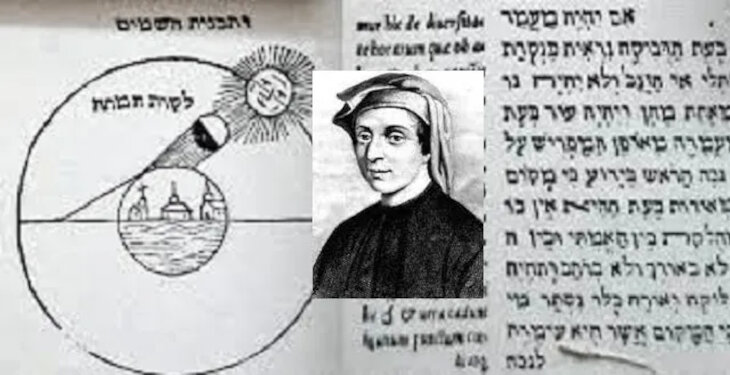 Legendary depiction of Abraham bar Hiyya
Few medieval Jewish scholars can match the breadth and influence of Abraham Ibn Ezra. Born in Muslim Spain, Ibn Ezra's life was characterized by ceaseless travel and intellectual curiosity. His wanderings took him across Europe, North Africa, and the Middle East, leaving a trail of astronomical treatises that would shape Jewish and European thought for generations.
Ibn Ezra's astronomical works were remarkably comprehensive, covering topics from the use of the astrolabe to the movement of the planets. But perhaps his most significant contribution was his role as a cultural bridge, introducing the advanced astronomical knowledge of the Islamic world to European Jewish communities.
In his biblical commentaries, Ibn Ezra often incorporated astronomical explanations, demonstrating a sophisticated approach to reconciling scientific knowledge with religious texts. This synthesis of faith and reason would become a hallmark of medieval Jewish thought, influencing scholars for centuries to come.
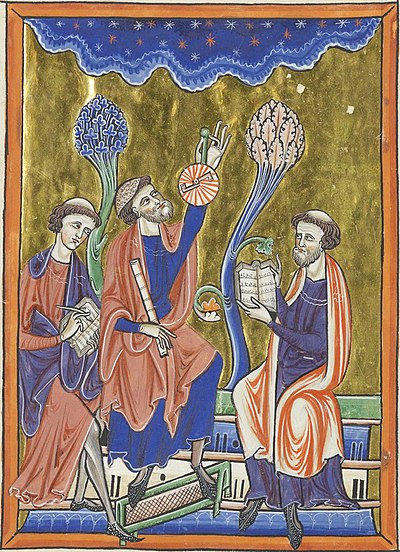 Illustration of Ibn Ezra making astronomical calculations
Our journey concludes in 14th century Provence with Levi ben Gerson, also known as Gersonides. A true polymath, Gersonides made significant contributions to philosophy, mathematics, and biblical exegesis. But it is his astronomical work that truly sets him apart.
Gersonides was not content with merely studying existing theories. He invented an observational instrument called Jacob's Staff, which allowed for more accurate measurement of angular distances between celestial bodies. This invention was used by European navigators well into the 18th century, playing a crucial role in the Age of Exploration.
In his magnum opus, "Milhamot Hashem" (The Wars of the Lord), Gersonides dedicated over 130 chapters to astronomy. He challenged some of Ptolemy's long-held assumptions about planetary motion, demonstrating a willingness to question established authorities that was characteristic of the best scientific minds.
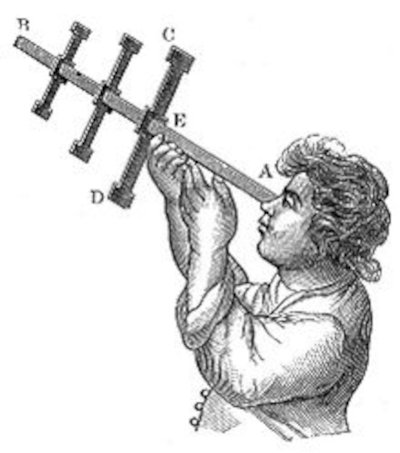 Illustration of Jacob’s Staff
Legacy and Influence
The contributions of these Jewish astronomers extend far beyond their individual discoveries, exemplifying key aspects of Jewish intellectual history. These scholars played a crucial role in preserving and transmitting the astronomical knowledge of the ancient world, much as the Babylonian academies had preserved and transmitted Jewish law and tradition. Their work demonstrates the fruitful exchange of ideas between Jewish, Islamic, and Christian scholars, reminiscent of the golden age of Jewish culture in Baghdad during the Geonic period.
Like Maimonides and Saadia Gaon before them, these astronomers showed that scientific inquiry and religious devotion could coexist and even enhance each other. Their willingness to challenge established theories and invent new tools reflects the Jewish tradition of critical inquiry, echoing the dialectical reasoning of Talmudic debate.
As we reflect on the achievements of these medieval Jewish astronomers, we're reminded of the words of Rabbi Abraham Isaac Kook: "The old shall be renewed and the new shall be sanctified." These scholars renewed ancient wisdom through the lens of their scientific discoveries, while sanctifying new knowledge by connecting it to Jewish tradition.
Their legacy invites us to continue this tradition of intellectual curiosity and synthesis. In an age where science and religion are often portrayed as being at odds, the stories of these medieval Jewish astronomers remind us that the pursuit of knowledge, in all its forms, can be a deeply Jewish endeavor. As we gaze up at the same stars our ancestors studied centuries ago, may we be inspired to follow in their footsteps – reaching for the heavens while remaining rooted in our rich tradition.











It isn't mentioned in the article, but one of the craters on the moon is named 'Rabbi Levi", in honor of Gersonides, Rabbi Levi ben Gershon.
But today not many can successfully synthesize the two disciplines of religion and science.
Eventually, one force becomes stronger than the other.