








 What Two Hebrew Words Reveal About Israeli Democracy
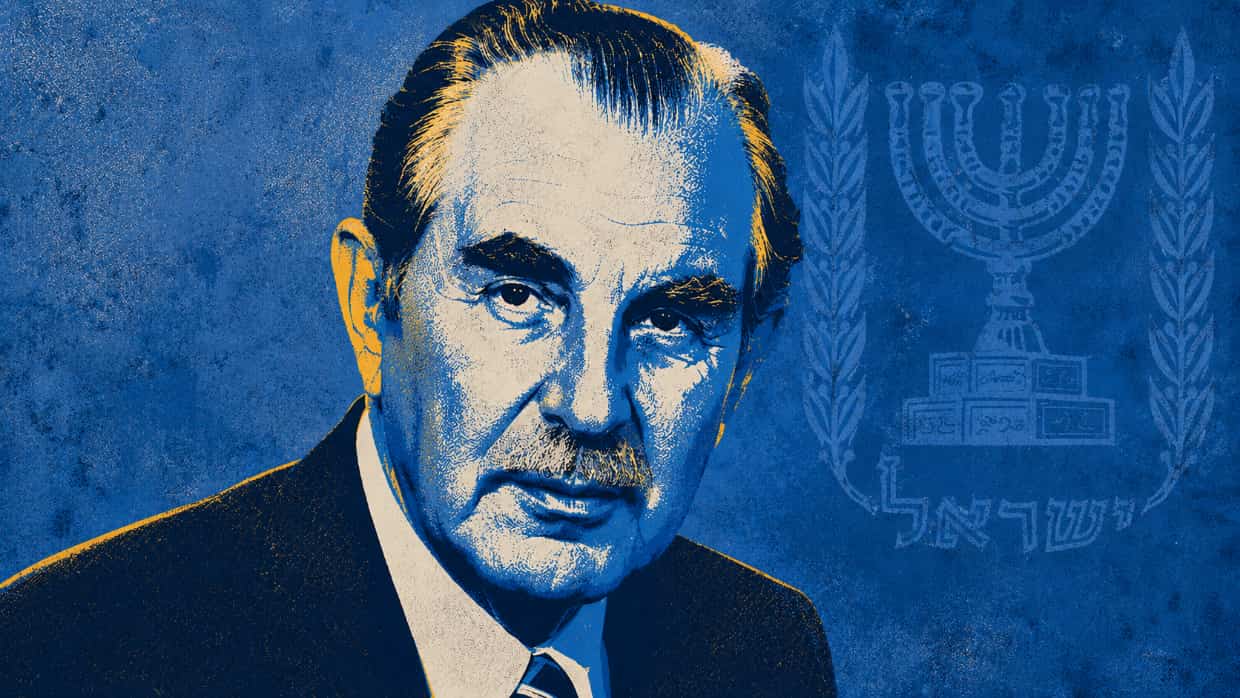






Israel's former President and father of current Israeli President Isaac Herzog defended the Jewish state his entire life. Now anti-Zionists are trying to erase him.
In 2025, activists in Dublin rallied to rename a park bearing Chaim Herzog's name. One Dublin City Council member falsely declared him guilty of "ethnic cleansing, genocide, racism, and apartheid," adding that "there never should have been an Israeli state just as there never should have been a Herzog Park." Another called him "a genocider."
The Australian Broadcasting Corporation published a piece falsely describing him as murdering, torturing, and shooting unarmed people trying to escape. A prominent Irish online magazine called him "a war criminal" who "massacred Palestinians."
Who was Chaim Herzog, really? He was President of Israel from 1983 to 1993, a statesman, freedom fighter, diplomat, and soldier. And his life story is a direct rebuke to everyone smearing him today.
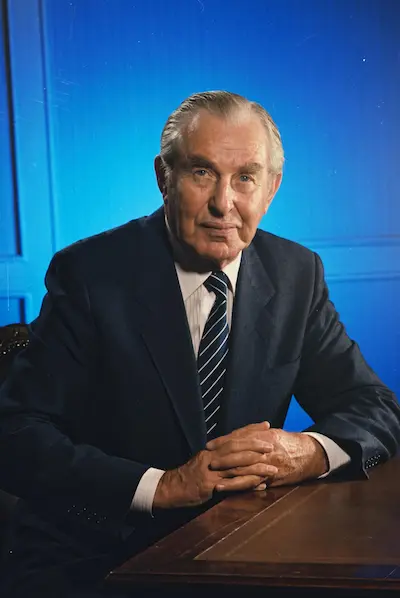 When Chaim Herzog was born in Belfast in 1918, his family was becoming one of the most prominent in Ireland. His father, Rabbi Isaac Halevi Herzog, had immigrated from Poland to England as a child, then made his way to Ireland, where he eventually served as Chief Rabbi. A brilliant linguist, Rabbi Isaac Herzog learned fluent Irish and championed Irish liberation, befriending leaders like Robert Brisco, a Jewish Irish partisan who later served as Mayor of Dublin, and Eamon de Valera, who later became Prime Minister. Rabbi Isaac Herzog was known as the "Sinn Fein Rabbi" for his ardent support of Irish independence.
Despite his family's illustrious connections, Chaim never felt at home in Ireland. "I did feel different," he later recounted. "I was always aware that somewhere in the background I was being judged by different standards. When a Jew was arrested for a crime, the entire Jewish community shuddered, because it was expected that all Jews would be thought guilty. There was an absence of psychological equality." (Living History: The Memoirs of a Great Israeli Freedom-Fighter, Soldier, Diplomat and Statesman, 1997)
As a teenager, Chaim's parents made a fateful decision: send him to the Land of Israel. Ireland's Jewish community was tiny, and they watched with dismay as young Jews drifted away from Jewish life. Hoping Chaim would remain proudly Jewish, they sent him to boarding school in Jerusalem.
Moving to Israel in 1935 was a culture shock. "I had come from another world," Chaim wrote, "one with teenage parties and rugby." Suddenly he found himself in a beleaguered community where Jews fought for their survival.
His school, Hebron Yeshiva, had been founded in the ancient city of Hebron but relocated to Jerusalem six years earlier after two dozen students were murdered by local Arabs during the 1929 Hebron Massacre. Chaim recalled "periodic and horrendous mass riots in 1920, 1929, and 1936," in which thousands of Jews were murdered and wounded. During the 1929 massacre, his eighty-year-old grandmother hid in a room where seventeen Jews were killed; she survived by pretending to be dead.
The Land of Israel, known then as Mandatory Palestine, was ruled by British troops who openly sided with the Arabs and refused to intervene in their periodic massacres of Jews. With Nazism rising in Germany, Jews in the land knew they had to build a future Jewish country capable of absorbing refugees fleeing Europe. "It was against this background that the Jewish community worked to expand and prosper and develop an alternative government," Chaim recalled. "We knew we had to be prepared for the inevitable day the British decided to leave."
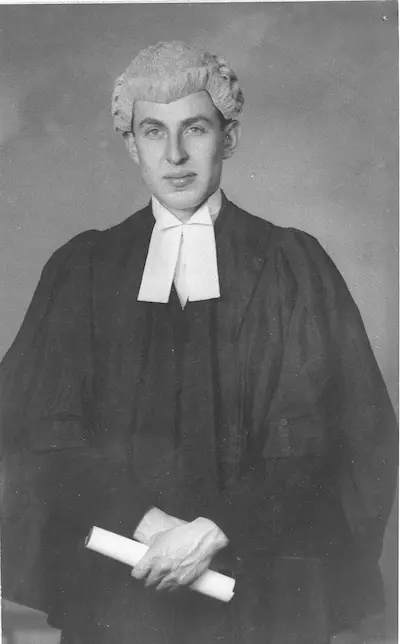 Herzog upon completion of his law degree, 1941.
Like many of his fellow teenagers, Chaim joined the Haganah, the Jewish underground militia and precursor to today's Israel Defense Forces (IDF). He was assigned to guard Jews in the Old City's Jewish Quarter, woefully under-resourced: "Two men and one rifle were entrusted with the security of the entire Jewish quarter."
Chaim traveled to London and volunteered for the British Army. He trained as an intelligence officer, interrogated Nazi prisoners of war, and traveled with Allied troops after the D-Day landings. In 1944, as his division's intelligence officer, he was among the first Allied soldiers to enter Nazi Germany. He photographed key infrastructure, monitored radio traffic, and questioned captured German troops as his unit advanced.
As the Allies pushed deeper into occupied Europe, they discovered the concentration and death camps. "My first personal encounter with this horror was at a small concentration camp just outside Bremen," Chaim recalled. "It was a terrifying sight, one I will never forget. The floors of the filthy huts were strewn with emaciated figures clad in striped pajamas. Many could not even lift themselves up; a tortured smile was their only greeting."
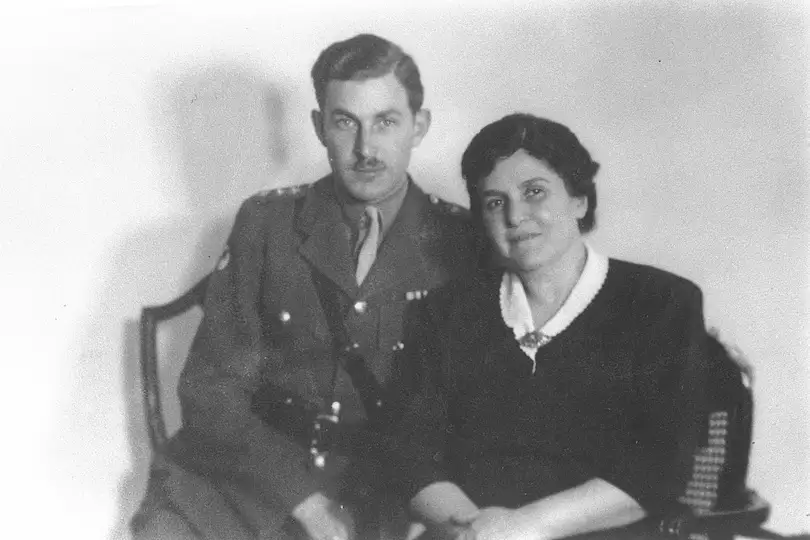 Herzog in his British Army uniform with his mother, 1945
Later, he witnessed the newly liberated camp of Bergen-Belsen: "The sight of the living, emaciated skeletons was by now horribly familiar to me, but that familiarity didn't make it any less terrifying. I told some of the survivors that I was a Jewish officer from Palestine. They all burst into tears. It was all I could do to keep from doing the same."
He remained in the British Army in Germany until 1947, helping identify and question captured senior Nazi officials. At the same time, from 1945 to 1947, he did everything possible to help Jewish Holocaust survivors stranded in European Displaced Persons (DP) camps reach the Land of Israel.
Britain, which administered Mandatory Palestine, blocked masses of Jewish survivors from entering. Afraid of angering the Arab population, British forces intercepted ships carrying Jewish refugees, ramming and sometimes sinking them. Thousands of Holocaust survivors who tried to reach the Land of Israel were imprisoned for years in a British-run concentration camp on the island of Cyprus.
Stationed near Brunswick, Germany, Chaim was ideally positioned to help. The region straddled the British-Russian demarcation line and "was honeycombed with coal mine tunnels that crisscrossed under the demarcation line," making it a prime corridor for Jewish partisans helping survivors escape.
"I did everything I could to aid this unofficial cause," he wrote. "I arranged for Danish border guards to be replaced by boys from the Jewish Brigade, making it easier for Jews to cross; a Russian Jewish colonel helped with rail transportation. American chaplains created fictitious units for which rations and transport were drawn, in order to move and feed Jewish refugees. Regardless of the uniform or the rank or the insignia, every Jewish heart beat as one. Never have I seen anything as expressive of the unity of the Jewish people and their willingness to sacrifice in order to save each other."
Demobilized in 1946, Chaim returned to Jerusalem and began practicing law. He was soon given a critical assignment: monitor the United Nations Special Commission on Palestine (UNSCOP), which was preparing to vote on partitioning the territory into a Jewish state and an Arab state. "Confronted with worldwide opposition to the Zionist position, we knew that our political future was in the hands of the United Nations," he recalled. His job was to identify sympathetic nations and encourage them to support partition.
"The Arabs rejected UNSCOP's proposed partition, which would have given them a Palestinian state," Chaim noted. "As was to be the case time and again, the Arabs were never willing to accept less than 100 percent of what they wanted and refused to compromise."
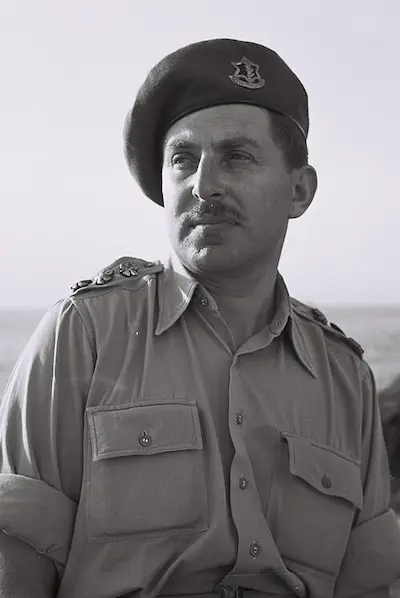 Herzog while serving as an Israeli military attaché in the United States, 1950
On November 29, 1947, the UN General Assembly voted to establish two states in Mandatory Palestine. Thanks in part to Chaim's efforts, the vote passed overwhelmingly. But Arab neighbors, along with Arab citizens of the new state, immediately declared war.
"While the Jewish community danced in the streets, Arab rioters marched on the commercial center of Jerusalem, looted and burned Jewish stores, and attacked Jews in the streets." Full-scale war engulfed the new state.
Chaim joined the Jewish Agency's Security Department, putting his wartime experience to work. His wife Aura served in the Haganah. During Israel's War of Independence, Chaim saw intense combat in battles between Israeli and Jordanian forces for control of the main road from Tel Aviv to Jerusalem. The 100,000 Jews of Jerusalem were surrounded, running out of food, water, and fuel. Families were eating weeds. After heavy losses attempting to capture Latrun, a strategic high point on the road, Chaim's battalion withdrew and instead built an alternate route. Dubbed the Burma Road, this improvised path broke the siege of Jerusalem and delivered desperately needed supplies. "Soon thereafter, and partly due to the building of the Burma Road, the so-called First Truce was negotiated. The Arabs realized they could not take Jerusalem, could not push us back into the sea, so for the first time in more than half a year, the guns were silent."
Chaim retired from the Israeli army as a major general in 1962. He practiced law and hosted a popular radio show. In 1975, he was appointed Israel's Ambassador to the United Nations, serving until 1978, and arrived just in time to confront one of the most vicious slurs against Jews and Israel in modern history: the claim that Zionism is racism.
This lie was promoted by the Soviet Union following Israel's victory in the 1967 Six Day War. Seeking to strengthen ties with Arab and non-aligned nations, the Soviets ramped up anti-Jewish rhetoric, invoking the notorious antisemitic forgery "The Protocols of the Elders of Zion" to argue that Jews considered themselves a "chosen people" superior to other ethnicities, which they called racism. Idi Amin, Uganda's brutal dictator who expelled between 50,000 and 80,000 Indians from Uganda in 1972, was an eager proponent.
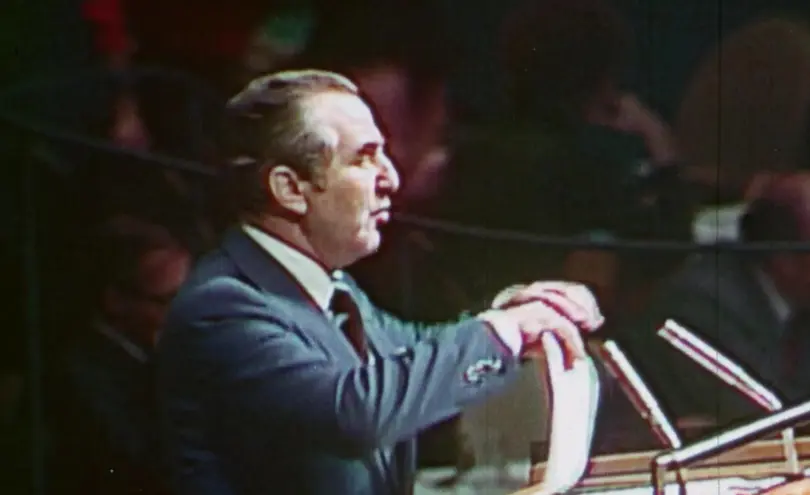 Herzog ripping up the UN resolution defining Zionism as racism in front of the plenum
In 1975, Arab and Soviet diplomats pushed a resolution defining Zionism as inherently racist to a vote in the UN General Assembly on November 10, the anniversary of Kristallnacht. It passed overwhelmingly. Chaim could not stop it, but his response inspired Jews around the world:
"I do not come to this rostrum to defend the moral and historical values of the Jewish people. They do not need to be defended. They speak for themselves. I come here to denounce the two great evils which menace society in general and a society of nations in particular. These two evils are hatred and ignorance. These two evils are the motivating force behind the proponents of this resolution and their supporters. These two evils characterize those who would drag this world organization, the ideals of which were first conceived by the prophets of Israel, to the depths to which it has been dragged today."
He went on to describe what Zionism actually is. After tracing the 4,000-year-old Jewish origins of the word Zion, he described modern Israel as a melting pot of communities and religions:
"The Arab delegates talk of racism. What has happened to the 800,000 Jews who lived for over 2,000 years in the Arab lands, who formed some of the most ancient communities long before the advent of Islam? Where are those communities? What happened to the people, what happened to their property?
"The Jews were once one of the most important communities in the countries of the Middle East, the leaders of thought, of commerce, of medical science. Where are they in Arab society today? You dare talk of racism when I can point with pride to the Arab Ministers who have served in my Government; to the Arab deputy speaker of my Parliament; to the Arab officers and men serving of their own volition in our defence, border and police forces, frequently commanding Jewish troops; to the hundreds of thousands of Arabs from all over the Middle East crowding the cities of Israel every year; to the thousands of Arabs from all over the Middle East coming for medical treatment to Israel; to the peaceful coexistence which has developed; to the fact that Arabic is an official language in Israel on a par with Hebrew; to the fact that it is as natural for an Arab to serve in public office in Israel as it is incongruous to think of a Jew serving in any public office in any Arab country, indeed being admitted to many of them. Is that racism? It is not. It is Zionism."
The resolution was withdrawn in 1991, but its poisonous effects linger today.
Chaim Herzog served as President of Israel until 1993 and died in 1997. His son Isaac now holds that same office. Those who want to know more about this remarkable man should read his books: Living History, Who Stands Accused?: Israel Answers its Critics, and Heroes of Israel: Profiles of Jewish Courage.
The people calling Chaim Herzog a genocidal war criminal are the same ideological heirs of those who stood in the UN and called Zionism racism. The names change; the hatred doesn't. Herzog spent his life fighting that hatred with facts, courage, and an unshakeable sense of Jewish pride. The least we can do is refuse to let them rewrite his story.








He did drift away. He like many of his colleagues at that time abandoned Jewish observance. Though his contributions are numerous and appreciated, he did not return to the practices of his illustrious forebears.
I can't highly recommend enough the Chaim Herzog Museum of the Jewish Soldier in World War II, located in Latrun, Israel, named in memory of Chaim Herzog. He is honored because his life and military career embody the museum's mission to highlight the 1.5 million Jewish soldiers who fought against Nazi Germany. It is a spectacular museum. Kids must be over 10 years old. Resrvatins must be made.
It hurts my heart that a country that once shared the ideals of freedom with Israel, that went through partition by the British - like Israel, that had their language and their people and their faith put down by the British, forget the ties that once were strong between the Israeli fighters who shared their knowledge of guerilla combat during the early days when the Irish were fighting for their own freedom.
That the Herzog name who were true Irish patriots should be slandered and vilified with such falsehood is a terrible shame
Fascinating article 👏👌💯
He was a role model For all Jews and all Israelis wherever they stand politically. I am proud to be an Israeli and I hope to see all my grandchildren and children join me in the most beautiful country in the world.
Amazing article! What a man and what a family! BH….