 Is It Time for Jews to Leave the UK?




14 min read


Three teenage girls slipped through Nazi-occupied Holland hiding in plain sight, and left a body count behind them.
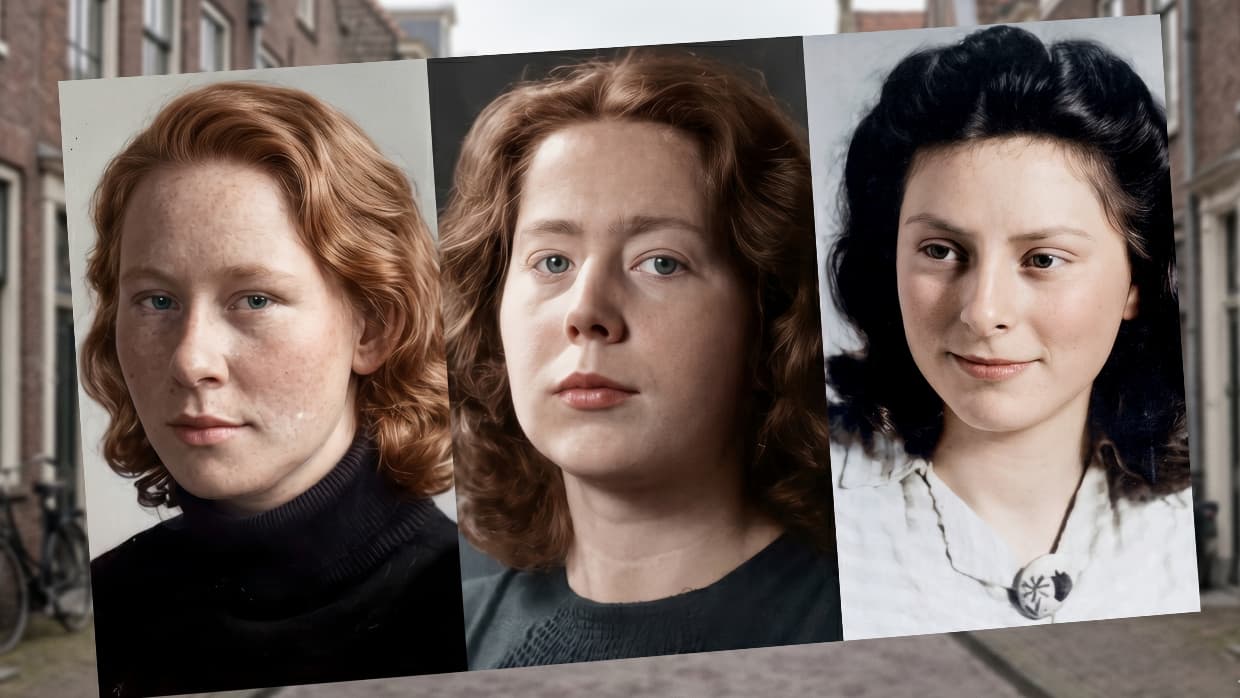
They slipped through Nazi-occupied Holland like ghosts. Three teenaged girls, a quiet red-haired law student and two sisters on bicycles who looked so harmless they glided past checkpoints with a smile. Their innocence was a mask. Behind it stood a trio bound by nerve, discipline, and an iron refusal to bow.
Hannie Schaft gathered intelligence and struck at those who enabled oppression. Freddie and Truus Oversteegen used their youth as camouflage to lure Nazi officers and collaborators into carefully planned traps. Together they sabotaged rail lines, smuggled Jewish children to safety, carried out targeted resistance missions — and yes, they killed Nazis.
This is their story.
Hannie Schaft was born in 1920 and grew up in Haarlem, a historic city in the Dutch province of North Holland, with a Mennonite Christian mother and a socialist father. She was a shy child, teased by schoolmates for her reddish-brown hair and freckles.¹
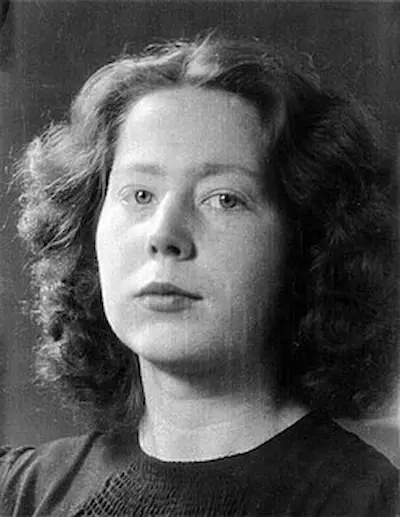 Hannie Schaft
She grew up in a politically engaged household that talked openly about justice and world affairs. Even as a quiet, serious student, she absorbed those dinner table debates, developing a sharp sense of right and wrong. By the time she finished high school, she saw the world darkening around her.
In 1938 she left for the University of Amsterdam to study law, believing it could be a tool for defending the vulnerable. There she found her closest companions in two fellow law students, Sonja Frenk and Philine Polak — both Jewish, both sharp, and increasingly aware of the danger tightening around them. The three young women studied together, debated politics over coffee, and tried to hold onto normalcy as the world grew more ominous outside their lecture halls.
In 1940, the threat she had long anticipated arrived with the Nazi invasion of the Netherlands. When she watched her friends' rights erode under occupation, she stopped waiting and started acting. Her first acts of rebellion were stealing identity cards to replace those stamped with an oversized "J" — the mark that targeted Jews for ever-tightening restrictions.
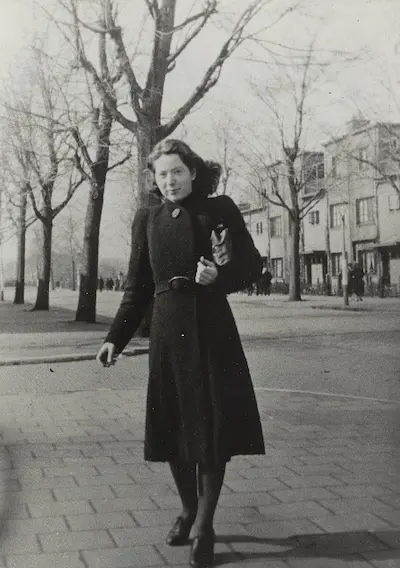 Hannie Schaft on the Kleverlaan, Haarlem, between 1938 and 1940
In 1943, new German regulations forced Hannie out of law school. Like roughly 80% of Dutch students, she refused to sign the Loyaliteitsverklaring (loyalty declaration), a pledge not to act against the occupiers. Refusal was supposed to mean forced labor in Germany, but the Nazis were overwhelmed by the scale of defiance. Tens of thousands rejected the oath, far more than the regime could deport without grinding its own machinery to a halt. The occupiers shut the universities rather than allow classes to continue under open rebellion.
Hannie returned to Haarlem, moved in with her parents, and joined the Raad van Verzet (Council of Resistance), known as the RVV.
The RVV emerged in 1943 as one of the Netherlands' boldest resistance networks. Where other groups hesitated, the RVV moved with daring intent: sabotaging rail lines, gathering intelligence, forging documents, and arming those willing to strike back. It was a lifeline for the hunted and a nerve center for direct action — and now Hannie Schaft was part of it.
She proved herself quickly. She moved intelligence through occupied Holland with quiet precision, memorizing troop movements, ferrying documents, forging identity papers, helping Jewish students vanish into hiding. Her studious appearance let her pass through the city unnoticed, making her one of the resistance's most trusted couriers.
But Hannie wanted to do more. She told her superiors she was ready for greater risks, trained in weapons, and joined operations targeting Dutch collaborators whose actions had endangered resistance members. The studious girl with red hair had become a deadly assassin.
Later that year, she was introduced to two young RVV operatives, sisters whose quiet courage matched her own. Soon they were working as a single, lethal team.
Truus and Freddie Oversteegen didn't stumble into the resistance — they were raised for it. Their mother hid refugees in the cramped corners of their barge and taught that injustice must be confronted head-on. Growing up poor but politically aware near Haarlem, the non-Jewish sisters learned early that danger was no excuse for silence. Truus (born 1923) carried a calm, strategic intensity. Freddie (born 1925), smaller and younger, masked her courage behind a childlike innocence. Together they became two of the most effective young operatives in the Dutch resistance.
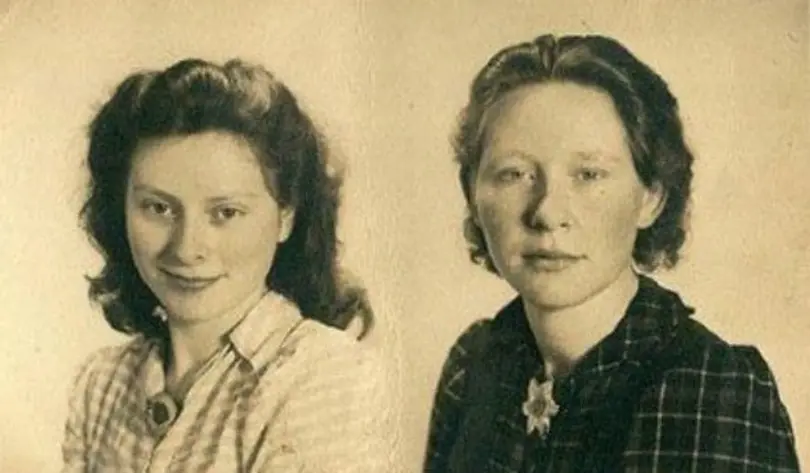 Truus and Freddie Oversteegen
After their parents divorced, the sisters lived with their mother, whose home remained a refuge for the persecuted throughout the 1930s. Growing up surrounded by fugitives and political tension, Truus and Freddie absorbed the expectation that when others are threatened, you act.
When Germany invaded, the sisters, just 16 and 14, slipped almost immediately into resistance work. They distributed anti-Nazi newspapers and pamphlets, vandalized German posters,² and used their bicycles and youthful appearance to move through occupied streets without drawing suspicion.
Their audacity drew the attention of Frans van der Wiel, commander of the Haarlem RVV, a man always scanning the margins for talent the occupation would overlook. In Truus and Freddie he saw two girls whose innocence masked nerve, discipline, and an almost unsettling conviction. He went straight to their mother and asked to recruit them. She agreed, with one warning: "Stay human."
With that, the sisters stepped into the RVV's inner world, a tight, fast-moving sabotage unit where missions were whispered, timed to the second, and carried out without hesitation.
The RVV worked in teams, and leadership believed the three teenagers would work well together. Between 1943 and early 1945, Hannie Schaft, Truus Oversteegen, and Freddie Oversteegen formed one of the most unlikely and effective resistance units in the RVV.
The Oversteegen sisters had come first, proving themselves through increasingly difficult assignments: distributing pamphlets, smuggling Jewish children, transporting weapons. Hannie joined after her law school was shut down and she returned to Haarlem. Her language skills, intelligence work, and document forgery made her indispensable. Once she demonstrated her reliability, she was folded into the small operational circle with Truus and Freddie.
Hannie was the intellectual. Truus was their decisive, grounded leader. Freddie, fierce and feminine, mapped out their missions.
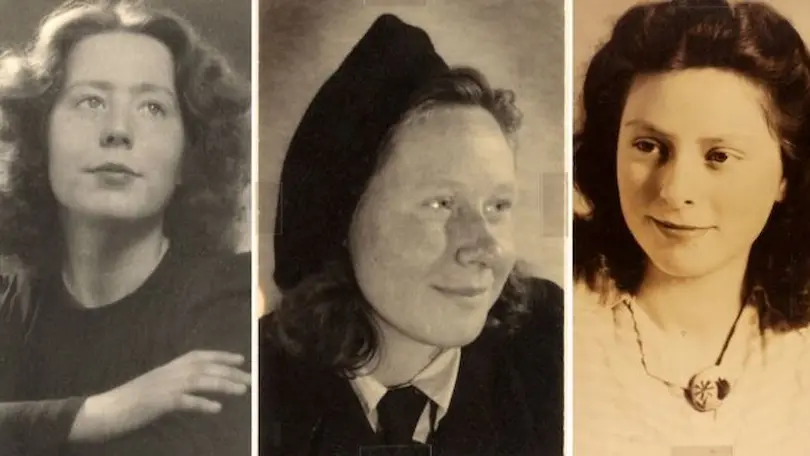 The deadly trio
They had one clear advantage over their male colleagues: their youth and beauty, which they wielded as a weapon. They dressed carefully, powdered their faces, darkened their lashes with mascara, applied eyeshadow and lipstick, making themselves as attractive and unremarkable as possible.³ This let them move through occupied streets in ways adult men simply could not — scouting, carrying messages, sabotaging infrastructure, taking on missions that demanded absolute trust.
The RVV had no formal training camps. The sisters learned to shoot and drilled quietly in the woods, improvised sessions shaped entirely by whatever their next mission required. Freddie's youth made her ideal for reconnaissance. All three quickly mastered courier work, weapons transport, and sabotage. They were taught to blend in, memorize routes, and avoid predictable patterns, skills that kept them alive.
As their responsibilities grew, they worked more tightly together. Schaft's analytical precision, Truus's steadiness, and Freddie's inconspicuous charm formed a combination the RVV recognized as unusually effective. Their work settled into a dangerous rhythm: nights spent planting disruptions along rail lines and bridges to slow German troop movements, days spent passing through checkpoints with forged papers and steady nerves, escorting Jewish children toward safe houses where survival was still possible.
With confidence came higher stakes. They struck supply depots and sent bridges collapsing into rubble. Soon the work narrowed into something closer to the line where sabotage ends and something far more final begins.
By 1943, the trio had moved beyond courier work and sabotage into armed missions against German soldiers and Dutch collaborators.
Freddie often served as the lure — approaching soldiers or collaborators in public spaces and guiding them toward quieter streets or wooded paths under the pretense of casual conversation or flirtation. Because she looked even younger than her age, she was the ideal decoy. Once she led a target into an isolated stretch, armed RVV members — sometimes including Truus or Hannie — carried out the planned attack.
Freddie later described the work simply as "a job that had to be done." Truus echoed her matter-of-fact honesty: "We used what we had. If they followed us, that was their choice."
Bas von Benda-Beckmann, a former researcher at the Netherlands' Institute for War, Holocaust and Genocide Studies, explained how the sisters worked: "Freddie was especially good at following a target or keeping a lookout during missions since she looked so young and unsuspecting. Sometimes they would follow a target to his house to kill him, or ambush them on their bikes. Both sisters shot to kill, but they never revealed how many Nazis and Dutch collaborators they assassinated. There were a lot of women involved in the resistance in the Netherlands, but not so much in the way these girls were. There are not that many examples of women who actually shot collaborators themselves."⁴
In 1943, the RVV identified a Dutch collaborator in Haarlem whose betrayals had led to the arrests of Jewish families and resistance members. Truus recounted the mission in interviews: Freddie handled reconnaissance, tracking the man's routine, while Truus and Hannie joined the execution team. The target's name was deliberately omitted from resistance records; the names of most targets were never preserved.
One of the few missions with a documented name came in 1944: the assassination of Willem Zirkzee, a Dutch police officer notorious for collaborating with the Nazis and hunting resistance members. By early 1945, he had risen to the top of the RVV's target list.
Schaft and her comrades tracked his routines through Haarlem, noting the same predictable path he followed each day. They chose a narrow street he always crossed, quiet enough for an ambush, quick enough for an escape. On March 1, 1945, the team waited. When Zirkzee appeared, they struck. Accounts differ on whether Schaft pulled the trigger or supported the operation, but all agree she was directly involved.
The mission succeeded, but its consequences closed in fast. German and collaborationist forces tightened their grip on Haarlem, hunting the resistance with renewed fury. In the shadow of that operation, Hannie's fate was already gathering around her.
Three weeks after the Zirkzee assassination, on March 21, 1945, the Germans finally captured the girl with the red hair.
Hannie was stopped at a routine checkpoint in Haarlem. A search of her bag uncovered copies of the underground newspaper De Waarheid (The Truth) and a pistol, enough to mark her as a resistance fighter. She was taken into custody and placed in solitary confinement. Interrogators tried to break her through isolation and relentless questioning. She gave them nothing.
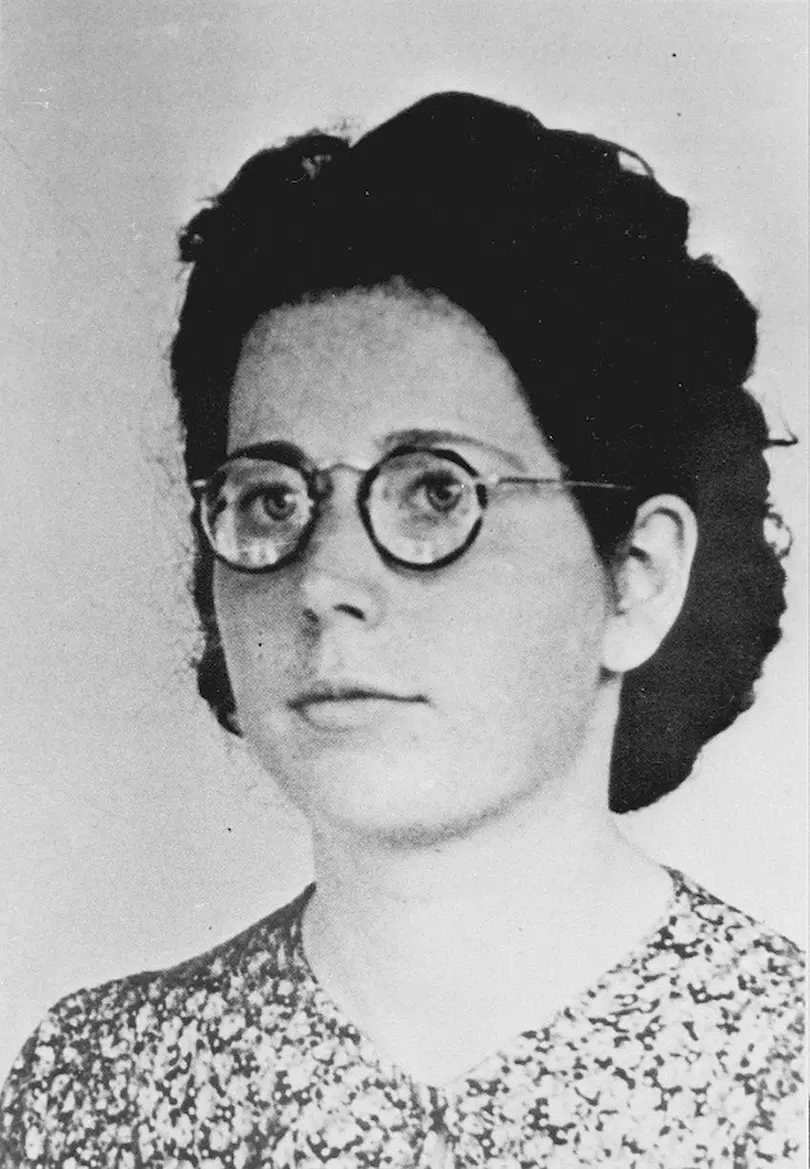 Hannie Schaft in disguise, with black dyed hair and wire-frame glasses, 1944
Her situation worsened when she was transferred to Amsterdam and confronted by Emil Rühl, a notorious Nazi interrogator. She was wearing fake glasses and had dyed her hair black but her red roots betrayed her. Rühl recognized her immediately as the elusive "girl with the red hair" who had plagued the occupation for years. He issued a brutal ultimatum: confess, or five Dutch girls would be executed. Exhausted and cornered, Hannie finally broke.
On April 17, 1945, just days before liberation, she was taken to the dunes of Overveen by two Dutch collaborators. The first soldier's shot grazed only her ear. She turned around and said, "Idiot, I shoot better." The second soldier's machine gun ended her life.
Hannie Schaft became the enduring symbol of Dutch female resistance, the legendary girl with the red hair who refused to bow to fascism until the very end.
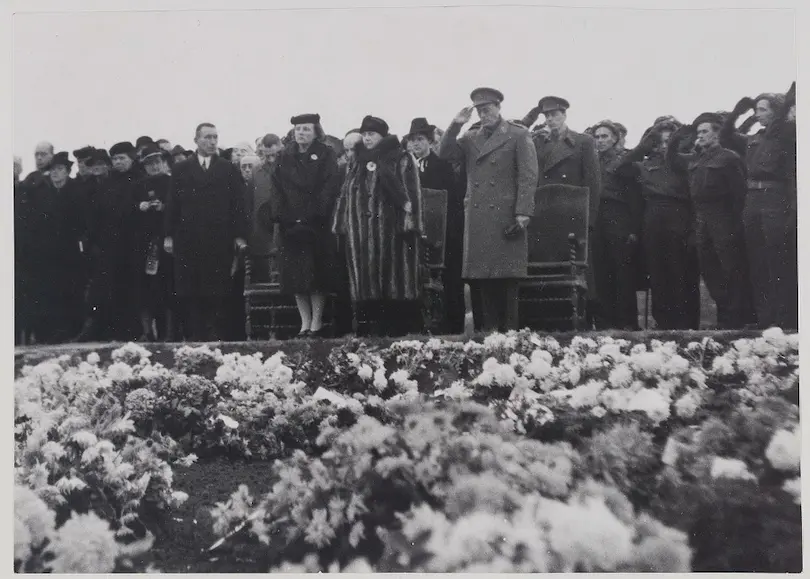 Funeral of Hannie Schaft in the presence of Queen Wilhelmina, Princess Juliana and Prince Bernhard on November 27, 1945. Image collection of the municipality of Haarlem
What Became of the Oversteegen Sisters?
Both sisters lived the rest of their lives with what we would now recognize as PTSD, severe nightmares, and episodes of fighting or screaming in their sleep. Letters from Hannie Schaft and accounts from fellow resisters suggest she faced similar trauma during the war, along with periods of depression, long before her arrest.
Truus offered a window into the source of that trauma in a 2019 interview: "While I was biking, I saw Germans picking up innocent people from the streets, putting them against a wall and shooting them. It aroused such an enormous anger in me, such a disgust, a feeling of 'dirty bastards.' You can have any political conviction or be totally against war, but at that moment you are just a human being confronted with something very cruel. Shooting innocent people is murder. If you experience something like this, you'll find it justified to act against it.
"Once, I was confronted with a Dutch SS soldier who was killing a small baby by hitting it against a wall. The father and sister had to watch. They were hysterical. The child was dead. I shot that guy. Right there and then. That wasn't an assignment, but I don't regret it."⁵
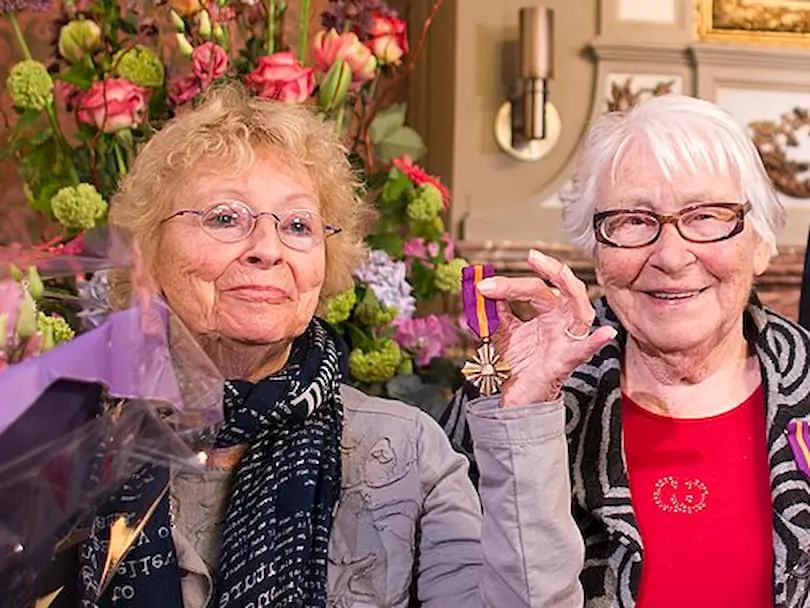 Freddie Dekker-Oversteegen and Truus Menger-Oversteegen being awarded the Mobilization War Cross in 2014
After the war, the sisters faced the long shadow of their past differently. Truus confronted it head-on: she poured her memories into sculptures, spoke publicly about their missions, and eventually became known around the world. Freddie chose a quieter path, focusing on her family. "I coped by getting married and having babies," she said in 2016, though the war left her with insomnia and flashes of memory, like watching a man she had shot fall and feeling the instinct to help him.
Both admitted that killing never came naturally. "It did not suit us," Truus told Dutch anthropologist Ellis Jonker, who interviewed both sisters. "It never suits anybody, unless they are real criminals."
For decades, the Netherlands offered them little recognition, dismissing them in part because of their communist ties. Only in 2014 did the country formally honor their service with the Mobilisatie Oorlogskruis (Mobilization War Cross). Later, streets were named after each of them.
Truus died in 2016 at age 92. Freddie followed two years later, on September 5, 2018, one day before her 93rd birthday. Their legacy, long overlooked, now stands as one of the most remarkable stories of resistance in occupied Europe.
Hannie, Freddie, and Truus's Legacy
Their work together showed how age, gender, and the ability to blend in became practical advantages in resistance operations. Today they remain central figures in how the Netherlands remembers women in the resistance.
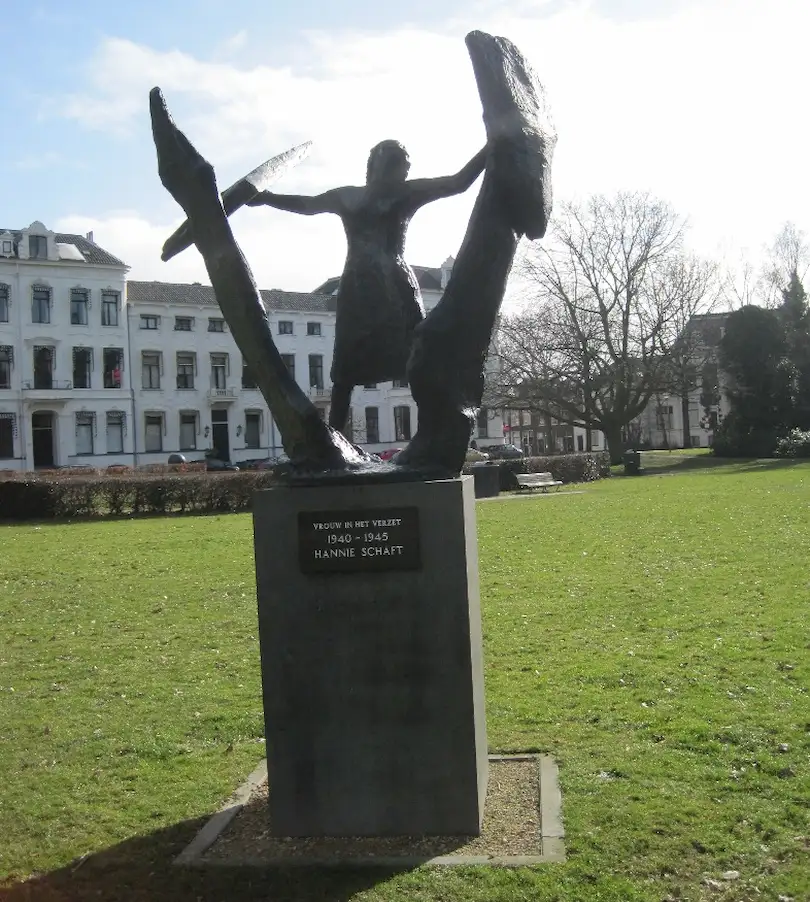 Woman in the Resistance 1940-1945
There is a bronze statue in Haarlem titled "Woman in the Resistance 1940-1945." It was forged by Truus Oversteegen herself to honor her fallen comrade Hannie Schaft. Unveiled in 1982 in Kenaupark, the statue's forward-driving stance captures the defiance of women who fought fascism with courage far beyond their years.
It also stands as long-overdue recognition for the three teenage assassins and the many women whose wartime bravery was ignored for decades. In its bronze silhouette, their stories claim their rightful place in the memory of a liberated Netherlands.
Footnotes
SOURCES