







 The Shofar Is Silent, Remember to Breathe


13 min read
12 min read
4 min read





It backfired gloriously.
In 1965, Homer and Melva lived next door to us on Hampton Boulevard, in the naval town of Norfolk. Homer and Dad went way back. They’d been in the same fraternity at William & Mary, played college pranks together, and were as close as two men could be. I don’t know if it was a fluke or by design how they ended up living side by side.
Homer stood a robust six-foot-four, to my father’s lanky five-foot-eleven. When he entered a room, it was like a mountain walking toward you.
My most vivid memory of Homer is him teaching me to body surf at Ebbtide Beach when I was five or six. He was patient and kind, his back as sturdy and broad as a dining room table. We all loved Homer. As for Melva, she was always off painting a canvas somewhere. A few of her fruit paintings hung in our house.
Standing beside Homer, Dad looked frail, due to his physical tribulations, which were many. Still, he had other attributes. He could dance, sing, play guitar, and compose songs. Any word you gave him, he could turn into a joke in five seconds. His card tricks were famous.
Homer and Melva were churchgoing Episcopalians, while we were at best Belly Jews — Jewish by the food we occasionally ate
Everybody wanted to be with Dad, and I guess you could say the same of Homer, but for entirely different reasons.
Homer and Melva were churchgoing Episcopalians, while we were at best Belly Jews — Jewish by the food we occasionally ate: lox, sable, matzah balls, brisket, borscht.
The biggest difference between Homer and Dad was that Homer made a good living. He never looked worried, always beamed a kind of modest prosperity, although I have no idea what he did. He was steady as the sidewalk.
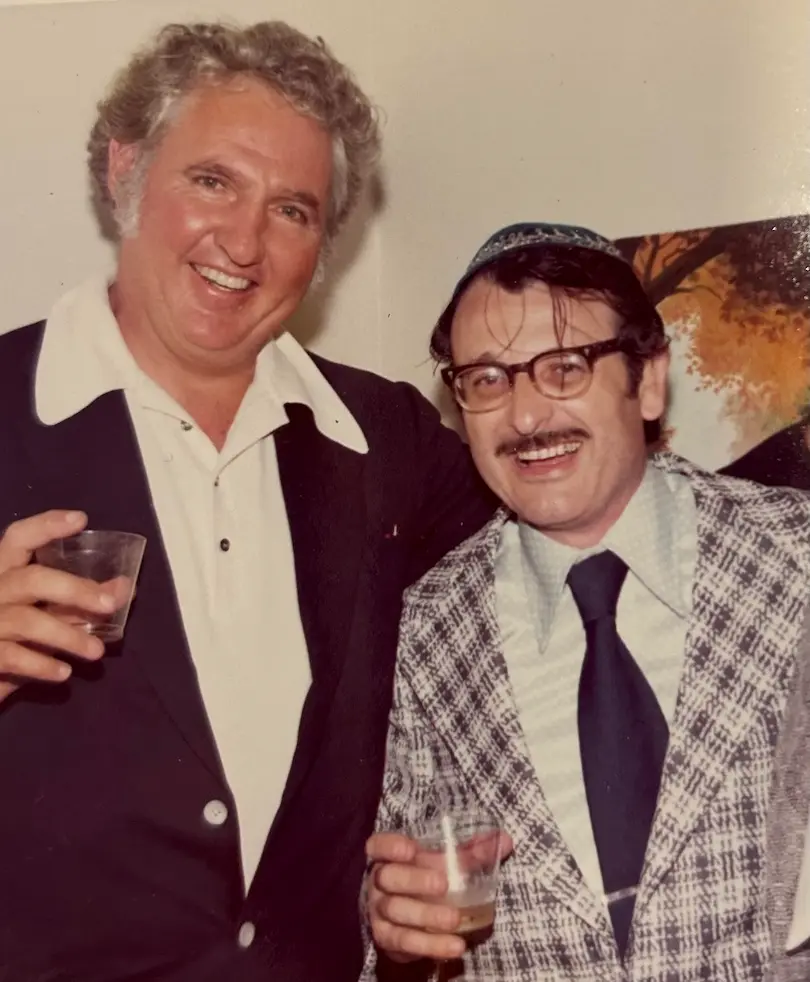 Homer and my dad circa 1975
Dad, on the other hand, was what you’d call a luftmensch — a drifting cloud. Though he could spin circles around Homer with his many talents, he barely scraped by. He tried his hand at photographing homes for a real estate company, did a stint in a pet shop and a
tailoring shop, and now he’d latched onto selling vibrating furniture. He believed vibrating furniture, due to its novelty and therapeutic appeal, would take off, and the commissions would come rolling in. Our rental on Hampton Boulevard housed a few leftover pieces in colors nobody else would buy.
The commissions didn’t come rolling in, though. And Dad had four of us to feed and a fetching wife from Casablanca eager to start living the American dream.
I’ve heard my father tell what happened next so many times.
“I come home from work,” my father tells me, “and I’m wondering how I’m going to hold it all together, when I see Homer. We start chatting. He’s trying to encourage me about my work, telling me I’m in the wrong crowd.”
He says, “Bert, people don’t understand what you’re offering. It’s not just furniture — it’s a medical cure.”
Dad says, “Honestly, I wouldn’t go that far, but it has brought people relief.”
So Dad and Homer are standing there on the front sidewalk when suddenly Homer says, ‘What do you think of Jesus?’
Now that question took Dad by surprise. In all the years he knew Homer, he never brought him up. Not once. And now he’s asking Dad what he thinks of Jesus.
He didn’t know what to say. Jesus doesn’t cross his mind much.
So Dad said, he was a good man. Lived a long time ago. Did some good things. But he wasn’t God, and not the son of God.
Dad was afraid he’d offended him, but Homer just smiles and says, “Did you know there are people in my church who feel exactly the same way you do?”
Then he tells Dad that to be in his church you didn’t have to believe Jesus is the son of God. His church was different, it didn’t get inside people’s heads and tell them what to think. You didn’t even have to believe Jesus did miracles.
Given your job and situation, you might as well become Christian, Bert, because Lord knows, you sure as hell aren’t much of a Jew.
Dad’s wondering where this is going, when he puts his arm on Dad’s shoulder and says, “We look out for each other in my church. It’s a brotherhood. I could introduce you to people who might be interested in your furniture.”
Then he said these words that are engraved on his forehead. “Given your job and situation, you might as well become Christian, Bert, because Lord knows, you sure as hell aren’t much of a Jew.”
It was like a tornado came down and sucked him right up to the sky. Like a vacuum. He’s getting whooshed up, higher and higher, till he finds himself looking down at him and Homer on Hampton Boulevard from the vantage point of the Milky Way, and he’s trembling, like God himself is shaking him out of his puny mind.
He goes back down to the sidewalk, and Homer is looking at Dad, asking if he’s all right. He must have looked like he’d been through three wars and a goat roping. Dad just tells him he’s fine and excuses himself.
The very next day Dad yanks me and my sister right outta James Munroe Public school and puts us into the Jewish School, Hebrew Academy of Tidewater Virginia.
The way I see it, we owe Homer. If not for him, who would’ve set in motion generations of Torah observant Jews, at least 60, among them Talmudic scholars, philanthropists, rabbis, rebbetzins and teachers, nearly all of them ethical human beings?
History shows when people start caring too much about another person’s eternity or soul— watch out. Homer was nothing like that.
But hear this. When those ladies in plaid skirts and buttoned-up blouses come to my door trying to convert me, they will say it is love, that they want to save my soul, but their words hit me like acid. Not because I fear they’ll any make inroads, but rather history shows when people start caring too much about another person’s eternity or soul— watch out. In the name of Heaven, any act no matter how heinous can be justified. Just ask the Spanish Inquisitors.
Homer was nothing like that. It wasn’t Dad’s soul that drew him, but the question of Dad’s bills, work, health — practical stuff. I think he hoped to help out my father — neighbor to neighbor — and was willing to dumb down his religion to the basics in order to get Dad
into the club with all its attendant perks. All you have to do is this, that and the other, and it’s a shoo in!
When I last saw Homer, it was at my sister’s wedding. He stayed overnight at our home before returning to Virginia. He still reminded me of a mountain. I overheard him and my father talking late at night in low, intimate tones — the way old friends talk. I don’t remember the words, only the cadence of it, something steady and familiar. And when it no longer felt right to listen, I slipped back to my room.
Ruchama's award-winning novel, In the Courtyard of the Kabbalist was just republished with a short story sequel.












BEEN THERE Ask- if Jesus was God, who did he pray to? Don't go to a resource when you can go to THE SOURCE...
I am a born again Christian. An ally and friend. I understand your Dad's story but admit I am a bit dismayed. I stand with jewish people and Israel. I have lost friends and family members for taking a stand. I don't push my Christiandom on anyone. My family went to Israel and it changed our lives. AISH I joined your site years ago to learn. Perhaps you could do a story about Christian allies like CUFI or individuals who are standing with you. We may not be your first choice as allies, but there are many of us.
Ms. Harnum, Thank you for being an ally! I believe the point of the article was to highlight the fact that this gentleman truly did mean well and was a good person. Further, it sounds like this was the best thing that could have happened to this family. But I agree with you. CUFI is a wonderful organization and there are plenty of wonderful Christians who stand by the Jewish people. It sounds like you are one of them, so thank you!
Tell us about your trip to Israel. What did you see and experience that affected your views? What were the reactions of your other family members? Did you go on an organized tour, or go to see things yourself?
Hebrew Academy of Tidewater! Our son was able to attend for kindergarten the one year we were stationed in Norfolk—we are a military family. He is now a proud, observant Jew, married to our beloved DIL and parents to our precious granddaughter.
We have all been approached by Christians ‘inquiring’ about ‘conversion’ from Judaism. Especially living so many years in the ‘Bible belt.’
Never!!!!!!!
Both our children are proudly, committed Jews, like their parents.
Am Yisrael Chai!
Thank you! Just 2 days ago, two men came to my driveway to invite me to their church. I foolishly thought I could admit my religion to the fella in the driver’s seat, then the man in the passenger seat went ballistic. I told them we’re done and that they needed to leave. My reaction to this encounter was the same as Dad’s in this story. I dove headfirst higher, faster and harder into my studies and keeping commandments. Funny how Hashem works, eh?
My husband, z"l, had a professor who found a surefire way of getting rid of some missionaries who came to his door. This one particular young missionary men actually had a regular schedule, it seemed. One day he and his wife stripped down to their underwear, sat cross legged on the floor, left the door unlocked and called out as the guys knocked, "Come on in. We'll let you tell us about your religion if we can tell you about ours." The missionary couple opened the door, peeked in, turned beet red and never came back.
A little drastic for sure, but it was great for a laugh!
Most of the Chr-stian denominations have missionaries - who are WELL SCHOOLED - on how to seem to be - just well meaning - nice Joe's & Jane's. All the while - their mission - is to QUIETLY SEDUCE you - into listening to their propaganda of their belief - in a son of a deity. Been there - done that. However - when confronted with what G-D's Written Torah Commandments - truly say & can show them - the various Scriptures where G-D said: "I alone am HE - there is no other g-d - BUT ME", And in the teaching in Balak - that Bilaam told Balak - "G-D is NOT A MAN - that He should be DECEITFUL - & NOT A SON of MAN - that HE SHOULD RELENT"! ALSO - all throughout the Bible - G-D FREQUENTLY - SAID: - HE was never going to ABANDON the People of ISRAEL - but will RESTORE US to Him!
All the Biblical references in ORIGIN|AL IVRIT WRITING - CLEARLY BLOCK any possibility of another deity being associated - on/as a equal deity with G-D OUR FATHER!
The Christian and Islam( Muslim) religion goes against Maimonides/ Rambam 13 principles of faith, and their religions come from distorting and warping of the mother so to speak religion the which is Judaism
"He didn’t know what to say. Jesus doesn’t cross his mind much." That made me smile.
What a beautiful story. Often when a Jew is less connected to Judaism - and someone from the outside does something that serves of a reminder of that lack of connection - the result is that that Jew realizes this and returns to Judaism. (This is what happened post-October 7, 2023 , as many previously disconnected Jews started returning to Judaism.)
By the way, with regard to Jesus, my grandfather - a knowledgeable and observant Jew who would debate missionaries who came to his door - had a great response to the question of Jesus being "the son of G-d:" he said, "Actually, he was the son of G-d. But so am I, and so is every other man, just as every woman is the daughter of G-d. Being the son of G-d made him exactly like all other men
That’s my response too! If we are NOT children of G-d, what are we? Aliens? Certainly that makes no sense.
All human beings on earth are the children of G_d
Homer doesn’t sound like much of a Xtian. In 1960’s VA, everyone belonged to a church; it was how one identified. If someone didn’t have obvious religious affiliation, others were suspicious about that individual’s character.
Wonderful!
I really, really enjoyed reading this! It was so well written, my ADHD didn’t even have a chance! Look forward to reading more of your stuff! 💕
Oh, in America, those people would knock on our door & I'd have them for breakfast, THEY were the meal. I gained some expertise because an old chavrutha would drag me to battle these folk for a year plus on motzash. He was OBSESSED with them because one theirs LISTENED to MS. HOMER, left his faith for hers & became a "minister." Poor Shelomo became somewhat of a world authority, though clearly Rav Tovia Singer has replaced him & his youtube channel has made him accessible to the vast majority of humanity (just like Aish). My wife, on the other hand, just couldn't stomach them & told them whenever you see a MEZUZAH on a house, just SKIP IT because it means there's someone JUST LIKE MY HUSBAND INSIDE & YOU'LL get nowhere w/him, but HE'LL get somewhere w/you.
That a real beautiful story. Thank you writing and sharing it!
BEEN THERE. Ask: would you eat previously chewed food? Neither would I. Enough said.
Full credit to your father for not taking the easy way out and putting spiritual gains above material ones!