Why Were the Graves of So Many Jewish GIs Marked by a Cross?


7 min read
8 min read
8 min read


9 min read


When my twin brother became religious, I flew to Jerusalem, armed with philosophical arguments, to bring him back home. My mission succeeded, just not the way I planned.
When my twin brother Ephraim became religious at age 17, I decided I needed to go rescue him.
We had both finished high school and gone to Israel to spend three months on kibbutz, picking fruit and having fun. He was going to move on from there to be a counselor on a Young Judea summer trip and I was going to travel through Europe. Just before the summer trip began, he was walking through the Old City of Jerusalem when someone made a pass at him. He ran. Turning a corner, looking for somewhere safe to go, he spotted a building he recognized — Aish HaTorah, a yeshiva. He knew it from a famous Rolling Stone article written by Ellen Willis, a pioneering American left-wing journalist, about her brother who became an orthodox Jew.
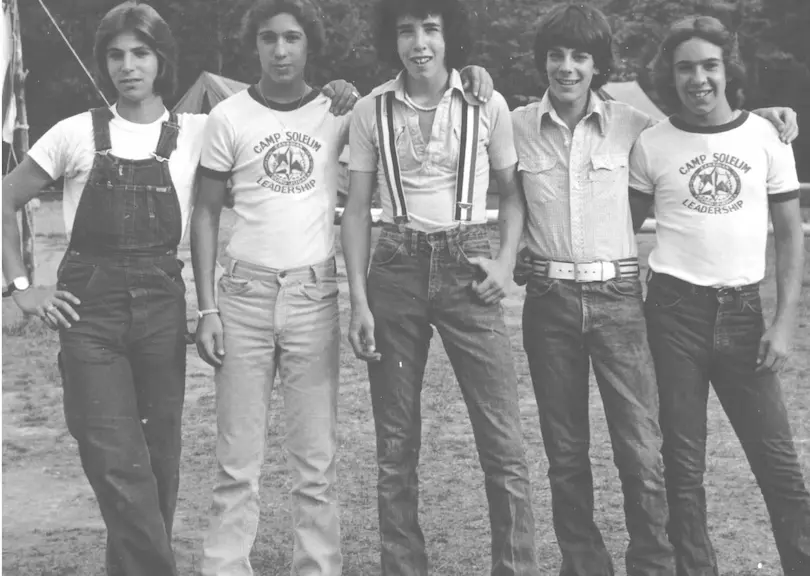 Me and the boys at camp
He went in, took his first class and found it compelling. He stayed for a few weeks riveted. He did his counselor job that summer and came back to the yeshiva in the fall, cancelling his plans to begin university. Just like that. A boy goes to Israel to pick fruit and comes back a religious Jew. None of us could make sense of it.
What didn't occur to any of us at the time was that the "cult" my brother had joined was the same one 120 generations of our own grandparents had belonged to.
In those years — the late 1970s — cults were a real and frightening phenomenon. When someone you knew disappeared into an intense, all-consuming community with strange new beliefs and rules, "cult" was the word people reached for. I got my parents the book Moonwebs about the Moonies to help explain what had happened to Ephraim. What didn't occur to any of us at the time was that the "cult" my brother had joined was the same one 120 generations of our own grandparents had belonged to.
Ephraim came home after his first year at Aish and I was braced for the brainwashed brother I had pictured. Instead, I got someone who had grown up. He was clearer, more grounded, more mature than I had ever seen him — honestly, more than I was. I had stayed on the conventional path — university, the right next steps — and I had assumed I was the one who had moved ahead. Sitting across from him, I realized he had something on me that I couldn't pinpoint. I was a little jealous.
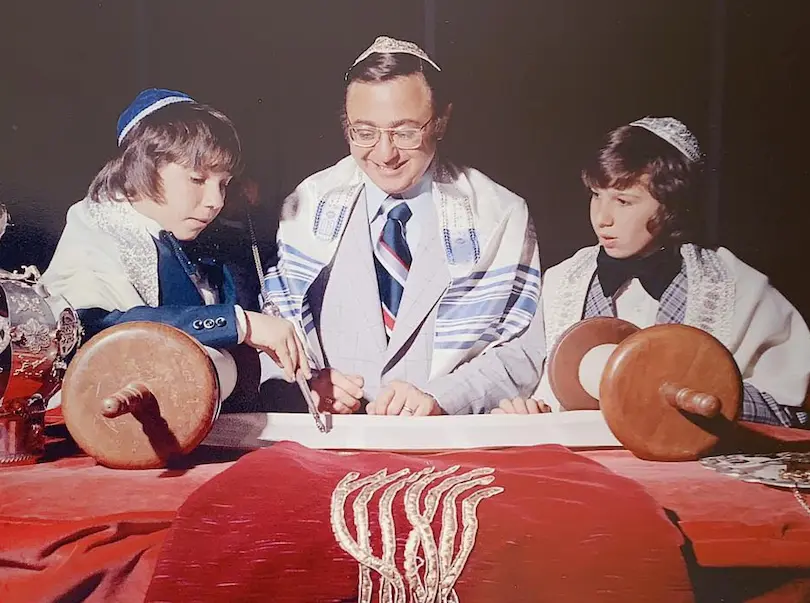 Me and my brother Ephraim celebrating our bar mitzvah
After he went back to Aish in Jerusalem, I decided I would eventually go there myself to rescue him. I felt that he was almost certainly making a huge mistake. The idea that God exists and He gave the Torah to the Jewish People at Mount Sinai sounded frankly ridiculous, not even worth serious consideration. I wanted to examine their claims, show Ephraim that the foundation was bogus, and bring him back.
The other, more subconscious reason, was that I saw something intriguing had happened to my brother at Aish, and whatever it was, I wanted some of it. I didn't believe it was Torah; I didn't think Judaism had much to offer. A lousy Hebrew school education had given me just enough to feel confident that there was not much there.
And lastly, I felt that I owed it to myself to seriously examine whether being Jewish meant anything real. Whether it should actually shape my choices, my life, who I married. I didn't take my Jewishness seriously, but I knew it was a question I hadn't answered, and I didn't want to leave it unanswered.
I was not a truth-seeker in the classic sense. I wasn't searching for meaning. I was happy in my life, playing sports, my social life, music and a healthy dose of partying. I was content with my life and the direction I was headed in. But I was intellectually honest. If I was going to go look at something, I was going to look at it straight, objectively. Truth mattered and if the evidence pointed somewhere, I would follow it; I wouldn't flinch from the conclusion.
I genuinely did not think that Judaism's foundational claim that the Torah is Divine might be true, and I certainly did not want it to be true. I wasn't interested in adopting a life of obligatory commandments that I thought were restrictive. I didn't know all the details but I knew enough to understand that it would mean giving up a tremendous amount of freedom.
I was certain there was zero chance Torah was going to hold up, and I went to Israel feeling quite secure that I wasn't about to make any major life changes. My mission was to spring my brother free, get some of the good stuff, and come home.
Before I went, I spent a year at university preparing. Confident as I was, something nagged at me. Ephraim wasn't the first person I knew to walk into Aish and not walk out the same — several other Canadians had gone and made the same jarring turn. Even my parents had flown to Jerusalem to see for themselves what was going on and came back saying: whatever this place is, the thinking is serious. These are not people you can simply wave away. That report unsettled me more than I let on.
I spent a year preparing, enrolling in courses in logic, philosophy, and the study of religion.
I enrolled in courses in logic, religious history, and the study of religion. Among them was philosophy, where I encountered the existentialists, who argued that life has no inherent meaning and that the only honest response is to create your own. At the time, this seemed like intellectual courage. Later, I'd see it differently. Universities are not exactly pro-religion, and by the end of that year I felt confident I knew the opposing case.
I was going to Jerusalem armed.
I arrived at Aish on a Thursday. That first Shabbat, Ephraim took me to the homes of three young rabbis. The Shabbat itself was something I had never experienced — the families, the singing, the beauty of the table. But I was there to do a job and I got into heated discussion and debate with each of those rabbis, giving them everything I got.
They were not the lightweights I had expected. They were smart, intellectually confident, and open to debate. By the end of that Shabbat, I had been trounced.
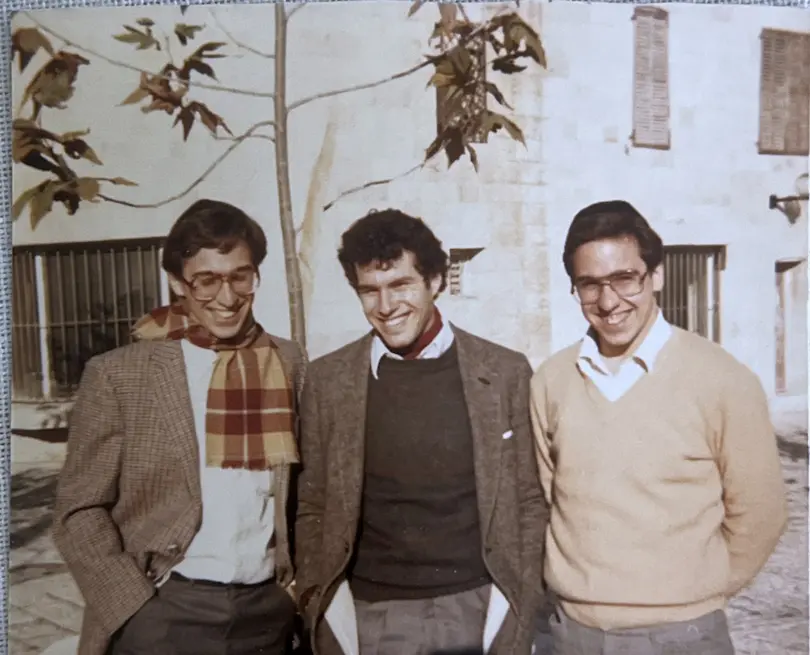 My brother Ephraim, Joel Hecker, and me at Aish
For the next three months I asked every question I could think of, every objection from my year of study, every challenge I had been carrying as ammunition. I was not thinking, even for a moment, that I was going to change my lifestyle. But after a few months, I began to realize that the evidence I was discovering was far more compelling than I ever imagined, and I could not just dismiss Judaism out of hand because I didn't feel like changing. I began to wonder whether it was precisely the wisdom and practice of Judaism that had brought about Ephraim's impressive growth.
When I stood back and realized that Judaism might actually be true — that God does exist and He is the Author of the Torah — I did not celebrate. In fact, I got a little depressed. Years later I came across a midrash that put words to what I had felt. At Mount Sinai, the Talmud says, God held the mountain over the Jewish people's heads and said: if you accept the Torah, good; if not, this will be your burial place. It sounds coercive. The Maharal reads it differently. The mountain, he says, is a picture of intellectual clarity. Once you see the truth, you have no way out. You are obligated — not because someone is forcing you, but because you understand: this is reality. Those months at Aish were the mountain coming down on my head.
Once you see the truth, you are obligated — not because someone is forcing you, but because you understand: this is reality. Those months at Aish were the mountain over my head.
I went back to university to finish my degree and I slowly started incorporating Jewish practice into my life. My initial observance was not out of love or spiritual connection. I started keeping kosher and observing Shabbat because intellectual honesty had cornered me. If there is a God and He gave a Torah, then keeping it, for me, was not a lifestyle choice that I could simply choose to discard. My fidelity to truth meant it's what I had to do.
During the year that followed, I lost many friends, ironically mostly my Jewish ones. They thought I went crazy. But I was slowly developing a spiritual side I didn't know I had within me, and beginning to taste the deeper pleasures of a Torah life. And there was an unexpected gift in being the odd one out: defending a truth that everyone around me dismissed forced me to clarify it and own it more deeply. That strength of sticking to your convictions no matter how unpopular never left me.
For me, the deep-seated pleasures of observing Judaism have been an acquired taste. The spiritual palate takes years to develop and I am grateful to have the beauty of Shabbat and the holidays, the depth of Jewish learning and a personal relationship with God animate my life. They are deeper and more profound than the pleasures they replaced.
But the main gift I received is a life with real, tangible meaning. Not the delusory manufactured meaning existentialists need to settle for — like choosing a paint color for a wall you know has nothing behind it, where even after the choice the wall is still hollow. What I got was objective meaning, one that was there before I showed up, and will be there long after I am gone.
My mission succeeded — just not the way I planned. I didn't bring Ephraim home; he brought me. Ephraim didn't need saving. He had simply arrived somewhere, a little ahead of me, at the same place 120 generations of our family had stood before us. I eventually caught up.