





 Biblical Imagery in Dolly Parton’s Music



13 min read


Everything you need to know about one of Judaism's most profound holidays.
Some moments don't just happen in time — they bend it. History has a handful of them: instants when the infinite broke through into the finite, when eternity stepped inside the clock. Shavuot marks one of those moments, when the Divine reached toward the human, and the human reached back.
The Talmud captures the uniqueness of this encounter in a striking pattern:
“Blessed is the Merciful One, Who gave the threefold Torah to the threefold nation, through a third-born child, on the third day of preparation, in the third month.” (Babylonian Talmud, Shabbat 88a)
Rashi unpacks this: the “threefold Torah” is Torah, Prophets, and Writings; the “threefold nation” is Priests, Levites, and Israelites; Moses was his parents’ third child; the Torah was given after three days of preparation; and it all happened in the third month, Sivan.
In Jewish thought, one represents unity; two, division and tension; three, a higher harmony that integrates opposites. Shavuot is that harmony in action: Heaven and earth, spirit and matter, God and humanity meeting in a shared space.
This theme is woven into the opening chapters of Genesis. On the second day, the Torah describes a split:
“Let there be a firmament in the midst of the waters and let it separate between the waters.”
At Sinai, the distance between Heaven and earth was bridged.
The world is divided between “upper waters” and “lower waters,” between Heaven and earth, the spiritual and the physical. Notably, the Torah does not say “and it was good” on that day; separation alone is unfinished work. Only on the third day does integration emerge. The waters gather, dry land appears, and the earth begins to sprout life and vegetation. For the first time, the Torah says, “And God saw that it was good” twice. Division is transformed into creative unity.
Shavuot is the spiritual “third day” of creation. At Sinai, the distance between Heaven and earth, fixed since the dawn of time, was bridged. From that moment, human beings could touch holiness and the Divine Presence could dwell within the physical world.
Even the Hebrew alphabet hints at this vision. The Jerusalem Talmud asks why the letter beit ב — the first letter of the Torah’s opening word, Bereishit (In the beginning)—has a projection pointing upward and another pointing backward. It answers:
If the beit is asked, “Who created you?” it points upward toward Heaven. If it is asked, “What is His Name?” it points backward toward the aleph א , teaching that His Name is One.
Beit , the first letter of creation, points both upward, toward its Creator, and backward, toward the underlying unity symbolized by aleph. Creation might look fragmented, but its inner purpose is to reveal oneness within multiplicity.
Shavuot sits at the heart of that purpose. The Torah was not given to create a class of scholars removed from daily life, but to sanctify daily life itself—to infuse business, family, agriculture, ethics, speech, and human relationships with holiness. Judaism does not escape the world; it transforms it.
The daily prayer Adon Olam puts this into sharp focus:
“Master of the universe, Who reigned before any form was created…
And after all things shall cease to exist, He alone will reign.”
God exists before creation and beyond it yet chooses to step into history and reveal Himself within a finite world. Shavuot marks that choosing. The Torah was given not to angels but to human beings—physical, imperfect, conflicted, and limited. It was entrusted to people who eat and sleep, work and worry, trust and fail. That is the greatness of Sinai: holiness taking root in ordinary human life.
The Talmud teaches that three leaders sustained Israel in the desert—Moses, Aaron, and Miriam—and that through them came three gifts: manna, the Clouds of Glory, and a miraculous well.
Together, they sketch a world where every layer—Heaven, earth, and everything in between—is touched by the Divine. Shavuot is the festival that reminds us that such a world is still possible.
The journey to this moment begins on Passover , when the Jewish people step out of Egypt as a newly freed but still undefined nation. The Exodus ends physical slavery, but leaves an open question: Who are we now—and what are we for?
The answer comes weeks later at Mount Sinai, when the people not only hear but, in some sense, see the words of God. Through the Torah they receive, they gain a spiritual identity and a national calling; redemption becomes complete.
The Torah underscores the connection between Passover and Shavuot through a mitzvah called Sefirat HaOmer —the Counting of the Omer . We count 49 days from the second night of Passover until the festival the Torah calls Atzeret , the Day of Assembly, later known as Shavuot. The name “Counting of the Omer” comes from the barley offering ( omer ) brought in the Temple on the 16th of Nisan, the second day of Passover; on Shavuot, the offering shifts to wheat bread.
Barley was commonly used as animal feed, while wheat bread is a distinctly human food. As we count, we trace a movement from a more instinctive, survival-oriented existence toward a more human life defined by choice, conscience, and a conscious bond with God.
Jewish mystical tradition speaks of 50 levels of holiness. The generation in Egypt, it teaches, had descended to the 49th level of impurity—immersed in Egyptian beliefs and almost devoid of faith. Only God’s decision to redeem them when He did prevent them from sinking to a point from which return would have been impossible.
The 49 days between the Exodus and Shavuot become a ladder of ascent: each day an opportunity to climb one more rung toward clarity, sanctity, and readiness to receive the Torah on the 50th day. Counting the Omer is not just marking time; it is measuring inner growth toward Sinai.
On the 49th night, we count the Omer one last time. The next evening, as the sun sets, Shavuot begins. It is the anniversary of the Revelation at Mount Sinai, when God communicated the Torah to the entire Jewish people and defined their mission and purpose as a nation. In prayer, Shavuot is called Zman Matan Torateinu —“the Time of the Giving of Our Torah.”
Shavuot is about the Torah as a whole—its total, all-encompassing impact on life. It cannot be captured in a single symbolic act.
Strikingly, Shavuot has no single, defining mitzvah. On Passover, we eat matzah; on Sukkot, we sit in a sukkah; on Rosh Hashanah, we blow the shofar. Shavuot has no comparable ritual. That absence is itself the message: Shavuot is about the Torah as a whole—its total, all-encompassing impact on life. It cannot be captured in a single symbolic act.
Jewish tradition teaches that the spiritual “light” revealed at the origin of a festival is available again each year when that festival returns. On Shavuot, that means the power of Sinai is not just a memory; it is something we can taste again.
The Torah describes the people’s response to God’s offer of the covenant in a famous phrase: “ We will do and we will hear .” They commit to action even before full understanding, expressing radical trust and deep willingness to accept God’s will sight unseen.
One of the most widespread Shavuot customs is designed to help us tap into that energy: all-night Torah study, known as Tikkun Leil Shavuot . After evening prayers and a festive meal, communities gather to learn and teach, often until dawn, studying material drawn from across the spectrum of Torah to demonstrate a desire to embrace it in its entirety.
At sunrise, the morning festival prayers are recited. People return home for a dairy-rich breakfast—and, often enough, a long nap.
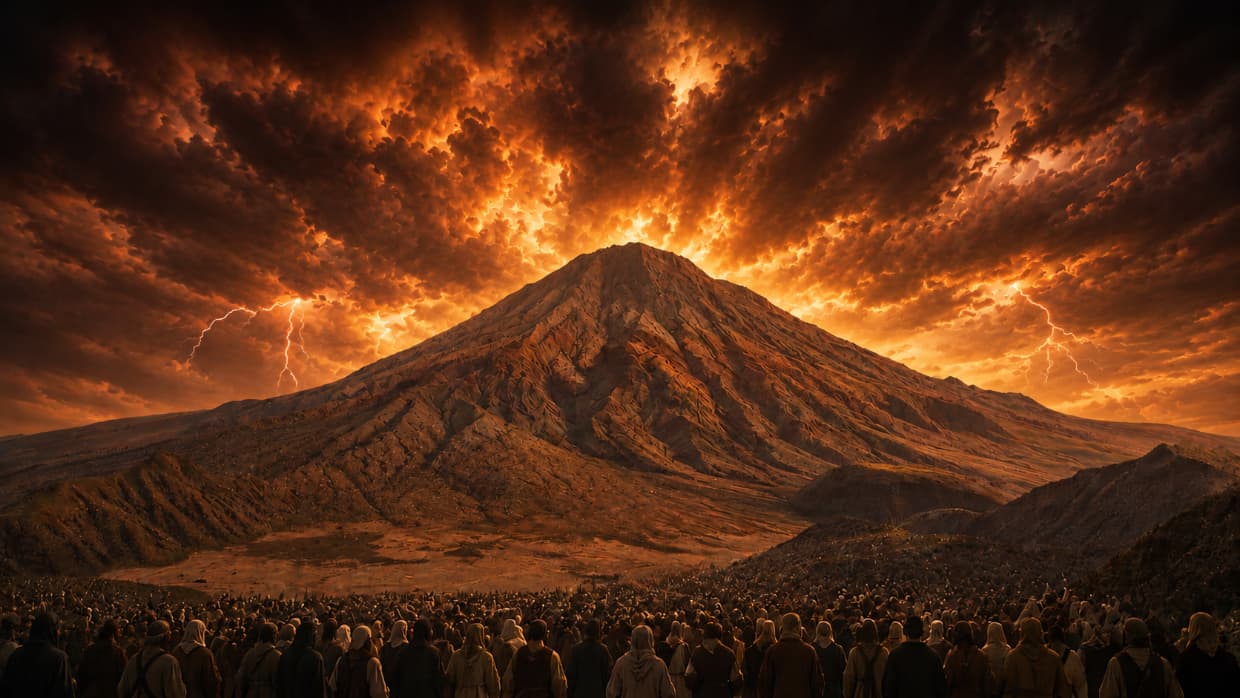
The revelation at Mount Sinai was unlike any other claimed revelation in religious history.
The Torah describes a scene where every man, woman, and child experiences the Divine word with all their senses; thunder, lightning, a shofar blast, a trembling mountain, and a voice that reaches an entire nation.
Because this claim centers on a mass, public event, it is not easily fabricated.
Unlike other faith narratives where God is said to speak to a single prophet in private—a mountaintop, a cave, a solitary vision—the Torah claims that the Jewish people themselves heard God declare, “I am the Lord your God Who brought you out of Egypt.” They also heard God address Moses, appointing him as His prophet and leader.
Because this claim centers on a mass, public event, it is not easily fabricated. If it had not happened, it would be nearly impossible to convince an entire nation—and their descendants—that their ancestors had once stood together at the foot of a mountain and heard God’s voice. That is why the Torah repeatedly stresses the public nature of the revelation and calls on later generations to remember—and to testify.
“You are My witnesses,” says the prophet Isaiah in God’s name. The Jewish people are witnesses not only in a poetic sense but in a literal one: their national story is rooted in a shared encounter with God at Sinai. There is even a mitzvah to pass on the memory of that day to one’s children, ensuring that Sinai remains a living reference point rather than a fading myth.
Shavuot, in this sense, is an annual day of testimony. Each year, the Jewish people stand together again—through prayer, study, and tradition—and say: we were there, we remember, and we are still bound by what we heard.
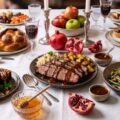
A beloved Shavuot custom is enjoying dairy foods . One traditional explanation is practical and evocative at once: fresh from Sinai, having just learned the laws of kashrut, the people were not yet equipped to prepare meat in accordance with those new standards, so they turned instead to simple dairy and plant-based foods.
Another layer of meaning comes from the Song of Songs : “Honey and milk are under your tongue.” The Torah is compared to milk and honey for its sweetness and delight. Both foods also symbolize gentle harmony with nature: they are produced without taking life or even halting growth. In this sense, they echo the Torah’s own promise: “Its ways are ways of pleasantness, and all its paths are peace.”
Eating dairy and, in some communities, milk and honey, becomes a way to taste the Torah’s sweetness and its vision of peace between the physical and the spiritual.
On Shavuot morning, we read the Book of Ruth in the synagogue. Ruth is a Moabite woman who chooses to join the Jewish people, leaving behind her homeland, wealth, and comfort for a life of faith and covenant. She becomes the model of the righteous convert.
Why this story on this day? One reason is that Ruth’s choice highlights what receiving the Torah really demands: the willingness to reorder one’s priorities, to let go of what once seemed valuable in favor of what is truly precious. Ruth shows that Torah is worth any sacrifice.
Reading Ruth, the paradigmatic convert, reminds us that this greatness is open to anyone who sincerely chooses it.
Another reason runs even deeper. On Shavuot, the entire Jewish people see themselves, in a sense, as converts. At Sinai, they accept God’s kingship and the entire Torah; they undergo purification; the men undergo circumcision; and the people as a whole enter into a covenant. These same elements appear, in individual form, in the conversion process. The laws of conversion are modeled on this “mass conversion” at Sinai, when a collection of former slaves becomes a covenantal nation.
Reading Ruth, the paradigmatic convert, reminds us that this greatness is open to anyone who sincerely chooses it—and that even King David, whose descendant the Messiah will be, traces his lineage back to a woman who began her journey outside the Jewish people.
Biblically, Shavuot is also called Chag HaBikurim , the Festival of the First Fruits, and Chag HaKatzir , the Festival of the Harvest. In ancient Israel, farmers would bring the first ripened fruits of the season to the Temple in Jerusalem as an offering of gratitude to God.
The mitzvah of Bikkurim required farmers to mark the earliest fruits of the seven species associated with the Land of Israel—wheat, barley, grapes, figs, pomegranates, olives, and dates—and later carry them to Jerusalem in a joyous procession. The Mishnah describes villagers traveling together, accompanied by music and an ox adorned with gold-covered horns and olive wreaths; workers in Jerusalem would stop their tasks to greet them, and the Levites would sing as the offerings entered the Temple.
To bring first fruits is to say: my effort matters, but it is not the whole story. The farmer has labored for months or years, yet acknowledges that rain, sun, soil, and timing are beyond human control. The first fruits are a declaration of faith and gratitude—not just for the harvest, but for the partnership with God that makes any harvest possible.
Today, with no Temple standing, we cannot bring actual first fruits. But Bikkurim is still remembered in the Shavuot Torah reading and in our prayers, and many communities decorate homes and synagogues with greenery and flowers to recall both the agricultural dimension of the festival and the idea that this is the time when God judges the fruit trees.
Rabbi Samson Raphael Hirsch notes that just as the first fruits ripen around Shavuot, so too the Jewish people “ripen” as a nation on this day. The seeds of freedom were planted at the Exodus, but the people truly mature into a sacred nation with the giving of the Torah.
Shavuot is more than the anniversary of a revelation; it is a celebration of possibility. It teaches that the distance between Heaven and earth is not absolute, that human beings can ascend higher than they ever imagined, and that the physical world can become a vessel for holiness.
At Sinai, God and humanity touched. Every year on Shavuot, we are invited to step back into that moment—and to let it reshape the way we live in the world today.











Wonderful!