





 Jews Are a Fifth Column: A Libel as Old as the Pyramids






6 min read


Barry Strauss’s Jews vs. Rome reveals how faith, unity, and defiance sustained the Jewish people—from Rome’s legions to Israel’s modern battlefield.
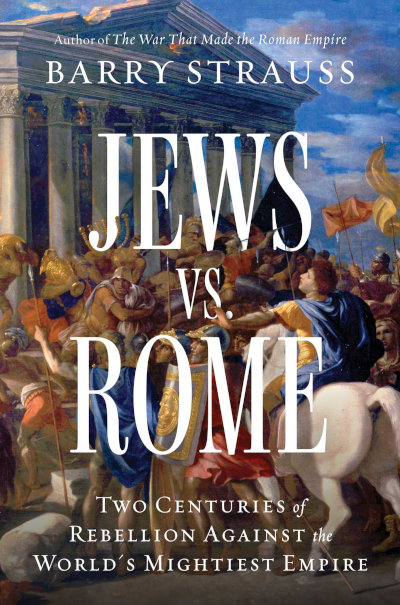
Israel is surrounded by forces set on destroying the Jewish state. Some individual Jews, possessing the hope that assimilation will gain them acceptance into culturally and politically elite circles, betray their coreligionists. Today’s headlines bear a striking resemblance to the battles between the Jewish people and Rome, as a brilliant new book shows. Jews vs. Rome: Two Centuries of Rebellion Against the World’s Mightiest Empire by Barry Strauss rivetingly recounts a tragic history that would conclude, millennia later, with the triumph of Israel.
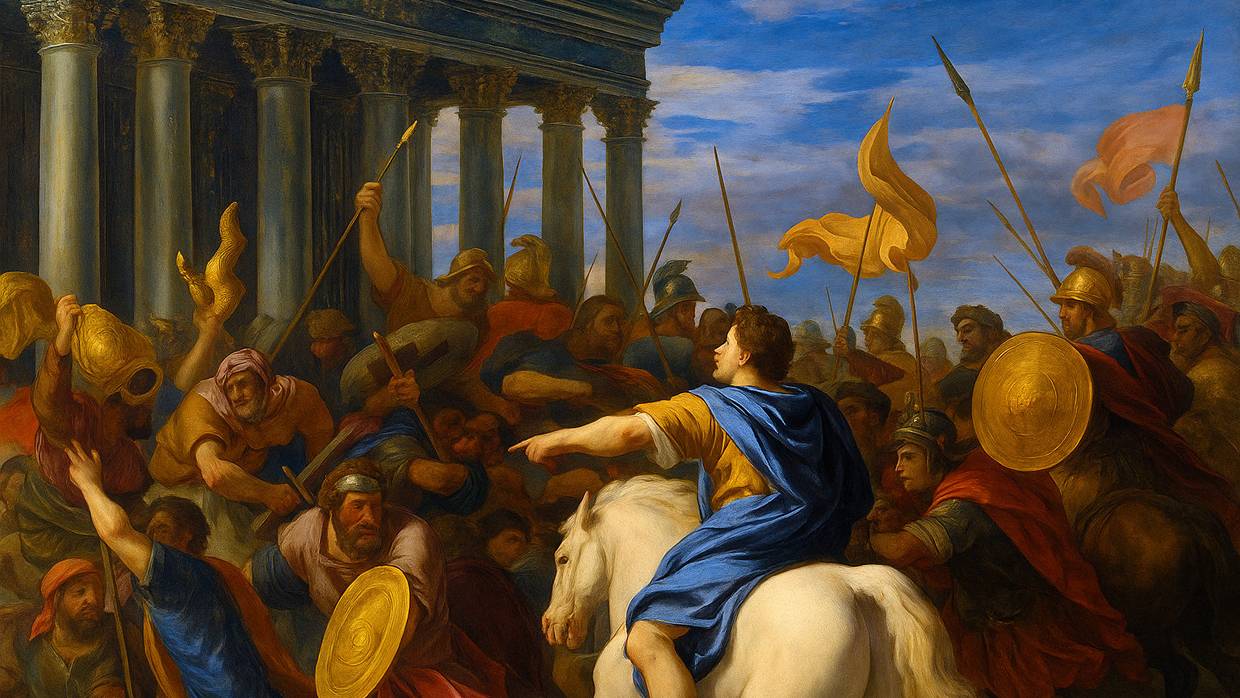
As Strauss, an Emeritus professor at Cornell University and current Senior Fellow at the Hoover Institution, notes, “During the space of seventy years, the Jews, one of the many people under Roman rule, revolted not once but three times. No other people in the empire—and there were many other rebel nations—had such a record.” The three occasions were the Great Revolt, from 66–74 CE, during which the Second Temple was destroyed; the Diaspora Revolt from 116–117; and the Bar Kokhba Revolt, from 132–136.
Following the triumph of the Maccabees, Rome had subdued Judea in 63 BCE. Decades of harsh treatment, including Pontius Pilate’s bringing imperial banners with the image of Tiberius Caesar into the Holy City of Jerusalem and Pilate’s misuse of Temple funds to build a new aqueduct, snowballed into enough of a revolutionary sentiment that the Romans sent a large force to quell it.
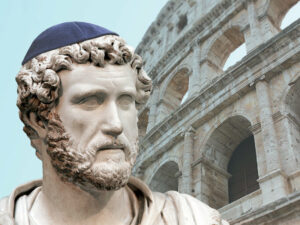
 Among the anti-Judean antagonists was the nephew of the Jewish philosopher Philo, Tiberius Julius Alexander. Josephus, another Jewish turncoat who serves as historians’ main source for details of the Great Revolt, noted that Tiberius Alexander was “not faithful to his ancestral ways.” The young man chose to, as Strauss recounts, “rise on the career ladder of the Roman army and colonial administration.” So it was that Titus’s chief military advisor during the Roman siege of Jerusalem was a traitorous Jew.
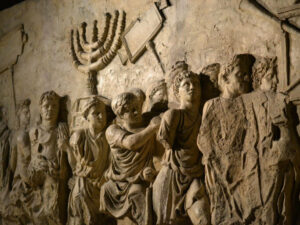
The war was completed with the destruction of the final rebel outpost at Masada in 74. Throughout, Jewish sectarian infighting had diffused any momentum the rebels might have demonstrated. Tens of thousands of Jews were killed or enslaved, and Jerusalem was left in ruins.
Josephus himself had survived by the skin of his teeth. As Strauss documents of the Jewish commander after his capture, “the Judean fought for his life by thinking on his feet. Josephus knew that [commander of the Roman legions] Vespasian would probably send him to Nero in Rome, where he would face execution after being tortured. To prevent that Josephus needed to make himself useful to Vespasian. He did that by prophesying a great future: Vespasian, he said, would become emperor. It worked. Vespasian retained Josephus instead of sending him to Nero.”
Unlike Tiberius, however, Strauss notes, Josephus “retained the faith of his fathers.”
While Josephus is hardly a figure to be admired, his chronicle of the Revolt has left the Jewish people with both wisdom and a warning: “It is impossible,” writes Strauss, “to read Josephus on the siege of Jerusalem without admiration for Jewish courage combined with horror at Jewish disunity.” One cannot help but conclude, therefore, that when Jews are united, there is no antagonist that can stand in our way.
Meanwhile, the Roman Colosseum was constructed with spoils and slaves from the battle against Jerusalem. Now-emperor Vespasian erected a Templum Pacis—“Temple of Peace.” Completed in 75, it showcased looted objects from the Holy City alongside booty from other wars of conquest. Coins were minted in 80/81 on the tenth anniversary of the Temple’s fall that proudly bragged Judea Capta—“Judea has been conquered.”
But the Jews would not remain quiet. Though these battles lack a historian of Josephus’s caliber to provide us with the details, the historical record indicates that pockets of revolt sprang up in Jewish communities in Mesopotamia (modern-day Iraq and parts of Syria, Turkey, and Iran) from the summer of 116 to the summer of 117. The Jews there likely fought alongside Gentile neighbors who also didn’t take kindly to Roman rule, possibly urged on by the Parthians, rivals of Rome. “The Romans suffered heavy losses,” Strauss notes, “but they crushed the revolt in the end.”
Less than two decades later, revolutionary winds blew again in Judea. Led by Bar Kokhba and his spiritual advisor Rabbi Akiva against the forces of the emperor Hadrian, the Jews fought valiantly for three and a half years. They even briefly achieved independence from the empire.
Eventually, the rebel forces were defeated, with their last stand in Betar, a strongly fortified city outside Jerusalem, on Tisha B’Av—the same date the Temple had been destroyed over sixty years earlier. The Romans then renamed Judea Syria Palestina, borrowing the name from the ancient anti-Jewish antagonists, the Philistines. It is the only known case of Rome changing the name of a rebellious province as punishment.
The Jewish people refused to wallow in defeat, however. As Strauss writes, the “nation’s leaders, in this case its rabbis, determined that the Jewish people could survive by means of spiritual rather than material armor. It was a bold strategy, but a necessary one. And it worked. Despite many vicissitudes, despite the threats of persecution, dispersion, and assimilation, the Jewish people have survived for two thousand years since the Roman conquest of its national homeland. Jewish culture remains remarkably similar today to what it was in the Later Roman Empire.”
Furthermore, as the author triumphantly concludes, after two thousand years, Judea was reborn into the modern State of Israel. “The Jewish people,” Strauss writes, “have reestablished a sovereign state in their ancestral homeland. They kept faith with the promise of Psalm 137 to remember Zion… the Jews have returned to Jerusalem. Their state prospers, but it struggles to find acceptance by its neighbors. Israel is a small state fighting for its place among much larger states and empires, east and west. Amid so many changes in history, some constant remains.”
Reading Jews vs. Rome serves as a bloody and tragic testimony—but also a timely guidebook for today. As Israel once again fights for its survival, the book reminds us that when unity of purpose is joined with spiritual strength, no adversary can withstand the power of our faith and resolve.










Very inspiring. I love the Jews' resilience. They share so much in common with my people, Igbos of Eastern Nigeria.
In the days of Greek oppression with its attempts to destroy Jewish culture and through the Roman domination and oppression with its desire to destroy and wipe out the Jewish peoples, there were the apocryphal writings to give hope and encouragement. In light of todays growing antisemiticism, there are recorded histories of the Jews that can bring hope and strength. I want to read more!
shalom;may I ask you to teach us a bit about the jewish revolt in cypress and north africa circa 118 ce, aka Kitos War? todah
I’m not the author of the above article, but here’s my article about the Kitos War: https://aish.com/ancient-antisemitism-and-the-kitos-war/