







 Peace Prize Winner Navi Pillay’s Long Record of Anti-Israel Hatred
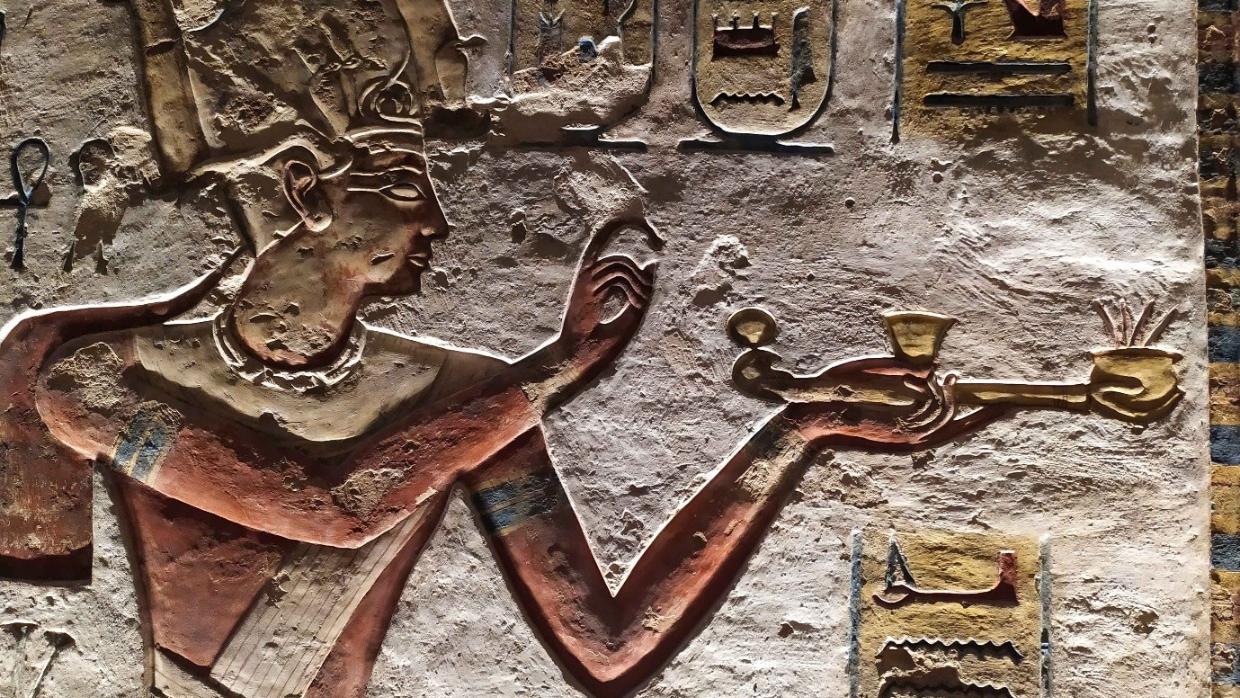






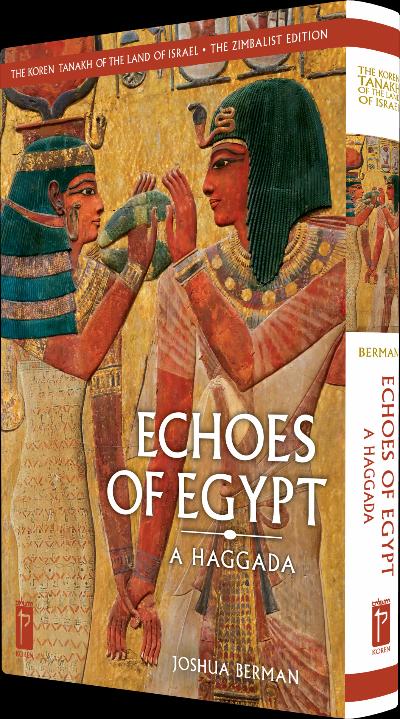
A new Haggadah takes you inside the Egypt your ancestors escaped. It changes what Passover means.
There is a stone slab sitting in the Cairo Museum right now, carved in 1207 BCE, that most Jews have never heard of. It was made by Pharaoh Merneptah, son of Ramesses the Great, to celebrate his military campaigns. He listed the peoples he had conquered, the nations he had crushed.
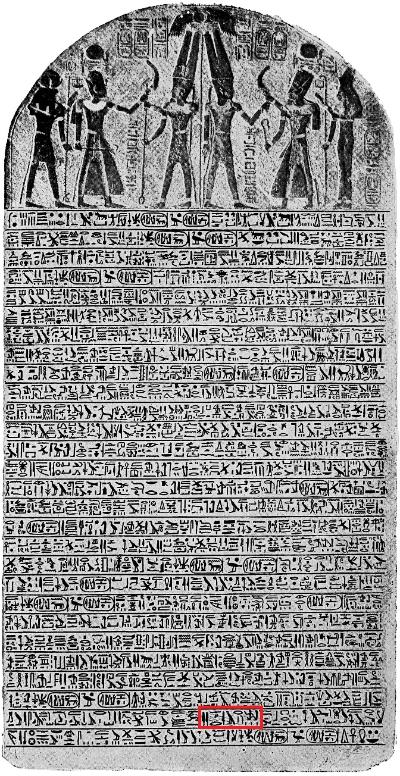 The Merneptah Stele, 1207 BCE. The red box marks the word Israel — the earliest mention of our people outside the Bible. Egyptian Museum, Cairo. Public domain.
Near the bottom, in hieroglyphics, he carved a name: Israel.
It is the earliest mention of Israel outside the Bible. An Egyptian pharaoh, three thousand years ago, recorded us. He thought he was writing our obituary. The inscription reads: "Israel is laid waste; its seed is no more." He was wrong. We have the stone.
That stone is not an artifact on the margins of Jewish history. It is Egypt speaking directly to us across three thousand years, in its own language, about who we were — and who it thought we would never become. Rabbi Dr. Joshua Berman, a professor of Bible at Bar-Ilan University, understood that if Egypt left this kind of evidence, it left other evidence too. He went to find it.
Many people who show up to a Passover seder carry a quiet suspicion in the back of our minds that the Exodus is more story than history, more symbol than fact. Rabbi Berman took that suspicion seriously.
In January 2021, Rabbi Berman boarded a flight to Egypt during the pandemic. He had been waiting for this trip for years. Not to see the pyramids as a tourist, but to see Egypt the way the Torah sees it, to walk through the temples, the tombs, the monuments of the civilization our ancestors left behind. He went with one of the world's leading experts in Egyptology and the Bible as his guide. What he found there became the basis of his new book, Echoes of Egypt: A Haggadah, published by Koren Publishers Jerusalem.
It's unlike any Passover Haggadah you have encountered. Most Haggadahs treat Egypt as a backdrop. Rabbi Berman treats it as the argument.
The Exodus was not simply an escape. It was a response to everything Egypt stood for, conducted in Egypt's own language, on Egypt's own terms, against its specific claims about God, power, and what a human being is worth. To understand what we were saying when we left, you need to know what Egypt was saying. Almost none of us do.
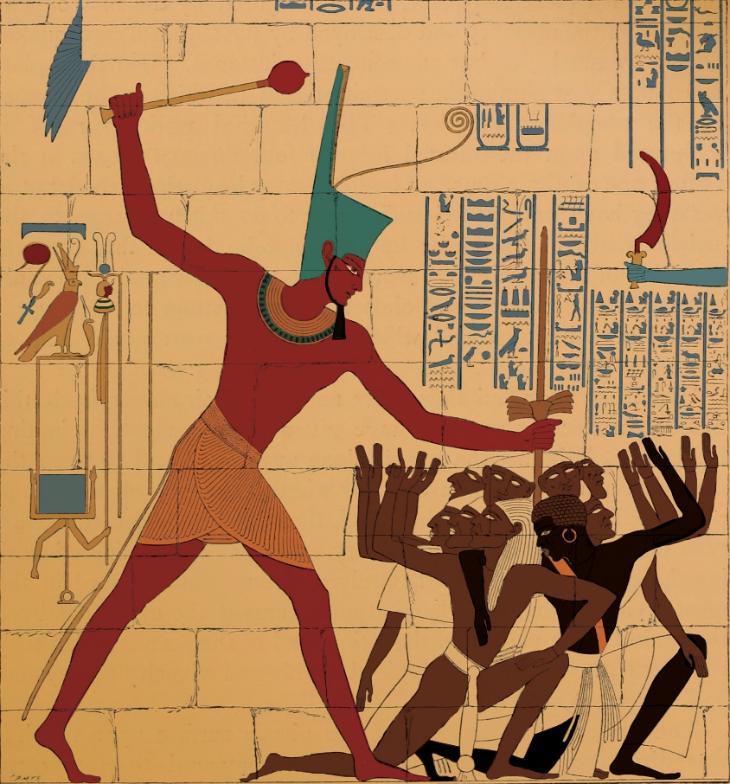 The pharaoh with raised right hand, crushing his enemies. This image appeared on temple walls across Egypt for three thousand years. It was not just art — it was theology. Illustration after ancient Egyptian temple relief. Public domain.
Pharaoh was not merely a king. He was a God, or as close to one as a human being could be. His authority was not political; it was cosmic. Without his rule and rituals, the Egyptians believed, the universe itself would descend into chaos. The common person existed to serve him and the gods, created for that purpose alone. This was not a fringe view. It was carved into every temple, painted in every tomb, inscribed on every monument. It was the organizing principle of one of the most powerful civilizations the world had ever seen.
The Torah enters this world and says: all of it is wrong.
When God commands Moses to perform signs before Pharaoh using his shepherd's staff, most readers move past it. Rabbi Berman stops there. The heka, the crook, was Egypt's emblem of royal sovereignty. In reliefs and monuments across three thousand years of Egyptian civilization, the king holds it in his left hand, resting it upon his shoulder. Pharaoh is the shepherd of his people; he holds them as a shepherd holds his flock, his power rooted in the cosmos and therefore unchallengeable.
When Moses performs the signs before Pharaoh with that same staff, every Egyptian in the room understands exactly what is being claimed. The Torah does not step outside Egypt's symbolic language. It enters it and takes the crook away.
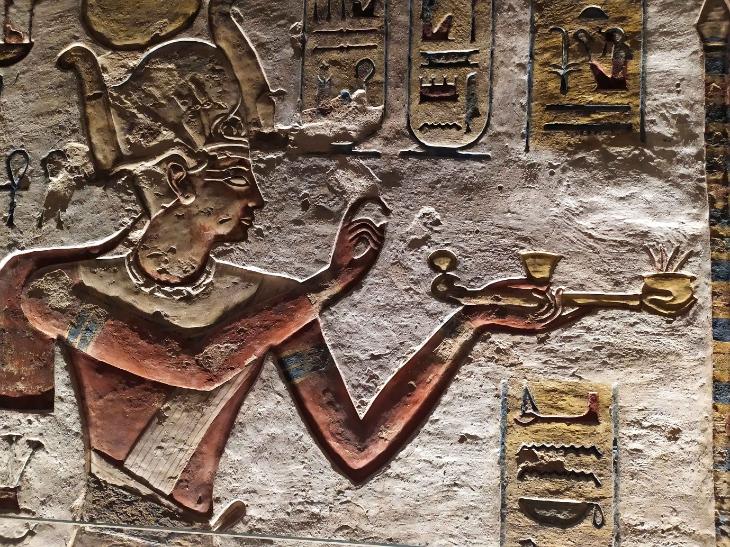 A pharaoh making an offering to the gods, a painted relief in Tomb KV11. The pharaoh alone could approach the divine — mediator between heaven and earth. Valley of the Kings, Egypt.
At the Kiddush, the blessing over wine that opens the seder, Jews recite words declaring that God chose us from among all peoples. Rabbi Berman places alongside it an ancient Egyptian carving of the God Ptah and Pharaoh Senusret I, carved in identical proportions, face to face, locked in intimate embrace. This image, or variations of it, appeared in Egyptian temples and monuments for three thousand years. It was the theology of chosenness made physical: one man, the king, elevated by the gods above all others, his authority rooted in the structure of the cosmos itself. The Kiddush does not choose a king. It chooses an entire people, equally, as partners in a covenant.
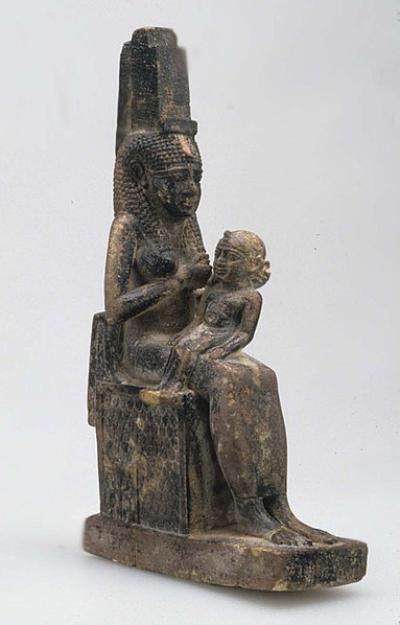 Isis nursing the infant Horus, a bronze statuette found across Egypt for three thousand years. Divine favor flowed through a single bloodline — God to king to dynasty. Walters Art Museum, Baltimore. Public domain.
Divine favor, in Egypt, passed through divine blood, from God to king to dynasty, and nowhere else. The sacred flowed downward through a single family to a single ruler. The Kiddush says something Egypt considered literally impossible: that God chose not a king, but an entire people, all of them equally.
In the retelling of the Exodus, when the Haggadah reads the verse that Egypt embittered our ancestors' lives with clay and with bricks, Rabbi Berman places a painting from the Tomb of Rekhmire, dated to the period of Israel's presence in Egypt: workers making mudbricks, a taskmaster standing over them, a slave bent beneath a yoke. The painting is three thousand years old. The words have been said at every Passover table for three thousand years. They belong on the same page, and Rabbi Berman puts them there.
At the maror, the bitter herbs Jews eat to recall the bitterness of slavery, Rabbi Berman stops at the haroset, the sweet paste that accompanies it. Every Passover, haroset contains something resembling straw. Almost nobody knows why. Rabbi Berman shows you. It connects to a specific moment in Exodus, chapter 5: Pharaoh's deliberate withholding of straw from the Israelite slaves. They had been making bricks with straw provided by Egypt. Pharaoh stops providing it but does not reduce the quota. The slaves must now scatter across Egypt to gather their own straw while still meeting the same daily brick count. It was not mere cruelty. It was a calculated political tactic designed to fracture their leadership, scatter their resistance, and turn them against one another. Your family has eaten haroset at every Passover. You did not know the straw in it was a memory of that specific act.
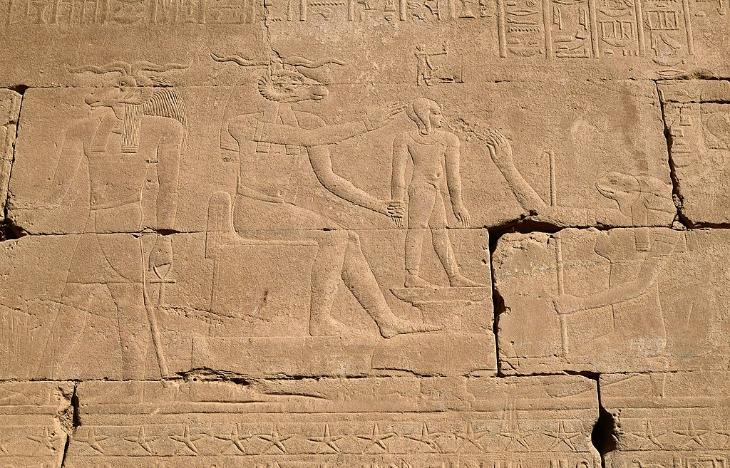 The God Khnum at his potter's wheel, fashioning a human being. In Egyptian belief, people were made for one purpose: to serve. Temple of Khnum, Esna, Egypt. Public domain.
Egypt said you were made to serve. You were clay on Khnum's potter's wheel, shaped for labor, created to sustain the people above you. The Torah said something different: every human being, not just the king, carries the image of God. That argument is three thousand years old. Your seder is still making it.
The seder ends with Hallel, songs of praise. At the verse declaring it is not the dead who praise God, Egypt's answer stares back: an entire civilization built around the theology of death, around the premise that kings passed through it and emerged still sovereign.
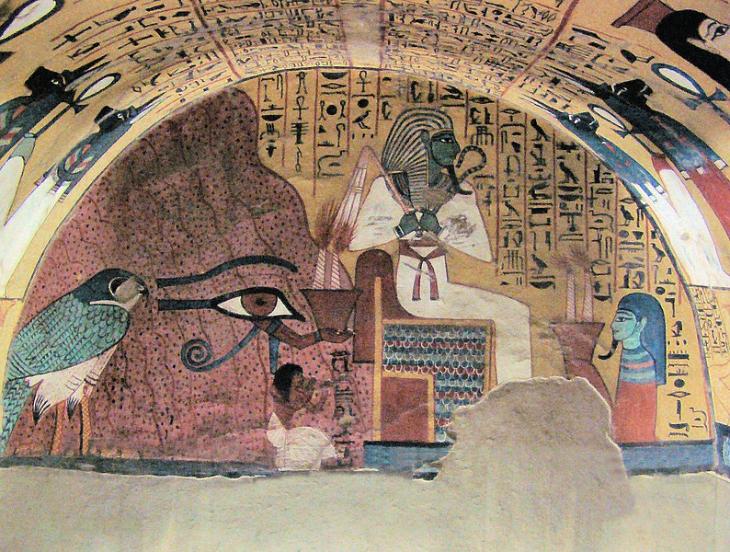 The Tomb of Pashedu, Valley of the Workers, Luxor. Egypt devoted its greatest art to the afterlife — and reserved its promises for the king. Tomb of Pashedu (TT3), Deir el-Medina, Egypt. Public domain.
Egypt's greatest achievements were its tombs. Death belonged to Pharaoh. He alone furnished the passage; he alone survived it as king. The Hallel says something else: the dead do not praise God. The living do. And every human being is alive enough to praise.
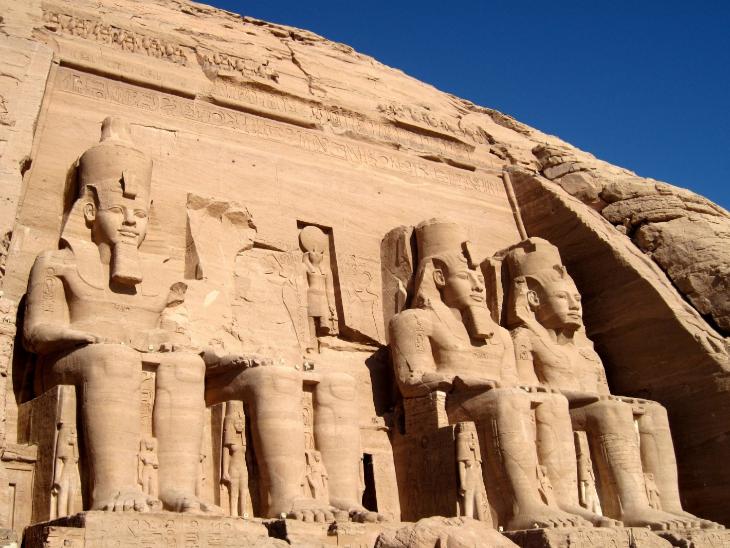 The Great Temple of Ramesses the Great at Abu Simbel, 13th century BCE. Four statues of the pharaoh, each over sixty feet tall, cut into the cliff face to last forever. Abu Simbel, Egypt. Public domain.
Four colossal statues of Ramesses the Great, each over sixty feet tall, cut directly into the cliff face at Abu Simbel. This is what empire looks like when it believes it is eternal. Our ancestors walked away from it. The seder is the story of why.
Rabbi Berman is careful to distinguish between showing that Egypt and the Torah share a symbolic world, which is well established, and claiming the Torah's author consciously borrowed specific Egyptian texts. Some sections of the book press further than the evidence strictly supports, and he says so. But the argument does not need every individual claim to hold. The Jewish people came out of a civilization that made specific claims about God, power, and human worth. The Torah answered those claims in their own language. That is what the seder has been saying every year. This book is the first time most of us will actually hear it.
At the center of the Passover seder is a single instruction: in every generation, each person is obligated to see themselves as if they personally left Egypt. Not their ancestors. Them.
 That is not easy to do when Egypt is just a word. It is easier when you have seen the stone in Cairo, or read the book written by the man who did.
When you lift the cup at the Kiddush, you will know what the blessing displaced. When you eat the bitter herbs, you will know what the straw remembers. When the seder ends with songs of praise, you will know exactly what your ancestors were singing against.
Echoes of Egypt: A Haggadah by Rabbi Dr. Joshua Berman is published by Koren Publishers Jerusalem.









Why don't they translate it in English and other languages word for word ? Instead of the way they wrote it ?
I wish this piece had appeared in my email links a few weeks ago. Koren Press in Jerusalem is out of stock and the one place I found from which I could order it says it will take 7-14 business days to receive it. 🙁 Maybe I will get it for next year
It's a great article but why it's not written like an article why do I have to keep on scrolling?.
The image of the Great Temple of Ramesses the Great at Abu Simbel, 13th century BCE. Four statues of the pharaoh, each over sixty feet tall, cut into the cliff face to last forever. Abu Simbel, Egypt. Public domain.
The second statue seems faded, not like the rest??
The ingrédients of charoseth are walnuts, dates, apples, and wine. Which of those is supposed to represent straw? And doesn’t the charoseth represent the mortar, not the bricks?
The charoset you describe is just the Ashkenazi version - usually without the dates. I grew up with charoset made with apples, walnuts, cinnamon, wine and sometimes a bit of sugar. Jews all over the world have different versions of the dish. Some are especially sticky - containing dates, bananas, figs, etc. The sticky types are often shaped into balls. The irony is that most are sweet unlike the labor they are supposed to remind us of.
Pity that I cannot show this to my husband z"l, who came from Egypt.