







 The Red Cross’s Jewish Problem





Blood libels throughout history follow the same script that was first written in 1149. The story behind it — corrupt bishop, murdered banker, monk who rewrote history — is stranger than fiction.
They claim that Israel harvests organs. Or that Israeli soldiers rape prisoners. Or that Israeli forces deliberately target children. These accusations follow a playbook of the first blood libel in history, written in Norwich, England, in 1149.
It started with a murder. The accused, Sir Simon de Novers, did not deny arranging the killing of Eleazar, a wealthy Jewish banker from whom he had borrowed a significant sum. Simon may have even boasted about it to friends, which is how the matter came to light when Eleazar's body was found in the woods outside Norwich.
The year was 1149, and English nobility was just recovering from the disastrous Second Crusade. Likely, Sir Simon was one of the English knights who participated in the crusade along with French and German armies and experienced a crushing defeat. In addition to the humiliation, the defeat entailed a major financial loss. Purchasing weapons, armor, and horses was a costly endeavor. Many knights had borrowed money before embarking on the crusade, hoping to repay their debts with the spoils they would bring back. Instead, their debts only grew and their future looked grim.
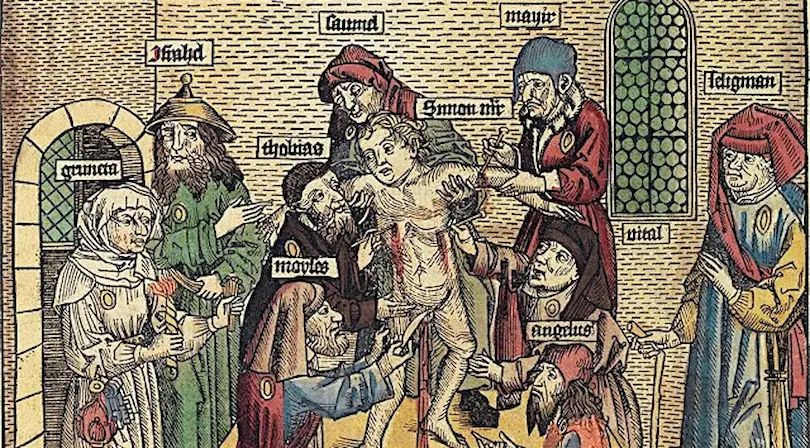
Antisemitism was on the rise due to the religious incitement from the church that had originally inspired the Second Crusade. Though officially protected by the king, Jews were frequently subjected to violent attacks. Contemporary chronicles describe many antisemitic incidents throughout Europe. Simon had good reason to believe that his crime would go unnoticed among them.
Perhaps Simon felt that he had nothing to lose and much to gain from his murderous act. In addition, his family had strong ties with the local bishop, William Turbe, and he counted on the bishop and his monks to come to his defense in a time of need.
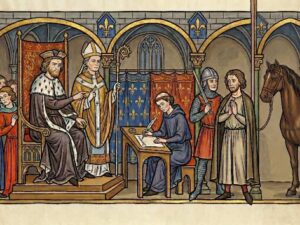
When the Jews of Norwich appealed directly to King Stephen for justice, Bishop Turbe did not let Simon down. At the trial, in front of the king and other nobles, the bishop delivered a powerful statement that turned the case around. Rather than defend the accused Simon, Turbe accused Eleazar, the victim of the murder, of another crime. He claimed that Eleazar was responsible for the murder of 12-year-old William, a Christian leatherworker apprentice, who had been found dead in the woods near Norwich five years prior to Simon’s trial.
Rather than defend the accused Simon, the bishop accused Eleazar, the murdered victim, of another crime – the murder of 12-year-old William, a Christian leatherworker apprentice.
Convinced by Turbe’s eloquent speech, King Stephen agreed to postpone the trial to collect more evidence. The trial resumed some time later in London, at the next council of clergy and barons.
Until Simon’s trial, no one expressed much interest in young William’s death. At the time, England was in the midst of a civil war, and discoveries of corpses with signs of violent death were not uncommon. No official investigation was ever conducted and no guilty party named. William’s life and death had been largely forgotten until the bishop and his monks thought of a way to make good use of William’s story.
Among the monks in the Norwich cathedral priory was Thomas of Monmouth, a recent arrival to Norwich. He had not been present in Norwich in 1144, at the time of William’s death. However, he was a talented mystery writer. Thomas presented himself as an amateur detective collecting evidence about William’s murder. Altogether, he wrote seven volumes over the course of 20 years, entitled The Life and Passion of William of Norwich.
Thomas of Monmouth wasn't there when William died. He arrived years later, picked up a pen, and spent two decades building a lie that would outlast empires.
Thomas completed the first volume in 1150, conveniently close to the time of Simon’s trial. The first volume briefly describes William’s life and then focuses on the alleged sequence of events in the days prior to his death. Thomas dramatically depicts how William was lured into a Jewish home, where he was cruelly tortured and then crucified, in a mockery of Christianity.
At the time, many readers apparently expressed doubts about Thomas’ version of events, which explains why the second volume begins with a passionate argument bringing “evidence” in support of the first volume.
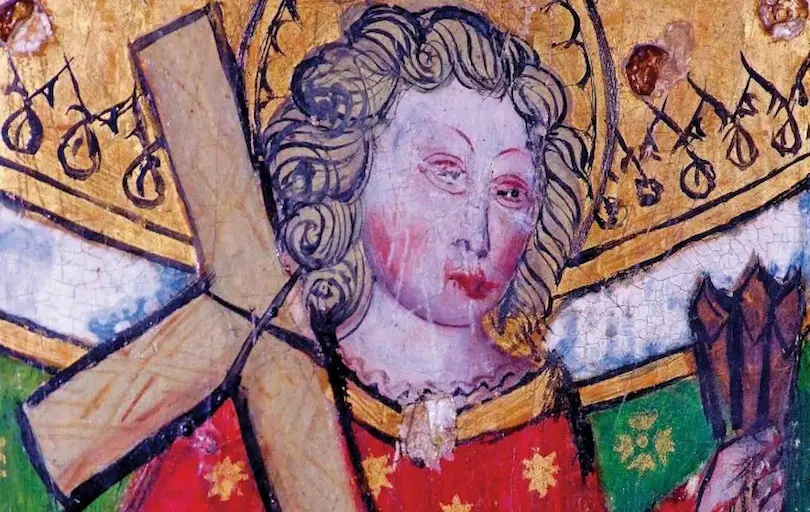
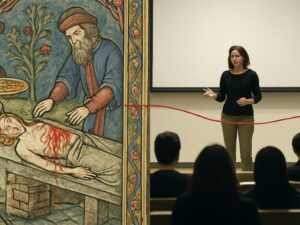
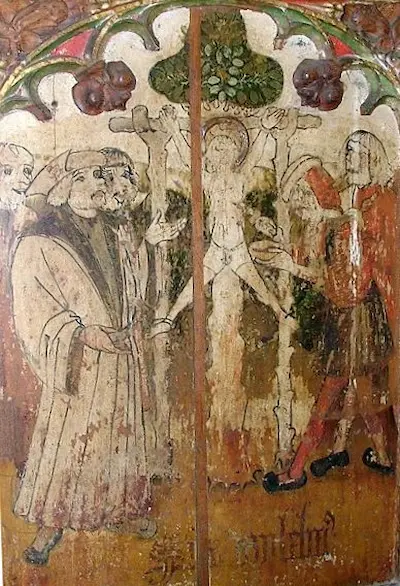 15th-century painting of St. William of Norwich.
Thomas’ supposed eyewitnesses were either dead or unavailable by the time of his writing, making it difficult to disprove their statements. In addition, Bishop Turbe and his subordinates were heavily involved in collecting this evidence.
Thomas also described three visions he experienced in 1150, where the founder of the cathedral, also long dead, supposedly instructed Thomas to move William’s body into a more sacred place, the chapter house. Such action would confirm William’s status as a martyr, murdered for his faith, thus collaborating Thomas’s version of events.
Thomas and five other monks performed the “translation” – moving William’s body to a more sacred place. The rest of Thomas’ books describe various miracles associated with William’s tomb and several more translations in the following years.
At the trial of Sir Simon, the unexpected accusation of the victim completely changed the course of the proceedings. Historian E. M. Rose wrote1:
Bishop William’s counterattack was stunning in its effect… Turbe offered a masterful defense, dramatic and enthralling, emotionally satisfying, logically consistent, and theologically acceptable, if not entirely persuasive… Turbe was not laying out a legal brief for William’s murder, merely demanding the postponement of the trial of Simon de Novers. He raised a procedural issue, one that was sure to gain sympathy with his audience.
The bishop’s strategy produced a judicial stalemate… Simon’s trial for murder was adjourned sine die, and the knight was free to go.
No further legal proceedings were undertaken either against Simon or against the Jews of Norwich. Simon continued to live in Norwich for at least the next two decades. Though no one was ever punished for the murder of Eleazar, the rest of the Jewish community of Norwich remained unmolested.
But the reverberations of the blood libel would cause much damage to Jews throughout Europe decades later.
Once Bishop Turbe and his monks had elevated William to the status of a martyr, they continued to make good use of his remains and relics. The stories of miraculous salvation occurring to those who had come to pay their respects to William’s grave, which Thomas continued to write, drew more visitors, and more money, to the Norwich Cathedral.
The Norwich Cathedral was a relatively new addition to the area, built after the Norman Conquest. Other English cities and their religious institutions had saints associated with them buried on their property. Norwich had none until 1150, when the monks invested much effort into turning William into a saint and publicizing the story of his martyrdom.
E. M. Rose explains2:
The possession of a body… was the basis of institutional patronage and a primary source of significant social power in this period. A divine patron could defend property, encourage bequests and donations, draw attention to the community’s strengths, and serve as a figurehead for a building campaign that in turn could spur other kinds of developments, both religious and commercial. A suitable saint could also lay the groundwork for civic and religious independence.
It was in Norwich monks’ best interests to spread the story. Along the way, the story acquired more gruesome details. E. M. Rose writes3:
The first ritual murder accusation therefore was a literary creation, a story composed years after the alleged events…
In the description of William’s martyrdom… we find the seeds of the plot outline that would become standardized in the later Middle Ages.
The plot invented in Norwich would later be used by powerful people to achieve their political or financial goals.
In 1171, over thirty Jews were accused of ritual murder and burned at the stake in Blois, France. Blood libels also surfaced in Gloucester, England, Bury, England, and Paris, France.
Accusations of ritual murder committed by Jews only grew, eventually culminating in the expulsions of Jews from both England and France.
In the subsequent centuries, accusations of ritual murder committed by Jews only grew, eventually culminating in the expulsions of Jews from both England and France. Many Jews lost their lives as shrewd politicians manipulated the blood libel narrative for their own personal gain.
Historian Gavin I. Langmuir summarizes the impact of Thomas’ book about William of Norwich4:
Thomas of Monmouth was an influential figure in the formation of Western culture. He did not alter the course of battles, politics, or the economy. He solved no philosophical or theological problems. He was not even noteworthy for the holiness of his life or promotion to monastic office. Yet… he created a myth that affected Western mentality from the twelfth to the twentieth century and caused, directly or indirectly, far more deaths than William's murderer could ever have dreamt of committing.
The blood libel didn't die in the Middle Ages; it mutated, like the recent New York Times column by Nicholas Kristof claiming that Israeli prison guards train dogs to rape prisoners. The column relied heavily on sources with alleged ties to Hamas. The Foreign Ministry called it "one of the worst blood libels ever to appear in the modern press."
The structure is similar to Norwich in 1149: A lurid accusation, credulous amplification by a powerful institution with something to gain, sources that can't be properly challenged, and a story that spreads faster than any correction ever will.
Thomas of Monmouth needed 20 years and seven volumes. Today, a false accusation and its consequences are global before the first fact-checker wakes up. The mechanism is the same, the difference is the speed at which a story becomes history.







I read that Moses Montifore and a president of the United States stopped a blood libel in I think Damascus, Syria I thought this primitive accusation went out in the middle ages, if people believe it these people are backwards and hateful individuals, it goes against the faith in Judaism where you are not allowed in any way have blood in the way we prepare food, and the non Jews have no such laws that Jews do which is ridiculous to me
If ignorant idiotic anti semites with know Judaism that would know that Jews are prohibited to use blood of any form, and with blood spots in eggs, boiling liver, and Koshering the meat with salt, covering the blood of the animal you slaughtered, besides there is a law do not give pain to any animal, so Jews are the most humane people in the world, it is the non Jews that eat blood not the Jews there are in the Torah ( Jewish bible) that it is absolutely forbidden to do it
The fact is that they don’t care what Jewish law permits, they’re only concerned with assuaging their guilt. They know exactly what they’re doing.
actually, the first blood libel was the 2,000 year old accusation that the Jews killed Jesus, when in fact it was the brutal Roman occupiers of Judea who did it, as described in detail in The New Testament..
A powerful and shameful story with its ramafications still on-going. Thanks for your recommendation of the book The Stones Speak. Just finished it and passed it on to a friend.
Very interesting article. Thank you.
Excellent; thank you for the factual, researched information that's so unlike the media garbage we're exposed to today.
(It's unsurprising that the first blood li(e)bel originated in the Unruly Kingdom.)
Krisof's blood libel in The New York Times
is just the latest in a long history of this
so-called paper of record printing "all the
news that's UNFIT to print." When this
paper ceases to exist, a new Jewish holiday
must be declared.
The New York Times is owned by the Ochs-Sulzbergers - a Jewish family.