






 In Poland, Even Winnie-the-Pooh Has a Holocaust Story





63 min view


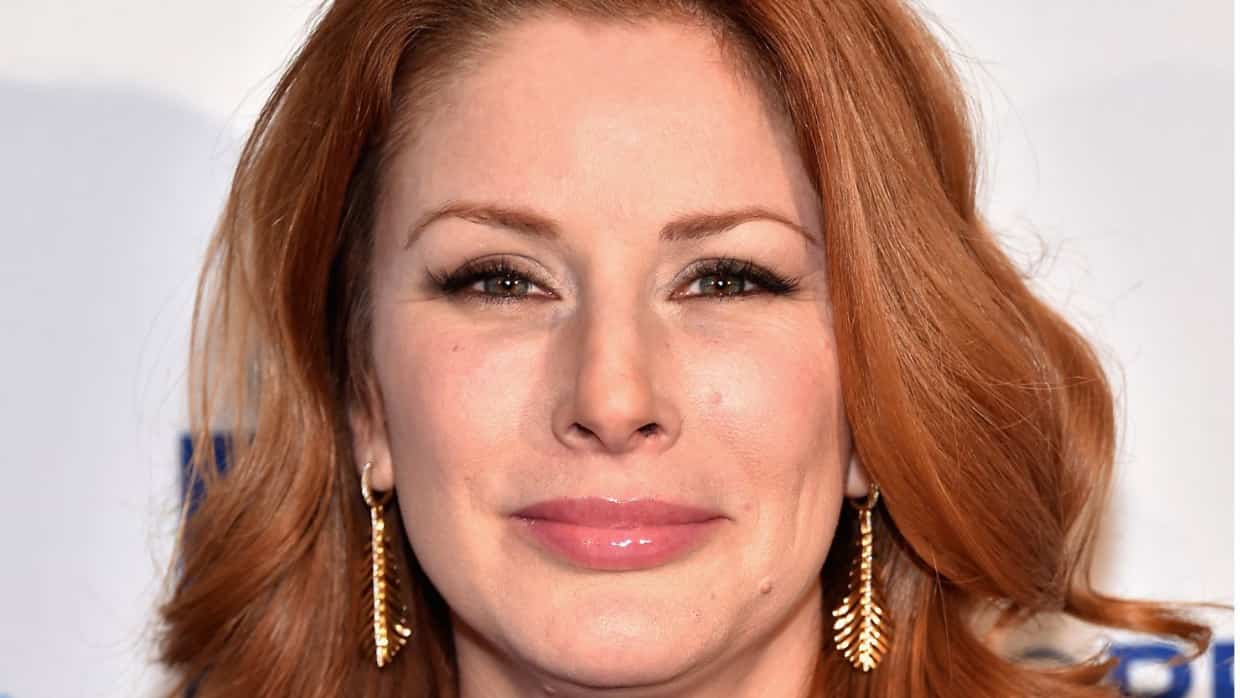
Diane Neal spent 25 years in Hollywood and has been through it all. October 7 didn't break her faith. It confirmed it..
You think you know Diane Neal. You've watched her for 25 years. She's Casey Novak, Assistant District Attorney on Law & Order: SVU. She's the sharp voice, the unflinching stare, the woman who walks into a courtroom and owns it.
You don't know her yet.
She was 16 when her older sister entered her in a modeling contest. A month later, she was living in Tokyo.
That's how fast it happened. A girl with zero interest in modeling, a girl who thought she'd have a couple of Nobel Prizes by now ("I still have time," she laughs), suddenly living all over the world, working for agencies like IMG alongside Tyra Banks and Nikki Taylor, doing commercials for AT&T and, in her words, "always maxi pads, because no one else would do it."
She doesn't say this with embarrassment. She says it like someone who figured out very early that money is just a tool, work is just work, and the only thing that actually matters is what you're building on the inside.
While other models were doing what models do, Diane was visiting every great museum she could find, every archaeological site, every library. She was reading. Studying. Saving money to pay for school.
"I got to see almost all the world's greatest museums," she tells me. "Everything that was of interest to me, I got to see. I got to read the books."
She went to David Mamet's Atlantic Theater on a whim, started helping friends with their film school projects, and stumbled into acting the same way she stumbled into modeling: completely by accident, with absolutely no pressure on herself. While everyone around her was clenching with ambition, she was laughing.
That lightness, it turns out, was the secret.
Before anyone was offering her anything, Diane made a decision: no nudity, no sex scenes, no compromises.
"If you make the decision before you ever have to make the choice," she says, "it's super easy."
And it didn't cost her. She worked on Law & Order: SVU for years. She worked on NCIS, on 24, on show after show. She turned down projects worth tens of millions of dollars. Agents dropped her. Studios tried to talk her out of it. And she just kept working.
"I've been on TV for 25 years, playing great roles, and I never had to compromise my morals. All these people say you have to do it. You don't. You really don't."
When I ask about Robin Williams, something shifts in her.
She met him through Richard Belzer, who played Munch on the show. Robin was Belzer's best friend, and Diane and Robin just clicked. She tells me she actually didn't love most of his movies. Patch Adams drove her nuts. Jumanji was not for her. But when she met him in person, she was completely gone on him.
"We could just sit around and laugh. He was exactly himself."
He knew everyone's name. He'd ask about your life and remember the details for years. He was always the first one on set, last to leave. When he met your kids, he wanted to know everything about them, and he still knew it a decade later. Anyone who was struggling, he brought along with him.
"We're all still friends," she says. "His makeup artist, his assistant. We all still talk."
When he died, Diane knew things the public didn't. She knew how sick he really was. She saw him through it with clear eyes and real grief, and she talks about it without melodrama, which somehow makes it land harder.
"The smarter and more creative you are, the higher your highs," she says. "But that also means you see every possibility on the downside."
She goes on to explain threshold theory, the neuroscience of creativity, the specific kind of intelligence that lets you hold contradictory ideas at once: that light is both a particle and a wave. That the same mind that sees wonder everywhere also sees everything that can go wrong.
There was a version of Diane Neal's life that looked, from the outside, like everything.
Twenty-five years on television. Real money and fame. A face on screens around the world.
And then it got ripped away. Not all at once, but in waves. A marriage that burned down ugly. A car accident. A fractured back. Cancer. A congressional run that ended in a public loss. Financial collapse so complete that she literally didn't know where her next meal was coming from.
"I was really good at being rich," she tells me. "I feel like I was born for it. I gave a lot away. I lived within my means."
But here's the thing about Diane. Even at rock bottom, she doesn't frame it as a tragedy. She frames it as a chapter.
Long before October 7, Diane had been feeling it, that pull toward something more real, more rooted, more her. She had grown up Jewish, always curious, always drawn to history and ancient texts and the archaeology of things that lasted. The career, the fame, the money, all of it had been interesting. None of it had been enough.
So she sold some of her grandmother's silver to afford the flight. Silver that had survived the Holocaust. She tells me this without self-pity, and then she says something that stops me cold: she could feel her grandmother telling her this is what it was for. It was placed there, earlier in the story, for exactly this moment.
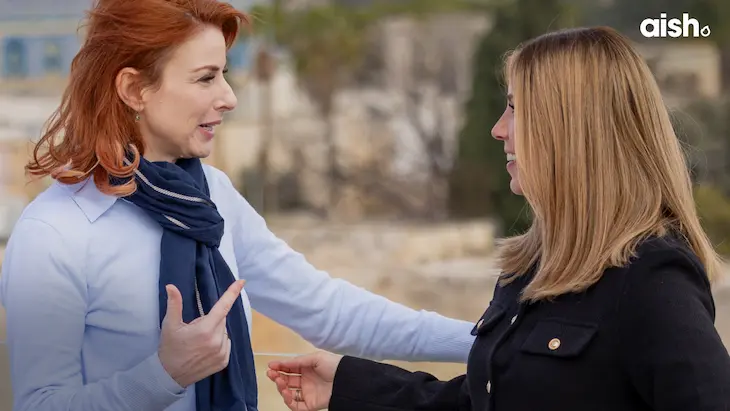
She made aliyah and feels at home in Israel. She's deepening her Jewish commitment, becoming more observant year by year, almost surprised by it herself.
And then October 7 happened.
What was already a personal spiritual journey became something urgent and clarifying. Diane had already seen antisemitism up close, had already felt the temperature rising in America in ways that reminded her of things she'd studied. After October 7, she stopped wondering if she'd made the right call leaving.
"I think it's Poland in 1939 out there," she says, and she does not say it for shock value. She says it because she believes it, because she's experienced what she calls near-antisemitic violence firsthand, in ways she's still processing.
"We have this land for a reason. I think we're all supposed to be here. We need to set up the infrastructure so that when people come, the way they came in 1948, we've got the jobs, the money, the farms, the places. Everyone come."
That's how Diane Neal reads her own life. Not as a series of losses and recoveries but as a story that's still being written, one that is, she is certain, worth sticking around for.
She was mopping up floodwater in her apartment, three inches of it across the floor, every makeup brush soaked, no towels, borrowing one from a neighbor, and she was having a pity party about it, she says, laughing. And then a neighbor, a non-Jewish American diplomat who lives nearby, showed up at her door with a plate of food.
"She just had a feeling," Diane says. "She showed up. Her 15-year-old son helped me clean up."
Just like that, the pity party was over.
"Every time I don't know how I'm going to pay the bank, every time I don't know where the next meal is coming from, I think: just hang on. It's worth hanging around to see how the story ends. Don't try to predict. God always comes through."
She got that line from Maimonides, the great 12th century rabbi and philosopher, who said simply: life is worth living just to see how it unfolds.
Diane lives by it. After everything, after the big life and the hard fall, after Hollywood and heartbreak, after loss and starting over, she's here, still laughing, still in motion.
Watch the full conversation with Diane Neal on No Reservations.












🩷🩷🩷🩷🩷
What an awesome podcast! Thanks for bringing me into your perspective. And that goes for both of you!
Thank you for sharing her story!
Wow! I loved reading about Diane Neal's friendship with Robin Williams. Her focus and level headedness gives me Chuzzuk!
Life is really quite grand when G-D - puts out HIS protective hand - where you stand - & shows you in life where to take a stand - & not listen to the music of the latest hot culture band - trying to sink you into the quagmire - & allure of life's immoral quicksand. He also gave you the wisdom & strength to handle & tame the alluring fame. May it continue to follow you - in everything you do.