




 The Laundromat and the Drunk Antisemite




4 min read


“Red Haggadahs” were published in the 1920s with the explicit goal of replacing belief in God with faith in Communist Russia.
One of the most unusual episodes in the long history of anti-Semitic persecution is the Soviet anti-Jewish campaign of the 1920s. Utilizing formerly Jewish converts to the new secular messianism known as Communism, under the leadership of a former Rabbi, Shimon Dimanshteyn, the Soviets embarked on a bizarre yet creative program of anti-Jewish propaganda.
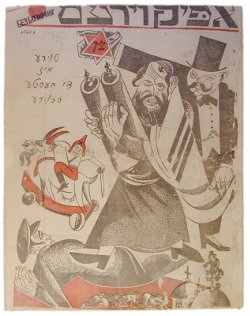 Cover of the fall edition of Der Apikoyres, Kiev 1923
Some of this was expressed in traditional media, such as the Jewish version of the Russian-language magazine Bezbozhnik (literally, “The Godless”), published in Yiddish under the appropriately Talmudic title Der Apikoyres (“The Heretic”). Communist youth were enlisted to organize lavishly catered Yom Kippur dances and stage anti-Jewish plays. Recognizing the powerful hold that religion had on Soviet Jews, the Jewish Section of the Communist Party (Yevsektsiia) also attempted to co-opt the population by capturing and transforming Jewish traditions and texts, including the Passover Haggadah. Called “Red Haggadahs,” several were published in the 1920s with the explicit goal of replacing belief in God with faith in the Soviet Union, and they have been the subject of recently published studies by Dr. Anna Shternsis of the University of Toronto.
“This year, we have revolution in this land – next year we will have a world revolution!”
The traditional text, read at Seder tables for generation after generation, reads “We were slaves to Pharaoh in Egypt, but Hashem our God took us out with a strong hand and an outstretched arm. If the Holy One, Blessed be He, did not take our ancestors out of Egypt, then we, our children, and our children’s children would remain slaves to Pharaoh in Egypt.”
 Cover illustration of a Red Haggadah by Alexander Tyshler, Moscow 1927
The officially atheistic Soviet Union could not tolerate such a passage, so the text of a Red Haggadah read instead: “We were slaves to capitalism until October (Soviet shorthand for the Communist Revolution of 1917) led us out of the land of exploitation with a strong hand. Were it not for October, we and our children would still be slaves.” Instead of God’s destruction of Egyptian army, the Soviet Haggadah describes success of the Red Army; instead of washing hands for ritual purity, the Communist text eliminates “rabbinical laws and customs, Yeshivot and schools that becloud and enslave the people.”
At the Seder's conclusion, Jews famously proclaim “This year we are here – next year in Jerusalem!” Following the Red Haggadah, participants at the Seder are urged to pronounce, “This year, we have revolution in this land – next year we will have a world revolution!”
By 1930, the notoriously antisemitic Soviet leader Joseph Stalin lost patience with the quixotic and typically unsuccessful propaganda efforts of the Yevsektsiia. Under his influence, the attacks on Jews and Judaism grew far more vicious and deadly, and celebrating even Sovietized Passover Seders became dangerous, entering a phase of persecution that is unfortunately familiar to students of Jewish history.
The Communist Youth movement organized distribution of forbidden hametz on the first day of Passover.
The Red Haggadahs of the 1920s, however, testify to an unusual period when overt government discrimination was milder. In her research Dr. Shternsis transcribed the childhood memories of Samuil Gil, who recalled how the Komsomol (Communist Youth) movement organized distribution of forbidden hametz on the first day of Passover: “We were given the task of going to Jewish homes and throwing a piece [of bread] into the window of ten different houses. The one who was fastest would receive a prize. We enjoyed the game very much, especially when the old, angry women ran out of their houses and ran after us screaming ‘apikorsim![heretics]' We felt like heroes of the Revolution and were very proud. In the evening, though, we would all go home and celebrate the traditional Seder with all the necessary rituals.”
Gil’s experience, specific to the unusual conditions of 1920s Ukraine, is also illustrative of the eternal pattern of Jewish history: “In every generation, someone rises to destroy us – but the Holy One rescues us from their hands.” Just as this truism is affirmed, so too may the conclusion of the Haggadah become our collective reality – next year in Jerusalem!













This is one sidedly against the late and unlamented USSR. It misses that the Yevsekstia rode an existing sentiment because in New York equally discontented young Jews organised Yom Kippur balls and banquets.
Zionism took the view that we have to go home to sort ourselves out and talking about next year is NOT enough. A good reason why enough 20th century olim had little patience with formal religon when there was work to do and no goyim doing it to buy from.
History is the Rabbinate could NOT cope with disruptions by industrialisation, migration and urbanisation - still can not - besides education for all. Israelis are settling into an easy going traditon with modernity and in Daispora self education like Limmud is by passing a diet of solely prayer & ritual.
It looks like in communist Russia it looks like they needed freedom the most, so in reality most Jews ended up trying to leave Russia, and escape Communism and some found Judaism in secret, if they were caught they vpcould up in Sibera, but Jews eventually tried to escape Russia Communism for instance a lot of Rabbis and students fought to free Soviet Jews from Russian Communism
Throwing bread into Jewish houses might make the inhabitants angry but Halachically it makes no difference at all: in the first place, the bread was not purchased and is not owned by the people living there; in the second the recitation of Kol Hamira designates all hametz as “garbage” - which I’m sure is how the thrown bread was treated.
Many years ago - we were told a story - of how the communist leaders repeatedly - came to classrooms - and had the children - pray to g-d - for candy etc.. Which the children didn't get. Then - they came to the classrooms and told the children - ask the state for candy. Which was promptly provided. This deviousness - is still being used - by them - and now other regimes. It's been upgraded with the new "AI" technology - and a laundry list of other misinformation propaganda.
The Lubavitcher Rebbe's father was chief rabbi of Yekatrinislav (Dnipro), Ukraine.
He was the rabbi who certified the only matza factory in the Soviet Union.
The communists wanted him to allow halachically questionable practices in 5he production.
Despite threats he refused and the matza was produced according to Halacha.
He was imprisoned and then exiled as a punishment. He never returned as he died in exile.
How sad to hear this