
 I Will Not Apologize for Living

5 min read
9 min read
6 min read





A new ADL report finds Jewish and Israeli artists are being pushed out of America's museums, publishing houses and performance venues.
Authors pressured to strip Hebrew words, Israeli settings, and even Jewish-sounding names from their manuscripts. A viral spreadsheet sorting writers by perceived politics and urging readers not to buy their books. Major museums celebrating nearly every heritage month except one, Jewish American Heritage Month. Jewish, Israeli and openly Zionist artists face growing scrutiny, protest, disruption and cancellation across live music, comedy, dance, film and campus programming.
These are among the findings of State of the Arts: Advancing Jewish Inclusion in Arts, Entertainment and Culture, a first-of-its-kind body of research and digital platform recently launched by the ADL (the Anti-Defamation League). It documents the systemic exclusion and marginalization of Jewish and Israeli artists across American cultural life.
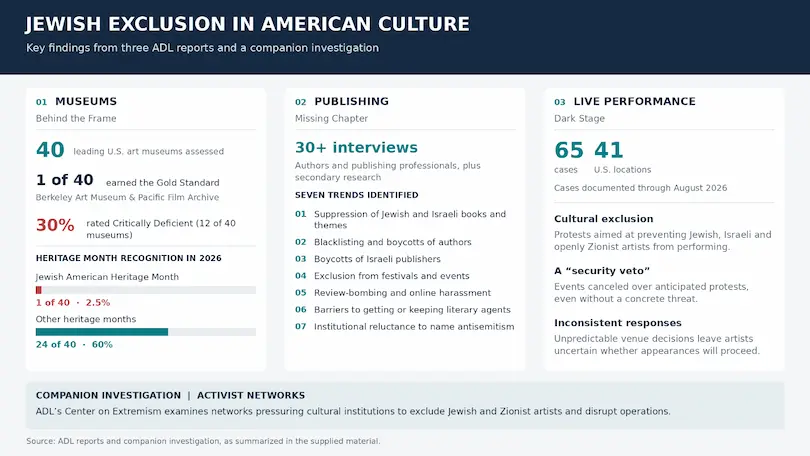
The museum numbers are stark. Of 40 leading U.S. art museums assessed, only one recognized Jewish American Heritage Month in 2026, while 24 of them (60 percent) actively recognized other heritage months during the same period. Only six (15 percent) had marked Jewish American Heritage Month before October 7, 2023, the day of Hamas' attack on Israel. Five of those six have since stopped entirely, and the remaining one has never offered dedicated programming.
The initiative, from the ADL's Ratings and Assessments Institute (RAI), takes a comprehensive look at three major cultural sectors (museums, live entertainment, and publishing), alongside a companion investigation from the ADL Center on Extremism into the activist networks driving this exclusion.
"Jewish and Israeli artists and creatives have been quietly, and in some cases loudly, pushed to the margins of cultural institutions and spaces, with no tracking or accountability in place," Luda Isakharov, ADL's associate regional director, told Aish.com.
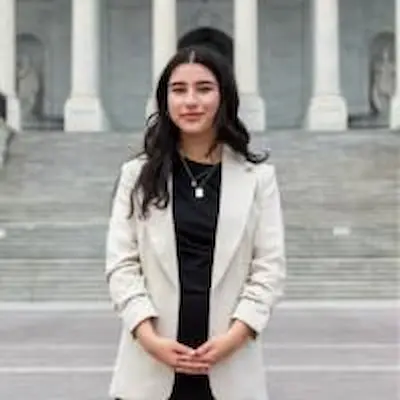 Luda Isakharov
"Many of them never reported what happened to them," said Isakharov. "They had nowhere to turn, no resources, or were afraid to speak out. We decided to use our model of consistent evaluation based on expert-informed metrics to bring the issue to the surface, and to use ADL's advocacy base, Legal Action Network, and incident response channels to address this issue head on."
Community members brought this issue to the ADL "again and again" over time, Isakharov said.
"Our team felt best equipped to take it on in a meaningful way. What has been really amazing as the lead on this project is spending dozens of hours meeting with artists and institutions, and taking their feedback to create something that captures, to the best of our ability, what they're experiencing, and in a way validates it and helps artists reclaim their voice. That part of the work is deeply human and depends on genuine connection."
What makes antisemitism in the arts so insidious is that so much of it happens below the surface, Isakharov said.
“We heard countless stories from artists and people in the field, but finding a way to accurately measure it was a real challenge. We had to get creative and think outside the box. We also wanted to approach the field with real sensitivity. Funding for the arts has shrunk over the past few decades, and many of these institutions are stretched thin, so we worked hard to make this constructive and to give them real tools to improve. But hearing artists thank us for this work, for putting words to and shining a light on what they've been going through for years, made all the effort worth it."
Along with her team, the study drew on outside research assistants, consultants from the art world, nearly 20 expert panelists, and dozens of affected artists across different mediums who previewed the work and gave feedback.
"Within ADL, this was a cross-functional effort that brought together our 23 regional offices in the US, who are ready to build relationships with museums and support venues as they deal with antisemitism, as well as our Legal Action Network, Incident Response team, and many others," Isakharov noted.
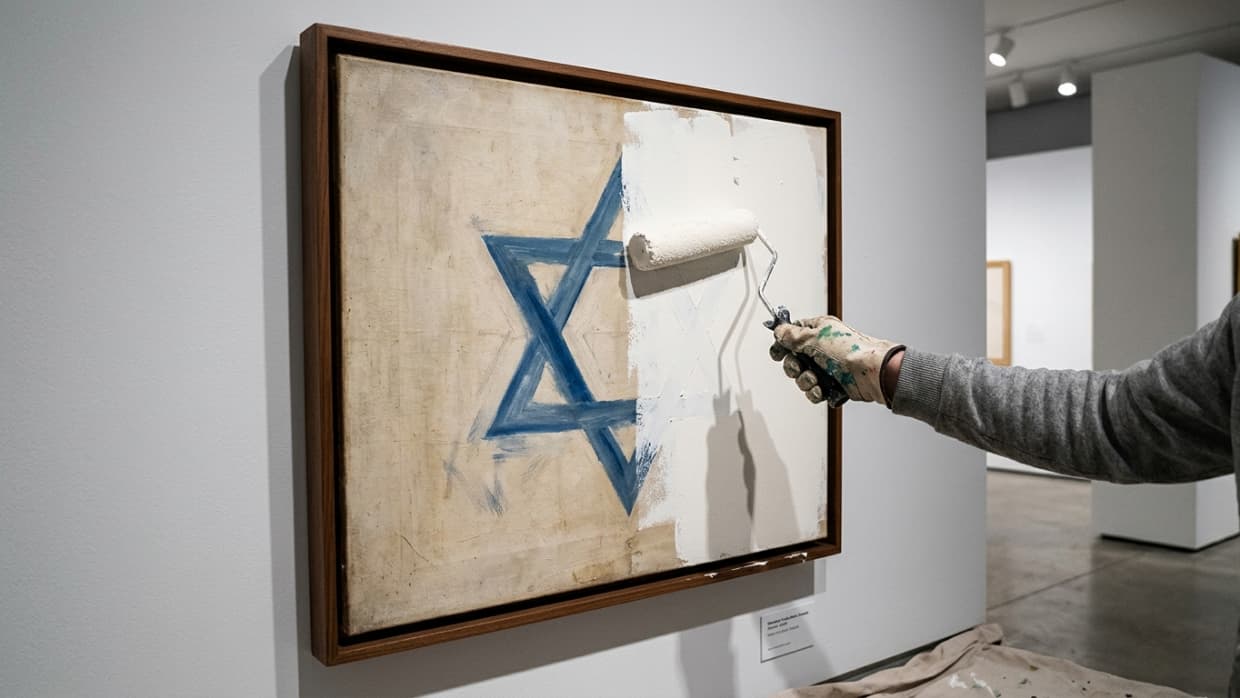
For "Behind the Frame: A Quiet, Systemic Erasure in America's Museums," the ADL conducted the first-ever systematic evaluation of antisemitism and Jewish representation across 40 leading U.S. art museums.
"We followed our large-scale evaluation model, which has been a successful driver of change in other sectors,” said Isakharov. “We graded 40 museums on the same 10 criteria, using the same standards, to create a holistic picture of each institution. We provided every museum the opportunity to engage with us through a survey covering all the metrics in April, and again through our data verification process in August and early September."
Over half of the museums engaged with the ADL at some point in the process. "We hope to engage even more as we roll this out. The grades create an incentive for museums to do better, and our best practice guide gives them a roadmap for how to get there."
Since October 7, books with Jewish, Israeli or Zionist characters are being shut down before they reach print, and their authors are facing blacklists and boycotts.
"Missing Chapter: Suppression of Jewish Voices in Publishing” identifies several anti-Jewish trends reshaping the industry since October 7: books with Jewish, Israeli or Zionist characters and themes shut down at the acquisition stage, along with blacklisting and boycotts of Jewish, Israeli and Zionist authors.
"For the literary world, we took a completely different approach," said Isakharov. "Data is much less available, and so much of what happens takes place behind the scenes, so we interviewed more than 30 authors and several agents."
As the interviews went on, the same trends kept surfacing.
"Many authors thought what happened to them was a one-off. Putting it all together showed us this is a pattern that can no longer be ignored and urgently needs to be addressed. Every trend in the report is backed by the story of a real Jewish author who lived it. The report is paired with guidance for readers, authors, and publishing houses, so it's just as constructive, and it's thoughtfully tailored to that world."
"If Jewish books never get published, they don't have to be banned," added Meg Keene, a publishing executive who served as a research partner on the report. "If books never appear in print, there is nothing to burn."
Keene is executive editor of Meg Keene Books, an imprint of Wicked Son distributed by Simon & Schuster, where she leads the acquisition and publication of contemporary Jewish fiction. She contributed extensively to Missing Chapter, the publishing portion of the project.
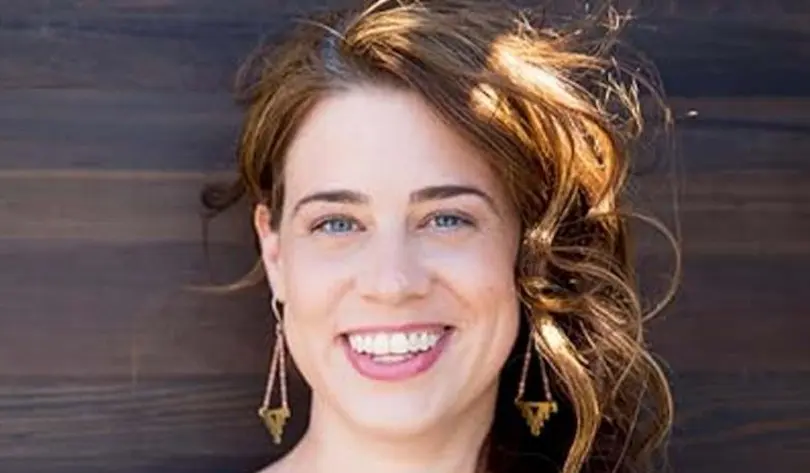 Meg Keene
"Since October 7th, it has been increasingly clear that Jewish artists across disciplines are experiencing exclusion that impacts their career trajectories and, in some cases, their ability to maintain employment," said Keene.
"The ADL's State of the Arts places individual experiences in a larger structural context. In the arts, a single lost opportunity can be dismissed as a matter of taste, but it's much harder to dismiss the same pattern appearing over and over again for Jewish artists across multiple industries."
Keene believes it is important to "pull back the curtain" on how discrimination works in publishing, since so much of the industry's gatekeeping happens privately.
"The gradual exclusion of Jews from public cultural life is bigger than the arts, because cultural life is one of the places where a pluralistic society explores what it believes and decides who belongs," she said. "We should all be concerned about where we are headed if this antisemitic exclusion is normalized."
Keene has felt the impact of antisemitism on her own career.
"It can be very difficult to identify any single professional setback as antisemitism, even when your experiences collectively begin to reveal a pattern of othering and exclusion. When an editor responds that, for some reason, they simply cannot relate emotionally to your Jewish characters, something feels off. When an agent tells you that it is good that your characters are not Zionists, even though those characters have family in Israel and speak Hebrew, it seems like a warning. When an agent says they can no longer champion you because your work is very good but editors do not want it, you understand that your public Zionism likely has a cost."
Keene described the “ambiguity” as what makes this kind of discrimination so destabilizing.
"It is easy to convince yourself that you are imagining a pattern, or that it is happening only to you. The importance of a report like ADL's State of the Arts is that it allows us to step back from individual incidents and see the collective pattern. The wider picture the report paints makes the problem impossible to deny."
For performing arts and entertainment, the ADL also produced a trend report on the exclusion of Jewish and Israeli artists and its consequences, along with a live, interactive tracker of problematic incidents at performance venues since October 7th.
This report and interactive case archive document 65 cases across 41 U.S. locations, the most recent from August 2026, showing how Jewish, Israeli and openly Zionist artists face growing scrutiny, protest, disruption and cancellation across live music, comedy, dance, film and campus programming.
One of the key trends they identified was protest activity, expanding from political advocacy into cultural exclusion, with campaigns increasingly aimed at preventing Jewish or Israeli artists from performing at all, as seen in repeated demonstrations against dozens of artists, like Matisyahu, the Batsheva Dance Company, and the Israel Philharmonic.
"On their own, each incident might not seem like much. Put together, they tell an entirely different story: a troubling pattern," Isakharov said.
"We also ran a public opinion survey of U.S. adults, and our colleagues at the ADL Center on Extremism put together a companion piece on the extremist activist groups targeting cultural institutions right now. All of this work builds on itself. Together, it draws a through-line of erasure and exclusion across the arts, one that isn't limited to a single space or corner."
Isakharov hopes people take away that "we need to be proactive" when they see these signs.
"What we see on museum walls and in their collections today reflects decisions made five to ten years ago. Since October 7th, we've tracked immense pressure on cultural spaces to exclude Jewish, Israeli and Zionist voices and push them to the margins. The work we do now to push these institutions to do the right thing will shape the culture, the media, the art, and the stories told to our children ten years from now. Jewish American artists helped shape American arts and culture in so many ways. We have to fight to keep our place, and we refuse to be erased."