







 The World Says You're a Jew. Now What?

7 min read
5 min read





Ad Reinhardt, Adolph Gottlieb, and Barnett Newman shaped Abstract Expressionism, bringing Jewish thinking to the biggest art movement of the 20th century.
In the mid-20th century, Jewish artists played a significant role in the rise of Abstract Expressionism, bringing unique perspectives to the New York School in ways that still resonate today. Three painters stand out: Ad Reinhardt, Adolph Gottlieb, and Barnett Newman.
The New York School refers to a loosely affiliated group of artists, poets, and thinkers who transformed American art in the mid-20th century. Emerging in the 1940s and 1950s, the New York School positioned New York City as the new center of the international art world, shifting influence away from Paris and redefining the direction of modern art. The New York School emphasized artistic freedom, intellectual rigor, and a deep engagement with contemporary history.
The New York School is famously associated with Abstract Expressionism, the first American art movement to gain international recognition. Abstract Expressionist artists rejected representational imagery in favor of large-scale abstraction, emphasizing gesture, color, and material presence. Their work sought to convey emotional intensity, existential struggle, and the immediacy of the creative act.
#“Art is art. Everything else is everything else. ”Ad Reinhardt
The rise of Abstract Expressionism in mid-twentieth-century America marked a decisive shift in modern art, establishing the New York School as the epicenter of the international avant-garde. Among the movement’s most influential figures were Jewish artists whose work responded to the moral, philosophical, and historical challenges of the postwar era. Ad Reinhardt, Adolph Gottlieb, and Barnett Newman each developed a distinctive abstract language that helped define Abstract Expressionism while engaging deeply with questions of meaning, ethics, and human experience.
 Abstract Painting, from the Black Paintings series, by Ad Reinhardt. At first glance this painting presents a flat black surface. But longer viewing reveals more than one shade of black and an underlying geometric structure. Fair use license. Wikiart.org
Ad Reinhardt is best known for his late black paintings, which represent one of the most rigorous expressions of Abstract Expressionism. These nearly monochrome works reject illusion, symbolism, and personal narrative in favor of what Reinhardt called “art-as-art.” His commitment to reduction and discipline positioned him as both a participant in and a critic of the New York School.
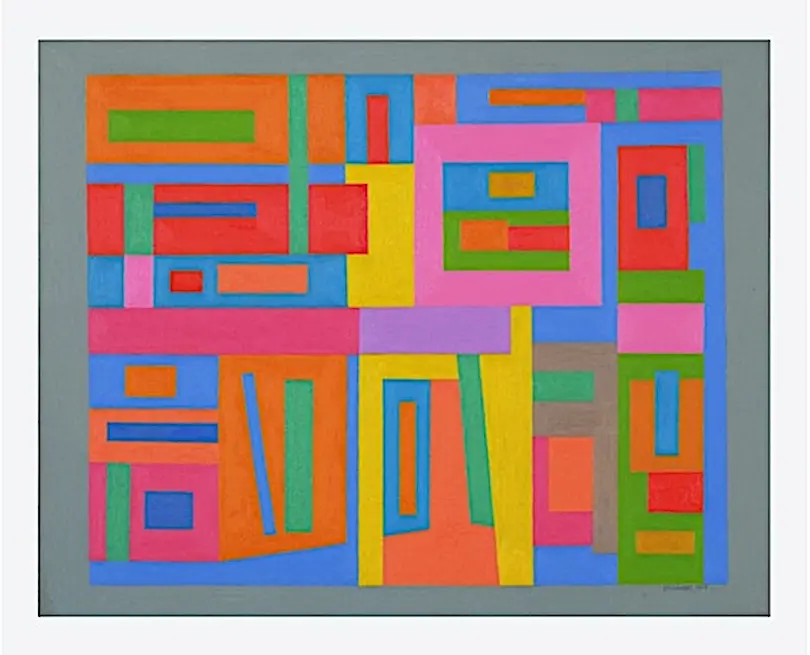 Untitled, by Ad Reinhardt. An extreme departure from his later works, we find a vivid palette of colors that engages the viewer. Fair Use license. Wikiart.org
Although Reinhardt resisted biographical interpretations, his insistence on restraint, ethical clarity, and contemplation resonates with broader Jewish intellectual traditions. His work challenges viewers to slow down and engage in sustained looking, transforming abstraction into a moral and philosophical act.
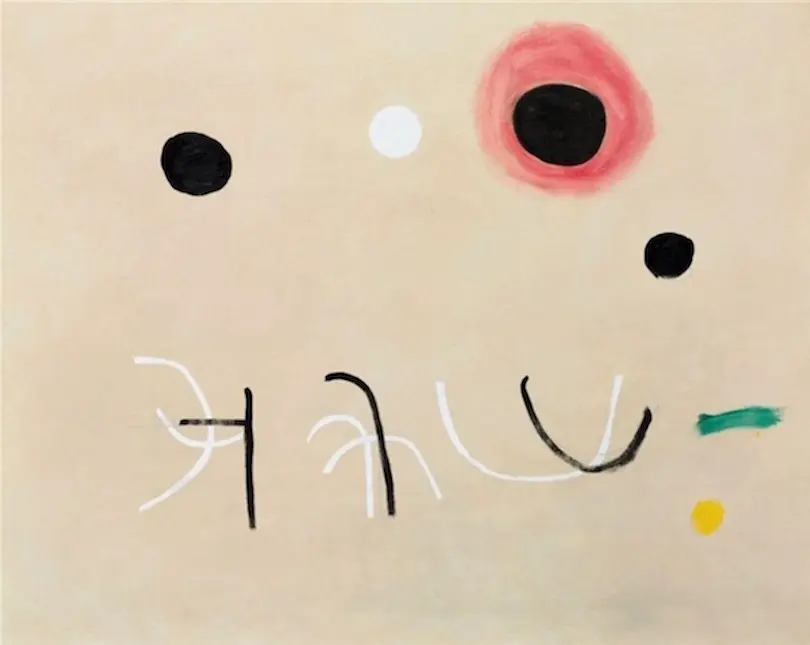 Festival, by Adolph Gottlieb. The use of symbols and marks allow the mind to wander in this piece, resembling Hebrew letters. Fair Use license. Wikiart.org
Adolph Gottlieb was a key theorist of Abstract Expressionism and an early advocate for abstraction as a response to contemporary history. As a Jewish artist working within the New York School, Gottlieb rejected literal representation in favor of mythic and archetypal images. His pictographs and later “burst” paintings suggest ancient symbols and primal forces without fixed meanings.
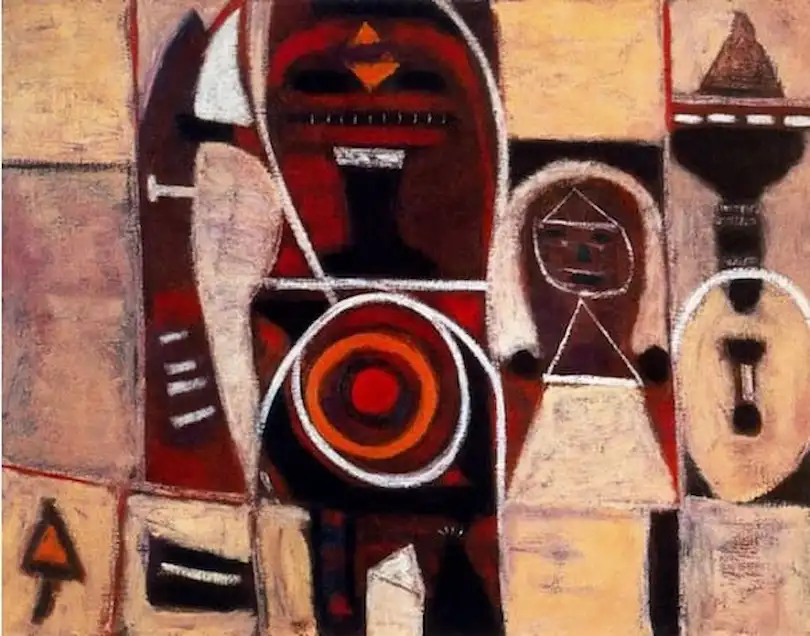 Pink and Indian Red, by Adolph Gottlieb. Part of the Pictograph series of works. Fair Use license. Wikiart.org
Gottlieb believed that images and symbols offered a universal language capable of expressing collective memory and psychological depth. In the aftermath of the Holocaust, this approach allowed abstraction to carry emotional and historical weight without direct reference, situating his work at the core of Abstract Expressionism’s expressive power.
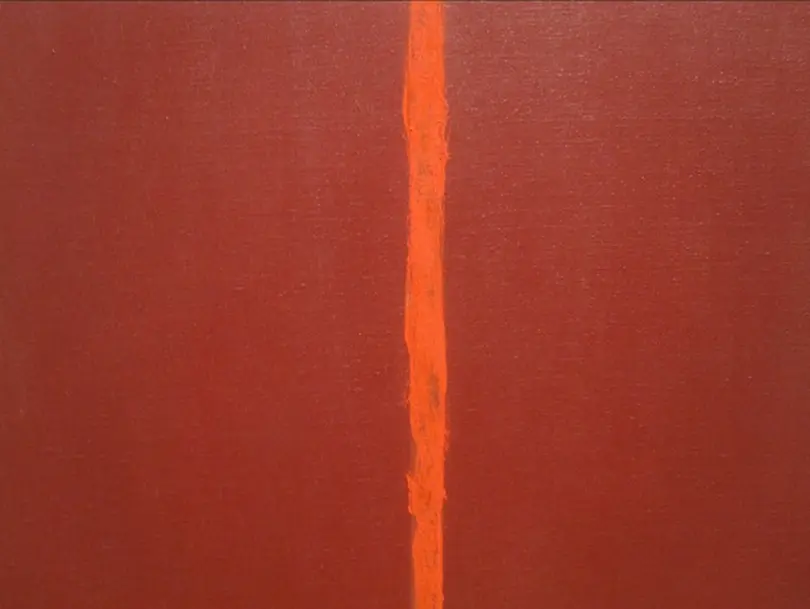 Onement III, by Barnett Newman. An expansive color field and a vertical bright red ‘zip’ line dominates this piece. Let your imagination roam. Fair Use license. Wikiart.org
Barnett Newman stands as one of the most philosophically ambitious figures of the New York School. His large-scale abstract paintings, defined by expansive color fields and vertical “zips,” explore themes of creation, origin, and presence.
 Vir Heroicus Sublimis, by Barnett Newman. The viewer is engulfed by the sheer size of this painting, 8 ft tall by 18 ft wide. In this piece, the red, white, and black vertical ‘zips’ are clearly defined with hard edges. Fair Use license. Wikiart.org
Works such as Onement and Vir Heroicus Sublimis position Abstract Expressionism as a site of renewal rather than despair. Newman rejected European tragic traditions and instead proposed a new moral vision rooted in human dignity.
Ad Reinhardt, Adolph Gottlieb, and Barnett Newman exemplify how Jewish artists greatly contributed to the rise of Abstract Expressionism of the New York School. While their painting styles differ dramatically, they share a commitment to abstraction as a serious, ethical, and philosophical pursuit.
Their work expanded the possibilities of modern art, demonstrating that Jewish cultural expression could be embedded in ideas, processes, and questions rather than symbols alone. Today, their paintings remain essential to understanding both the history of Abstract Expressionism and the enduring contributions of Jewish artists to the New York School and modern art.









what about mark rothko?!!!!!!!!
Yes, Raanan, you're correct! Mark Rothko was Jewish, and contributed to the New York School. There were also other Jewish artists creating at that time as well such as Lee Krasner and Helen Frankenthaler.
For brevity of this post, I focused on three artists.
Thanks for reading!
I don't call that art. Well, maybe from the American School of Mishigass.
I remember taking an evening course at university in music appreciation. The professor began by defining 'music' in the simplest way. The definition was sounds separated by silence. So, a child banging on a pot with a tablespoon is creating music. By this type of definition of 'art', I guess the above examples could be defined as 'art' as well. However, most children could do better without even knowing it.
Hi Gary, and thank you for reading.
I think the definition of art is different for each person. While a certain piece of artwork won't 'speak' to me, another might. Some people are looking for a story with recognizable forms, another might be interested in color combinations or texture. Whichever, art is a personal journey for each person.
We have to remember that these artists created at a time when social, cultural, and business institutions refused to include Jews and recognize their accomplishments. So what is noteworthy, is that these artists were favorably recognized in the art world in spite of being Jewish.