






 In Poland, Even Winnie-the-Pooh Has a Holocaust Story

7 min read
7 min read
4 min read



5 min read


The Pitt's most compelling character is falling apart. An ancient Jewish principle might be exactly what he needs.
The Pitt is one of the hottest shows on TV right now. Dramatizing the chaos of the Pittsburgh Trauma Medical Center (affectionately referred to as The Pitt), each episode of the Emmy Award-winning series details one hour of a continuous 15-hour shift over the season. It's been called one of the most medically accurate medical shows ever made. Noah Wyle plays Dr. Michael "Robby" Robinavitch, the Jewish Chief of Emergency Medicine and Senior Attending Physician.
(Spoilers ahead.)
Robby fights to give the best care humanly possible in an understaffed, underfunded, overcrowded, and increasingly broken system. But between losing his mentor during Covid, being unable to save his son's girlfriend from wounds of a mass shooting, and 20 years of leading emergency care in a trauma center, Dr. Robby is left with his own profound trauma.
At the end of season 1 we see Dr. Robby privately break down into a full panic attack as he recites the Shema, Judaism's central declaration of faith. By season 2, he is in a full-blown mental health crisis. He's pulling away from the people closest to him, riding his motorcycle without a helmet, and has admitted he's not sure he wants to be here anymore. His colleagues recognize the signs and are terrified that his upcoming sabbatical won't be a rest – it will be his final exit.
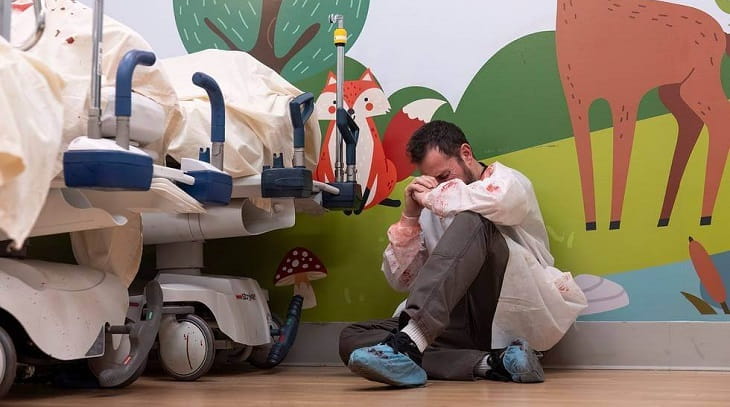
The man who has spent 20 years refusing to give up on anyone else has quietly given up on himself. If Dr. Robby got in touch with his Jewish faith, what might he find that could save his life so he could continue to save others?
"Your Life Takes Precedence"
We've all seen the airline safety video. "If the cabin should lose pressure, place the mask on your face before assisting others." The idea behind this is the cornerstone of a Jewish ethical principle “Chayecha kodmin”, which means "your life takes precedence." in a life-or-death scenario, your own life comes first. Not only are you not obligated to sacrifice yourself for someone else, you're actually forbidden from doing so.
The Talmud's classic example: two people traveling through a barren desert with only one jug of water between them. If they split it, neither will survive. Rabbi Akiva ruled that the owner of the water should keep it and is under no obligation to give up his life for the other traveler.
Valuing life stems from the recognition that your own life has infinite value. In the airplane scenario, a drop in cabin pressure can cause someone to pass out in seconds. If the parent goes unconscious, both the parent and the child are done for.
Even though Dr. Robby is saving lives day in and day out, if he runs himself into an early grave, he won't be good to anyone. This reality gets called out near the end of season 2. Joy, a medical intern, leaves when her shift is over but is stopped by a resident, Dr. Langdon. "We're in disaster mode here,” he tells her. “We put in the extra time if we're needed." Joy shoots back: "You know 62% of ED docs report suffering from burnout? So maybe all you lunatics need to learn how to set some boundaries."
Joy is keenly aware that her mental health takes precedence. But would Dr. Robby take the message of “your life comes first”? Probably not. He doesn't have the healthy sense of self Joy does. Which means there is another piece of Jewish wisdom he needs to take seriously.
Love Your Neighbor as Yourself
Rabbi Akiva, who coined the phrase "your life comes first" is also famous for saying that the great principle of the Torah is "love your neighbor as yourself." Don’t the two values conflict? How can you let your friend die in the desert? How can an exhausted Dr. Robby walk out of the Emergency Department when people are literally dying?
Dr. Robby is suffering from a devastating lack of self-love. That is why all he can do is sacrifice himself.
Implicit in "love your neighbor as yourself" is that you have to love yourself first. You can’t love others if you don’t love yourself. By the end of season 2 we learn that Dr. Robby was abandoned by his mother as a child, and that the only value he sees in himself is what he does in the hospital. He is suffering from a devastating lack of self-love. That is why all he can do is sacrifice himself.
With very few exceptions, we're not commanded to die for noble causes. We're supposed to live for them.
Our lives need balance. Maimonides (who was also a physician, by the way) based a whole section of his masterwork the Mishneh Torah on developing healthy character traits. The core principle of that section was finding your balance and not overcorrecting your flaws. It is ironic that often times our modern medical care so completely misses this essential element of wellness. It doesn't matter whether you're saving lives, saving your country, or saving your family, at a certain point you have to put yourself first. If you don't love and value your own self, the love you give to others can become embittering, resentful, and even caustic.
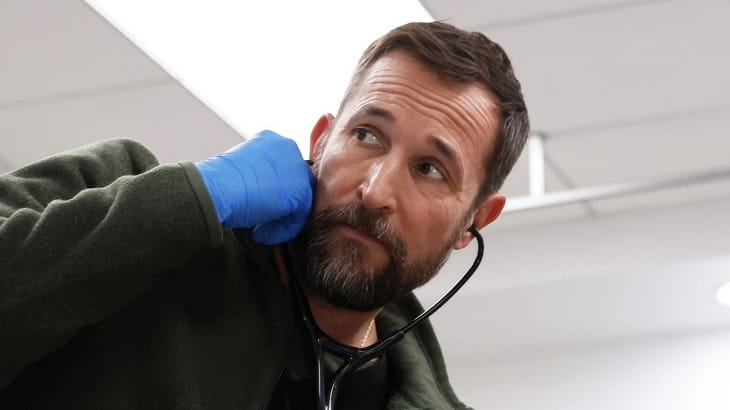
Judaism would tell Dr. Robby that the same tradition that commands him to save every life that walks through his ER commands him to save his own. That his value as a human being isn't measured by how many patients he pulls back from the edge, but by the simple fact that he is alive. The Shema he recited in the middle of his panic attack wasn't a prayer of defeat. It's true purpose is a declaration that life has purpose, especially his.
Hopefully Dr. Robby will find a life outside of being a doctor during his much-needed sabbatical and get the help he needs. Otherwise, he may never pull himself out of the Pitt.













Yes, I agree that self-esteem is important, it's the platform for all the good things that we try to do - we first believe that we may be able to succeed. A correction: The logic behind wearing first the oxygen mask, is not to give precedence to one's life, but to ensure we can help others wearing their masks. Imagine an airplane cabin with everybody trying to put masks on others...
I didn’t see the first season of The Pitt. I will have to see if it’s still available.
It's on HBO Max
Great piece of writing providing great insight into how to better deal with trauma. Our own traumas and the traumas of others. I so much prefer this sort of wisdom that Judaism teaches, than articles trying to narrow those values down to the taking of sides politically. Maybe it's just me! Thanks for this essay.
How do we rationalize this self-worth truth with the heroic loss of life in warfare to save one's people and country?
It's one of the few exceptions.
Of course the soldier that is your opponent also wants to save his people and country, or at least that is what he thinks. Sometimes it is clear who are the bad guys and who are the good guys, but that is not always the case. You can compare the US soldiers being the "good guys" clearly in World War II but what about Vietnam???? That was opaque, yet it was a war and many people on both sides died.
As a nation the US were the Good Guys in Vietnam. As a nation the majority of people in the US did not value Vietnam's freedom as much as their own. The US quit and went home leaving the very Nation they promised to protect and defend to fall into the hands of the Bad Guys. Unfortunately the Good Guys don't always win. Or maybe when the US lost it's will to fight they became the Bad Guys.
I'm glad I'm not the guy traveling with Rebbe Akiva and that one jug :^) Sorry, I understand his point but still.... if you love others as yourself, you share it and find out how to struggle to survive. And maybe that's the lesson for Dr Robby. Go, learn, rest, look for some goodness that's worth savoring, and saving in the world. After all the struggles saving peoples, he just needs to want to find things worth saving in his world. And that takes time, and sleep and exercise, and some good food, and maybe some good company- all of which you have to go look for.