

 What Two Hebrew Words Reveal About Israeli Democracy






The Israelites left Egypt with no food, no water and no plan. Then they stumbled on a campsite that had been waiting for them.
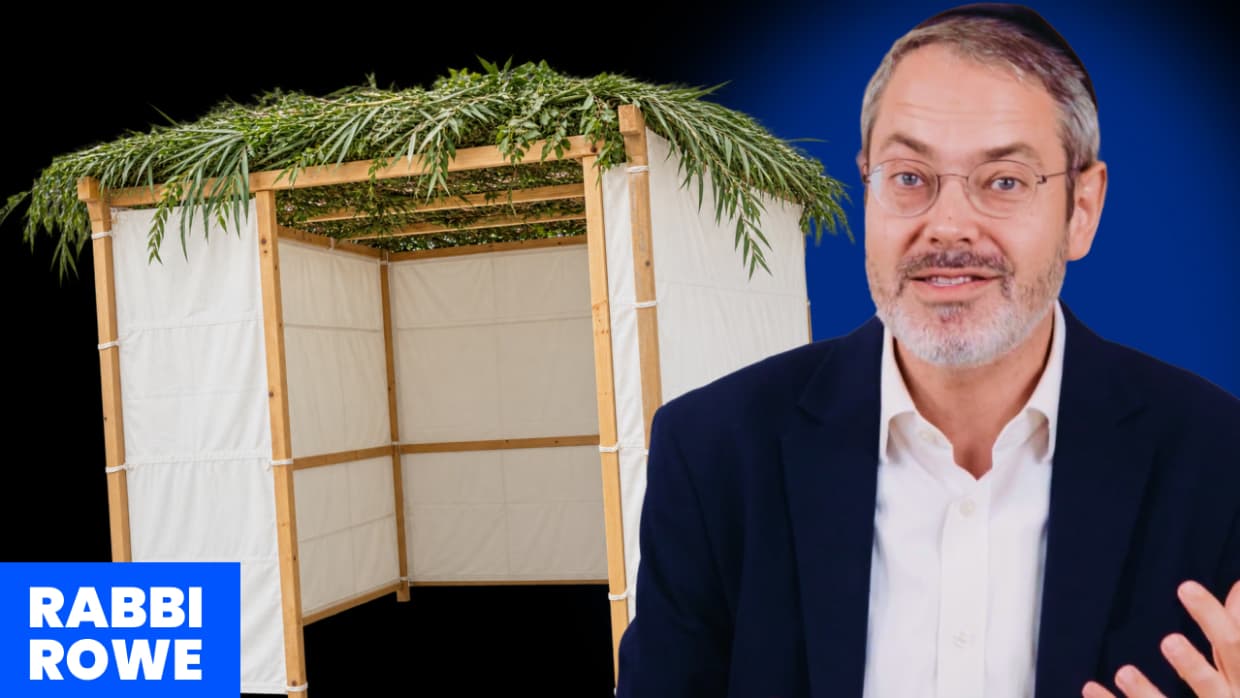
The Torah calls Sukkot "the time of our joy." This is the festival meant to teach us how to be happy in the world.
Strangely, though, we don't do anything obviously happy. We leave our homes and move into a sukkah, a hut with a roof so flimsy it isn't even waterproof. What does that have to do with happiness?
Everything.
The Book of Leviticus (23:43) explains the reason for the holiday: "So that your future generations will know that I placed the Children of Israel in sukkot (huts) when I took them out of the land of Egypt."
There's just one problem. The Torah never describes the Israelites living in sukkot when God took them out of Egypt. Throughout the 40 years in the desert, whenever the Torah mentions where they lived, it's always an ohel, a tent. Never a sukkah.
So how do we make sense of this? I want to share an idea I find very exciting, but first, one more critical question.
The Talmud says that when God speaks of placing us in sukkot, it could mean either physical huts, which the Torah never mentions, or the Clouds of Glory, which it does. A special cloud surrounded the people and protected them on their journey through the desert. But how does a hut connect to a cloud?
I said the Torah never mentions the Israelites dwelling in sukkot. But if we read carefully, there is one moment where it does. The Torah tells us they traveled to a place called Sukkot: "The Children of Israel journeyed from Ramses to Sukkot" (Exodus 12:37).
Why would a place be called Sukkot? Interestingly, the Torah mentions another place with the same name, in a completely different region. When Jacob returns to the Land of Israel, he too comes to a place called Sukkot.
Bible critics argued that the Egyptian Sukkot must be a mistake. We can locate it on the map. Today it's known as Tjeku, and excavations show there was no settlement there when the Israelites left Egypt. It wasn't a city.
James Hoffmeier, one of the world's leading experts in Egyptian archaeology, says the critics have it backwards. Of course the Israelites wouldn't escape Egyptian slavery and head straight into an Egyptian city. If Tjeku had been built up, they would have avoided it. They went there precisely because it wasn't.
What Tjeku was, at the time of the Exodus, was an old campsite. In earlier times, Semitic peoples sometimes migrated from Canaan down to Egypt. Travelers needed places with food, water, and people to trade with. Tjeku had been a massive Semitic transit camp.
Now picture the scene. The Israelites are leaving Egypt with no provisions and no idea what lies ahead. Pharaoh has told them to go. Moses has told them to follow him. It's a tremendous leap of faith. They head out into the desert and the questions start: What will we eat? What will we drink? Where will we even sleep tonight?
Suddenly they arrive at an old campsite, full of huts that had been standing there for decades, maybe centuries, along with materials to build more. "In sukkot I made the Israelites dwell when I took them out of Egypt," God says, on that very night.
Imagine being one of those Israelites and seeing a place that had been waiting for you. It was God's way of saying, "I've got you covered. You'll be looked after. You're not taking this journey alone. I'm with you every step of the way." And it was there that the Clouds of Glory descended and carried them through the rest of the journey.
So when we sit in the sukkah, we remember that first night out of Egypt, when God had prepared a place for us and showed us He would carry us forward. And we remember the Clouds of Glory, which came down that day at Sukkot and led us the rest of the way.
This reveals something remarkable. Every place in the Torah called Sukkot is a transit camp, a place you stop on the way somewhere else.
And that's the secret of life. The more we try to stand still, the less life works for us. The more we accept that life is a journey, the more incredible it becomes.
Being on a journey means you're growing. It means you're not trying to stay put. It means you're trying to become a better person. We just had Rosh Hashanah and Yom Kippur. We had deep moments, powerful dreams, real desire to change. But no one changes in a day. So take those dreams and ask yourself, "Who am I going to be a year from now?" Then, just like the Israelites heading into the desert, begin the journey one step at a time.
What was my dream on Rosh Hashanah and Yom Kippur? Who did I think I could become? Write it down. Set goals. Then start walking. One small step in that direction, then another, then another.
That's where life's true joy lies: in growing, in heading somewhere, in living with meaning and purpose, in actually becoming something. When all we try to do is make ourselves comfortable, there's no deep fulfillment in it. But when we're taking steps, growing, moving toward a destination, that's where simcha, true joy, comes from.
And when we know God is walking with us every step of the way, we know we're on the right path, the path to greatness. We don't need to be perfect. We don't need to have arrived. The joy is in the journey itself.
As we sit in our sukkahs this year, may we travel back in time and feel the magic of that first night. Feel the Israelites' fear, and their elation, knowing they were marching one step at a time, not only out of Egypt toward the Land of Israel, and not only away from their troubles, but toward building all of history. May God accompany each of us on our own journeys, and may this be a true time of simcha, of joy.