Click here to buy
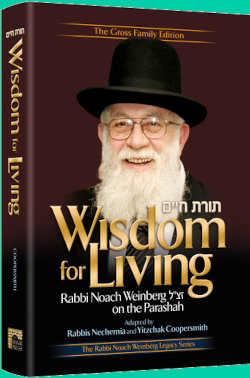
Wisdom for Living
Rabbi Noah Weinberg on the Parashah



7 min read


In this week's Torah portion we find the episode of the sotah, the woman suspected by her husband of adultery. She is brought to the Temple in Jerusalem, the Beis Hamikdash, and given a choice: Accept guilt, or drink the "bitter waters," which serve as a miraculous test. If she is guilty, she will die on the spot, and if she is innocent she can return to her husband.
What immediately follows is the discussion of the nazir, who takes a vow of abstinence that prohibits him from drinking wine or coming in contact with the dead for a specified period of time. The Sages explain that the laws of the nazir are juxtaposed with the laws of the sotah because one who sees a sotah in her state of degradation, and perceives firsthand what frivolity and wine can cause, should immediately take a nazirite vow prohibiting himself from drinking wine (Sotah 2a).
Now, isn’t the person who witnessed the ordeal of the sotah the last one who needs to become a nazir? He has seen upfront the horrific consequences of too much wine. So why does the Torah teach that specifically he who has seen the sotah should become a nazir?
The Mishnah says, "Anyone whose good deeds exceed his wisdom, his wisdom will endure" (Ethics of the Father, 3:12). This means that if everything a person understands he immediately puts into action, his wisdom will endure. But if he understands something and does not put it into practice, his wisdom will disappear. As the Mishnah continues, "Anyone whose wisdom exceeds his good deeds, his wisdom will not endure."
If you have an insight but don't act on it, you are going to lose that insight. That is the nature of the human condition. Therefore, the person who has seen the sotah’s degradation must immediately react and do something to fortify himself against similar transgression. That is the only way for him to hold onto his clarity. In contrast, if one does not translate his new awareness into some concrete action, the inspiration will fade and he will forget the lesson he learned, making himself susceptible to the dangers of intoxication and escapism.
One of the more problematic areas where a failure to act leads to denial is gratitude. When I started my first yeshiva, Rabbi Yitzchak Hutner, my rosh yeshiva in Yeshiva Rabbi Chaim Berlin, gave me a startling piece of advice. He said, do not expect that your students will have any hakaras hatov. They will not have any gratitude. It's not in the mindset of this generation.
I was taken aback, but it did not take too long to discover that Rabbi Hutner, of course, was right. Today, young people do not even think they owe their parents anything. "What do I owe my parents?" they say. "Did I ask to be born?" This lack of gratitude comes from not acting on the realization that they do indeed owe their parents, and it, in turn, leads to the perverse situation of children feeling betrayed by their parents for not giving them what they crave. "What do you mean I can't have the car? You're not even using it!"
In previous generations, no one’s parents owed them anything. You owed your parents. Regardless of what they did to you, they gave you the gift of life and brought you into this world. You didn't expect anything from them because you owed them.
I remember that when I was a child, two brothers stopped talking to each other because one of them convinced their elderly father to move in and stay with him instead of sharing the burden with his brother and having the father move every other week. The brother was upset about losing the opportunity to take care of his father. Today, siblings will fight over whose turn it is to visit their parent in a nursing home. "It's your turn to visit! I can't go." That’s what happens when we don’t put into action the gratefulness we should have toward our parents. We soon forget we even owe them and then start thinking how much they owe us.
In contrast, let me tell you a story about a remarkable man who took to heart what he understood and completely turned his life around. He was a young, athletic man when he was shot at a university in Chicago and became a quadriplegic. He told me that when he lay in the hospital bed, realizing that he would never move his arms and legs again, what flashed through his mind was: What is life really all about? Is it worth living? If you can’t move your hands and feet, if you can't go anywhere, if you can’t play sports, what then does it mean to be alive?
He spent an entire hour pondering these questions and thinking about the meaning of accomplishment. How can I make a difference in life? I’m never going to run a mile; I’m never going to feed myself. So what is life all about? Is it about attaining wisdom and understanding? What is there to understand?
He was fascinated by these questions, and he spent the next hour thinking about the meaning of life. Then, all of a sudden, he had an epiphany. If I had never been shot and forced to confront these questions, I never would have stopped to think about the purpose of my existence. I’ve been running too fast, going nowhere. With great determination, he decided to go figure out what the true meaning of life is.
He then began to think about what human beings are really seeking. What do I want? Who am I? What are the genuine pleasures that life has to offer? How can a human being be utterly preoccupied with making money, or jumping from one sensory pleasure to another, or consumed with what people think of him, and ignore his own quest for meaning? He told me that he realized then how insane we can all be.
Then he had another epiphany. Which is a greater tragedy: not to be able to move your arms and legs for fifty years, or to spend seventy years running around and conquering the world without knowing what life is all about? Which is a greater tragedy: living a full 70 years in possession of all your faculties and not knowing the true meaning of life, or being a quadriplegic and knowing what it is that makes life meaningful?
He told me that the answer was immediately obvious: what a tragedy to spend a lifetime not knowing the purpose of your life.
And then he said, “You know, it’s a good thing I was shot.” He didn't thank God at that point because he didn't know yet that there is a God. But he appreciated that it was good to be alive, even if you cannot move your arms and legs. He understood that life is precious and meaningful. And he spent the rest of his life pursuing meaning, eventually becoming an observant Jew, immersing himself in Torah study, and making an incredible Kiddush Hashem. All because he acted on his insight.
A person who witnesses the shocking death of a sotah must transform the startling lessons he learned into action. He has to take a step and make a change; otherwise, he will have squandered a great opportunity. Nothing changes if nothing changes.