Click here to buy
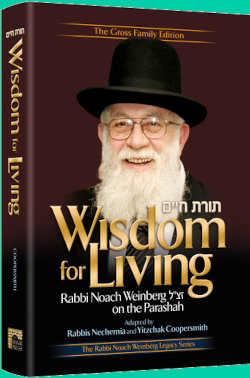
Wisdom for Living
Rabbi Noah Weinberg on the Parashah



5 min read


Ethics of the Fathers begins by summarizing Judaism's educational philosophy with the statement: “Stand up many students.” The mishnah does not say "teach" or "inspire"; it says "stand up," emphasizing that our primary goal in educating our students and our children is to make them independent. Our role as parents and teachers is to raise young people who can think for themselves.
The Sages tell us that Rabbah, when testing Abaya, would purposely impart something incorrect or illogical to ensure he did not just accept what he taught him without first critically examining it. (Brachos, 33b)
If we do not think for ourselves, we will remain a passive blank slate conditioned by society, and our values and convictions will be a mere accident of birth. Using our mind to assess and think critically is an essential part of individuation. It is the engine that creates the true, unique self.
Rabbi Kalonymus Kalman Shapira, the Piaseczna Rebbe, who perished in the Holocaust, described it this way in his personal diary, To Heal the Soul: “There must be a person who can stand by himself, who can decide what he wants for himself. But if there is no such person, just a crowd, there can be no free choice or personal will. Because who will choose, if besides the herd there is no one there at all?
“Are you a person who can stand by himself, or are you just a member of the human species? Man cannot remain imprisoned by social rules, cultural customs, or accepted thought without the ability to see beyond them; he must have a mind of his own. Without this, not only is he not a Jew, he is not even a person.”
Yet this week’s Torah portion seems to contradict the value of being an independent thinker. The verse says, "According to the teaching that they will teach you and according to the judgment that they will say to you, shall you do; you shall not deviate from the word that they will tell you, right or left" (Devarim 17:11).
Rashi, citing Sifri, (17:24) explains, "Even if this judge tells you that right is left, and that left is right. How much more so, if he tells you that right is right, and left is left!" Chazal seem to be instructing us to ignore our own opinion and accept the viewpoint of the rav, even if it seems completely illogical. What happened to the importance of thinking independently?
To complicate matters, the Talmud (Horiyos 2b) discusses a case where an individual sage is expected to oppose what he considers a mistaken ruling of the Sanhedrin HaGadol (the Supreme Court) and stay resolute in his viewpoint. The case involves a piece of chelev, forbidden fat, that the Sanhedrin HaGadol mistakes for shuman, permissible fat. If a member of that very Sanhedrin eats the fat, knowing that his colleagues ruled incorrectly, he is obligated to bring a sacrifice for inadvertently transgressing by eating the non-kosher fat.
The question is, why is his action viewed as inadvertent, when he knew he was eating non-kosher fat?
The Talmud answers that it is because he erroneously thought that the obligation of “According to the teaching that they will teach you… shall you do" applies even in such a case. It does not. The individual sage who recognizes that the Sanhedrin HaGadol is making a mistake is required to stick to his guns and not follow their ruling.
This Talmud seems to be at odds with the statement of the Sages on our Torah portion concerning the obligation to obey our leaders even if they tell us “that right is left, and that left is right.” How do we reconcile these two sources?
The resolution lies in the different nature of the rulings involved.
Our parashah is referring to decisions based on a judgment call or sevara. In cases that require logical deliberation and reasoning, we need to defer to our sages, who are far more educated in these matters and whose perspective and judgment are far more aligned with Torah than ours. This is hinted to by the fact that Chazal illustrate the need to accept their ruling with the example of calling your right hand your left hand and vice versa, because whether something is on the right or on the left is really a question of perspective.
In contrast, the Talmud’s case involving the kosher and non-kosher fat is a matter of determining objective fact. In such a situation, we can know the facts even though we are educated than our sages. Therefore, we are obligated to stick to what we know, even if it contradicts the opinion of our rabbi.1
My rosh yeshiva in Yeshivas Chaim Berlin, Rav Yitzchak Hutner, was reluctant to answer a student’s question unless the student offered his own approach first. Rav Hutner was instilling a powerful lesson about the importance of developing intellectual independence. He trained his students to first put in the hard work to think through the issue and arrive at their own conclusions. Only then would he impart his precious words of Torah. I embraced this approach with my own students, as well.
You are responsible to have a dei’ah, an educated opinion, and you also need to have the humility to defer to those whose understanding is far greater than yours. However, subjugating your opinion does not mean you do not have a viewpoint. It means you are choosing to be subservient because you recognize that you are not an expert in this area and that your perspective is not nearly as pure and Torah-based as the nuanced opinion of a talmid chacham, a Torah scholar.
Striking this balance ensures that there is leadership, that there is proper deference for Torah scholars, and that each individual is encouraged to develop his independence and uniqueness.