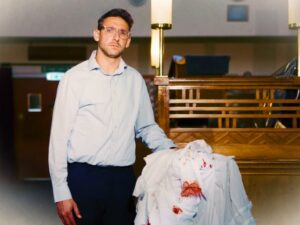


 After the Manchester Synagogue Attack, They Danced Through Their Tears





GOOD MORNING! Last week, as you may recall, I wrote about the “Three Weeks” and that, historically, they have been a calamitous time for the Jewish nation. Right after the email edition went out, I received an email that began:
“Dear Rabbi Zweig...I lost my daughter...my only child – on Friday, July 3. I am melting away; my heart is broken. I was sitting here saying prayers for you to send me anything and all of a sudden this came from you. That is what Rabbi Packouz did for me for many years...it’s so unreal to most but I know what I know. Me and God…we are very tight. I am grateful and thankful. I can’t see anymore to type but I wanted you to know…”
Then, just as I sat down to compose this week’s column, I received news that one of my friends, Rabbi Nosson Glueck, a man whom I have known and admired for over fifty years, suddenly passed away. We casually throw around terms like “genius” and “brilliant,” but they were truly apt descriptions of who he was. May his memory be a blessing.
Suffice it to say that I feel fully immersed in the feelings of loss that are associated with the “Three Weeks.”
There are two distinctly different elements to recovering from a loss: grieving and mourning. Grieving is the internal emotional, psychological, and even physical response to a loss. It is what a person experiences on the inside. Grieving involves finding ways to go through the pain, put the loss into perspective, and internalizing one’s new reality and self-definition without the loved one.
Mourning, on the other hand, is the external expression of grief. It includes the behaviors, rituals, customs, and practices through which grief is expressed. A large part of the mourning process is expressing the feelings of loss; the sense that something that was once an integral part of our identity has been taken away and we are now “less.”
That is why Judaism’s mandated period of mourning over the loss of one’s closest relatives (known as shiva) is so important. It is a time when family and friends converge and visit the bereaved to express their shared sorrow and pain, a practice called “nichum aveilim – comforting the mourners.” The goal of the visit is to let the mourner feel connected to more people – sources of life and energy – which can help alleviate the pain of being severed from someone close to them.
Although mourning is initially a period of darkness and pain, this process of redefinition is also the beginning of a passage towards the light and healing. This communal connection is crucial to a person’s ability to restore their spirit and begin to heal. Being there for them helps them in this process of redefining themselves and facilitates a path to move forward.
This Shabbat – the Shabbat after Tisha B’Av – is called Shabbat Nachamu, meaning the Shabbat of Comfort. It is named after the first words of the haftarah (a reading from the scriptures that is read in synagogue after the weekly Torah portion). This week’s haftarah comes from Isaiah 40, and begins, “Nachamu, nachamu, ami – Be comforted, be comforted, My people.” This prophecy from the Almighty brings comfort and provides some relief. Knowing that the Almighty is ever present in our lives and that He has not forsaken us is the very definition of being “connected.”
Shabbat Nachamu is no ordinary Shabbat; this Shabbat fosters comfort and relief and there is a tradition of treating it almost like a holiday. The sages (see Ritva on Ta’anit 30a), say that the food we eat on this Shabbat should be extra special – like that of a festival. This is the first of seven Shabbats of consolation, but the only one that has this special elevated status.
Fittingly, this week’s Torah portion contains what may very well be the most famous and important verse in Judaism known as the “shema.”
“Hear, O Israel; The Lord our God is One Lord;”
This verse is a centerpiece of the morning and evening prayer services and encapsulates the monotheistic essence of Judaism. Indeed, this succinct statement has become so central to the Jewish people and is also the climax of Ne’ilah, the final prayers on the holiest day of the year – Yom Kippur. This prayer is recited every night before one goes to sleep and is also traditionally the last words of a Jew as he prepares to leave this world.
The shema is not just a statement of theology; it’s a statement of identity and existence. If one’s self-definition is based on finite things like wealth, career, or the physical body, then one is merely a finite being.
However, one who defines his existence through a connection to the Almighty, the Torah, and the Jewish people is defining himself by something eternal. A Jew dies with the shema on his lips because at that moment he is affirming that his entire life was about something infinite – the mission to be an ambassador for the Almighty and to tether his identity to the eternal destiny of the nation.
The shemaencapsulates Judaism’s understanding of the essence of the Almighty, and how everything in creation is ultimately connected and unified in His singularity. The very structure of this verse is burned into the Jewish psyche from a young age.
One of the most well-known builders of Jewish schools and communities in the 20th century was Rabbi Yosef Shlomo Kahaneman, also known as the Ponevezer Rov. He was a brilliant scholar with an endless devotion and commitment to the Jewish people. After World War II he traveled the world over to rebuild what was lost, and the stories surrounding his exploits are legendary.
One such story: Shortly after the war ended, Rabbi Kahaneman travelled to Europe to gather Jewish orphans and take them home to Israel. Many Jewish children had been entrusted to local convents or Christian orphanages by their doomed parents who were being deported to the death camps, and the local priests and nuns were loath to give them up.
In one orphanage, the priest in charge told Rabbi Kahaneman that there were no Jewish children present. Undeterred, Rabbi Kahaneman stood in front of the orphans and called out in a booming voice the “Shema Yisrael” prayer and immediately young children, who’d last heard those holy words years before as their parents tucked them into bed, began crying and calling out “Mama! Papa!” Rabbi Kahaneman triumphed and reclaimed many orphans and brought them to Israel. Their remembrance of this essential prayer ultimately led them to new lives in Israel.
Man’s Search for Meaning by Viktor Frankl has sold more than twelve million copies worldwide. Frankl describes his experiences in the Nazi concentration camps, but more than his travails, he writes as a psychologist about what provided him with the strength to survive.
Frankl poignantly describes how prisoners who gave up on life and hope for a future were inevitably the first to die. They died less from lack of food than from lack of something for which to live. By contrast, Frankl kept himself alive by thinking of his wife and dreaming of lecturing about how his experiences reinforced what was already a central part of his thesis before entering the camps – that the primary motivational force of every person is a search for meaning.
Frankl’s autobiographical memoir is followed by an outline of his therapeutic doctrine of curing the soul by finding meaning in life. His theory gains credence from the backdrop of his personal experiences in the concentration camps and how he found meaning while confronting his suffering.
After arriving at Auschwitz, Frankl was stripped of his most precious possession – a manuscript that was his life’s work, which he had hidden in his coat pocket and viewed as his “mental child.” Realizing that the odds of his survival were small, “no more than one in twenty-eight,” he had what he describes as “perhaps his deepest experience in the concentration camps.”
“I had to undergo and overcome the loss of my mental child. And now it seemed as if nothing and no one would survive me; neither a physical nor a mental child of my own. So, I found myself confronted with the question whether under such circumstances my life was ultimately void of meaning.
“Not yet did I notice that an answer to this question with which I was wrestling so passionately was already in store for me, and that soon thereafter this answer would be given to me. When I arrived I had to surrender my clothes and, in turn, I inherited the worn-out rags of an inmate who had already been sent to the gas chamber [...]. Instead of the many pages of my manuscript, I found in a pocket of the newly acquired coat one single page torn out of a Hebrew prayer book, containing the most important Jewish prayer, the ‘Shema Yisroel.’ How should I have interpreted such a ‘coincidence’ other than as a challenge to live my thoughts instead of merely putting them on paper?”
Then, in the concluding sentence of this best-selling book, which has been translated into twenty-four languages, Frankl again draws on this timeless proclamation of faith:
“Our generation is realistic, for we have come to know man as he really is. After all, man is that being who invented the gas chambers of Auschwitz; however, he is also that being who entered those gas chambers upright with the Lord’s Prayer – the Shema Yisroel on his lips.”
This understanding, that we are all ultimately connected and that everything in the universe is joined through the absolute singularity of the Almighty, is where we must draw our strength to heal and move forward. May it be the will of the Almighty that all those who have suffered losses find hope and consolation, and that our splintered communities become unified and whole once again. Amen.

Moses pleads with God to enter the Holy Land, but is turned down. (Remember, God always answers your prayers – sometimes with a “yes,” sometimes with a “no,” and sometimes with a “not yet.”) Moses commands the Children of Israel not to add or subtract from the words of the Torah and to keep all of the Commandments. He then reminds them that God has no shape or form and that we should not make or worship idols of any kind.
The cities of Bezer, Ramot, and Golan are designated as Cities of Refuge east of the Jordan river. Accidental murderers can escape there to avoid revengeful relatives. They then wait there until tried.
The Ten Commandments are repeated to the whole Jewish people. Moses expounds the Shema, affirming the unity of God, Whom all should love and transmit His commandments to the next generation. A man should wear tefillin upon the arm and head. All Jews should put a mezuzah (the scroll is the essential part) upon each doorpost of their home (except the bathroom).

When we are no longer able to change a situation,we are challenged to change ourselves.
- Viktor E. Frankl