
 Those Shameful Thoughts and What They Really Say about You





Machine guns crackled. Bodies tumbled into the pit. As his line approached the edge of death, just before the bullets began to fly, a Holocaust survivor heard his grandfather cry at the top of his lungs: "Shema Yisrael, Adonai Eloheinu, Adonai Echad!" Others joined, calling out those holy words as bullets ripped their bodies apart.
I listened to this testimony during my 2016 Birthright trip to Yad Vashem, the Holocaust museum in Jerusalem.1 Though not yet religious, I felt something deep in my soul connect to the heroism and nobility of the Jewish people. At the brink of death, facing hatred and murder, they shouted our anthem—the Shema: "Hear Israel, the Lord our God, the Lord is One!"
The words those Jews cried out trace back to this week’s Torah portion, where Moses first taught the Shema to our ancestors. To connect with this timeless prayer that so many Jews lived and died by, we must understand the true meaning and depth of these six holy words:
שְׁמַע יִשְׂרָאֵל יְהוָה אֱלֹהֵינוּ יְהוָה אֶחָד
"Hear, o Israel, Adonai is our God, Adonai is One!"
Let’s begin our exploration by examining the first two words - Shema Yisrael - “Hear, o Israel.” Why are we commanded to hear and not see? Furthermore, why do we cover our eyes when we recite the Shema?
Consider how differently your eyes and ears process the world. Sight captures instantly—one glance, complete picture—just like a photograph. In contrast, sound builds meaning through continuity. Try saying: “Mo.... no.... syl.... lab.... ic.” Incomprehensible. Similarly, imagine trying to appreciate a concert through a one second sound bite. Impossible!
Unlike seeing, hearing demands stringing together a continuum of inputs to form one cohesive harmony of experience. We don't enjoy a moment of a song or a word of a speech in isolation. Listening requires wholeness. We grasp the full beauty and meaning only when we listen from start to finish.
The same principle applies to God's presence. We don’t perceive God's presence at a glance—it flows as the background music to our lives—something we experience only when we embrace the greater continuum. That's why the Shema begins, "Hear, o Israel!" Cover your eyes and listen! When you look back at the whole symphony of your life, of Jewish history, of mankind, can you hear the Divine orchestration?
But what exactly are we listening for? The next words of the Shema—'Adonai Eloheinu'—reveal the specific melody we seek to hear. But why does the text say 'God, our God'? What do these words mean?
The apparent repetition, "the Lord, our God", carries deep meaning. God appears twice, but each name represents a different divine aspect.2 The first name, the Yud-Hey-Vav-Hey (יהוה), contains the Hebrew words for past, present, and future being—haya, hove, yihiye—revealing God as the eternal 'I Am' who transcends time—His highest aspect and true nature. Our sages teach that this name represents God’s eternal mercy and love.3 Kabbalistic texts4 reveal that by examining the letters of this name, we can see the process of giving in action:
Yud: Picture the yud as a small coin—a gift.
Hey: The gift enters a hand (the hey represents a hand holding the small yud—the coin).5
Vav: The hand extends outward (The vav represents connection—the Hebrew prefix meaning "and").
Hey: The other's hand receives the gift; the giving reaches completion.
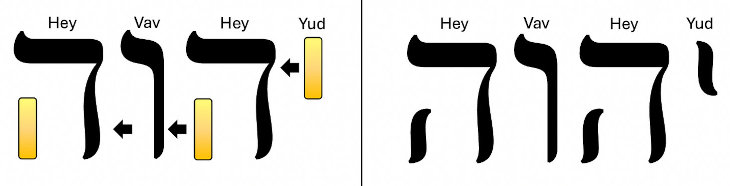 (Note: if you print this, please do not throw it away - a paper with God's name is holy and must be kept in good condition or buried properly)
Whereas God's name YHVH (Adonai) represents His aspect of mercy and love, the name Eloheinu represents His aspect of divine justice and universal power - cause and effect, natural phenomena.6 Therefore, when we say "YHVH is Eloheinu", we declare that God's aspect of mercy and love drives the cause and effect and natural power of the universe.
This brings us to the Shema's crescendo: "Adonai Echad." When we declare that God is one, we affirm that God's aspect of mercy and love stands behind everything. It's all one. It's all love.
That's our national anthem. Listen Israel! Piece together all the disparate fragments of life and perceive how they all comprise a beautiful, harmonic, symphonic melody—how everything in the expanse of time and space and beyond collectively expresses God's eternal love.
Now that we understand the magnificent meaning of our national anthem, we can appreciate the courage and faith of so many Jews who, over the millennia, proclaimed "Shema Yisrael, Adonai Eloheinu, Adonai Echad" on the verge of death. After starvation, torture, beatings, watching family and friends murdered, and facing imminent death, can you imagine what it takes to say "It's all from God, it's all one, and it's all love"? That's a greatness we hope we'll never need to put to the test, but one that we believe lies deep and latent within all of us.
This week, I challenge you to transform the Shema from ancient words into lived experience.
If you don't yet recite the Shema: Start small. Choose one evening each week—Friday night works beautifully—to speak these six words with intention. Before you begin, spend a moment reflecting on the week’s events. Can you detect the underlying melody connecting seemingly random moments?
If you already say Shema daily: Take your practice deeper. Before your bedtime Shema, pause for sixty seconds. Review your day—the frustrations, victories, unexpected encounters, quiet moments. Ask yourself: How might these scattered notes comprise part of a larger divine composition?
For everyone: This week, when facing a difficult situation, remember the Holocaust survivors who proclaimed "It's all one, it's all love" even in hell's depths. Can you find that same faith in your smaller struggles? Sometimes hearing God's symphony requires covering our eyes to the immediate chaos and listening for the deeper harmony beneath.
Shabbat Shalom!
Avraham
Inspired by the classes of Rabbi Akiva Tatz and Rabbi Beryl Gershenfeld