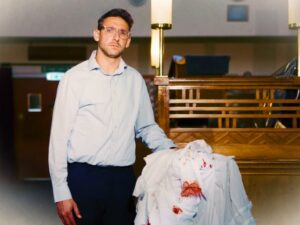

 After the Manchester Synagogue Attack, They Danced Through Their Tears





The Torah ends with a song - but not the kind you'd expect. Moses's final prophecy, written in the distinctive two-column format of biblical poetry, doesn't celebrate triumph or offer hope. Instead, it predicts failure, exile, and national catastrophe with absolute certainty.
Why would our greatest prophet choose this harsh message as his farewell declaration? And why deliver it as a song?
At first glance, Moses's prophecy in this week’s Torah portion reads like a sobering tale of human failure that unfolds in four acts. First, God showers His chosen nation with kindness - rescuing them from Egypt, nurturing them in the desert, bringing them into the Promised Land. Then, in act two, at the height of their prosperity, the people grow fat with comfort and turn away from their Creator. This leads to the devastating third act: God's presence withdraws and catastrophe follows: wicked enemies scatter the Jewish people to the corners of the earth. Finally, God avenges His people and cleanses their land.
What makes this prophecy unique is its certainty. Most biblical warnings speak in conditional terms - "If you sin, then consequences will follow." Bechukotai and Ki Savo offer clear choices with predictable outcomes, giving us agency over our destiny. But this week’s Torah portion strips away all conditions. These events will happen, period.
And indeed, the Ramban points out that everything in this prophecy has unfolded exactly as written: God rescued us from Egypt, protected us in the wilderness, brought us to Israel, and blessed us with success. Then, we grew arrogant, sinned, and suffered a painful exile. Given this flawless track record, the Ramban concludes, we can be absolutely certain about the final act of redemption.
But there's a troubling detail buried in this promise. According to the prophecy, we don't earn this redemption through repentance or merit. God saves us simply to vindicate His own name before the nations. Are we really just helpless cases, destined to fail and be rescued only because our enemies are worse?
The Malbim offers a stunning parable that unlocks the deeper meaning of this song: A king decides to free a slave who has a well-known history of theft. Despite knowing the slave's character flaws, the king appoints him treasurer of the royal vault. But here's the twist: before giving the slave this position, the king writes a note in his private ledger stating, "I know this man will steal from me." Why does the king write this prediction? Not to warn the slave or prevent the theft, but to remind his future self not to punish the slave when the inevitable happens. After all, the king made this appointment with full knowledge of what would occur. The responsibility lies with the one who chose, not the one who acts according to his nature.1
This parable reveals the true message of Haazinu: we have a Father who believes in us and loves us unconditionally. The prophecy doesn't seek to crush us with inevitability, but to assure us that even at our lowest, we're never truly lost.
The Talmud2 records a fundamental debate that reinforces this theme. Rabbi Yehuda argues that our status as God's children depends on our behavior: "When you act like sons and cleave to the Holy One, you are called sons, but when you do not act like sons, you are not called sons." Rabbi Meir forcefully disagrees: "Either way you are still called sons!" He proves his point by citing verses where God calls Israel "sons" even while criticizing them - "foolish sons," "sons in whom there is no faithfulness," "sons who deal corruptly." Even at our worst, the Torah never stops calling us God's children. The law is decisive: we follow Rabbi Meir. No matter what, we remain God's children.
I once heard an interview with NBA legend Kobe Bryant about his father's role in his basketball career. Kobe described his experience playing in a summer league at age eleven. He scored zero points the entire summer. After his final game, he approached his father, devastated. His father wrapped his arm around young Kobe and said, "Son, I love you whether you score 0 or you score 60." Smiling during the interview, Kobe exclaimed, "I said to myself, 'Cool, I've got the love, now I'm going to go score 60.'" He went on to become one of the greatest scorers of all time.
That's the power of unconditional love. When we internalize this certainty and feel God's arm wrapped around us, we gain the strength to brush off our zero-point days and strive for our full potential. The song's harsh predictions don't chain us to failure - they create the ultimate safety net, freeing us to reach for the stars. Rock bottom doesn't mark the end - it offers a new beginning, backed by the certainty of God's eternal love. In that light, Haazinu isn't just a prophecy - it's our Father's eternal promise that no matter how far we fall, His love will always be there to lift us back up.
This understanding transforms how we approach both our own failures and those of others. When you face your next setback, pause and ask: "How would I speak to someone I love unconditionally about this situation?" Then extend that same compassion to yourself. God's love doesn't fluctuate with your performance, and neither should your self-worth.
Now comes the harder challenge: extending this same unconditional love to others. Just as Kobe's father wrapped his arm around his devastated son, we can become sources of unwavering support for the people in our lives. The next time someone disappoints you - your child, student, friend, or spouse - remember the Malbim's insight. You entered this relationship knowing human nature. Your role isn't to punish the inevitable stumbles; it's to love through them and help the person rise again.
May we all find strength and peace in the unconditional love that God surrounds us with, no matter whether we succeed or fail!
Shabbat Shalom!
Avraham