Click here to buy
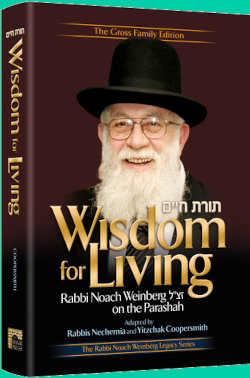
Wisdom for Living
Rabbi Noah Weinberg on the Parashah






This week’s parashah contains Moshe’s enigmatic song. Chazal learn two different – but related – teachings on how to learn Torah properly, from the following passuk: “May my teaching drip down like the rain, may my utterance flow like the dew; like storm winds upon vegetation and like raindrops upon blades of grass” (Devarim 32:2).
The Talmud derives from this passuk that if one is not careful, Torah learning can actually kill him:
R‘ Benaah said: Whoever studies Torah for its own sake, his Torah becomes an elixir of life to him…. But whoever studies Torah not for its own sake, his Torah becomes a deadly poison to him, as it says, “May my teaching drip down like the rain,” and “arifah” [whose form “yaarof” is used in this verse to mean “drip down”] means nothing other than “killing,” as it says, “And they shall axe the back of the heifer’s neck [‘ve’arfu’] in the valley” (Devarim 21:4). (Taanis 7a)
Understand the power of Torah. When learned with the proper motivation, it is a sam chaim, an elixir of life. But if learned lo lishmah, not for its own sake, that same Torah will become a sam hamaves, a deadly poison. If a person’s intent in learning Torah is to use it for his own selfish interests, or to sharpen his intellectual acumen to tear others down, he transforms the essence of Torah – which is Toras Chaim, the source of life – into a deadly toxin that drives him away from the Almighty.
Drawing on this verse, the Sages shed light on a different aspect of how Torah, when not learned properly, can cause damage.
The Sifri says:
A person should always collect his Torah learning into general principles and extract their details, for if one leaves his learning as a collection of details, they will make him weary and he will not know what to do, as it is written, “May my teaching drip down like the rain.” The word “lekach – teaching” refers to Torah, as it says, “For I have given you a good teaching (lekach), do not forsake my Torah” (Mishlei 4:2), and the word ”arifah –drip down” means to gather in. (Sifri 32:2)
The Sifri gives a metaphor to illustrate the point. A traveler does not take his money with him in small denominations, because that would be burdensome and impractical. Rather, he changes his money into large bills, which are easily transportable and can be exchanged for smaller bills when necessary.
The Sifri is teaching a crucial lesson about how to retain your Torah effectively. The Torah is a compilation of thousands of details. If you try to store your learning as minutiae, it will become too burdensome to maintain, and exceedingly difficult to access. This will result in your forgetting much of what you have learned, which Chazal liken to a woman giving birth and burying her child (Sanhedrin 99a). Learning Torah will become a very painful endeavor.
What is the solution? You need to collect the myriad details into organized, summarized klalim – fundamental, overarching principles. This technique enables you to hold onto enormous amounts of material, and instead it being a crushing burden, it will be a well-organized and accessible summary of any aspect of Torah you learn.
This is why our Sages teach that the strategy for mastering Torah is to use simanim, general principles that amalgamate reams of details into an interconnected, orderly system, as the Talmud states, “Rav Chisda said: The only way to acquire Torah is through simanim, as the Torah says, ‘sima befihem – place it in their mouth’ (Devarim 31:19). Do not read it as ‘sima’ [place it], but rather as ‘simana’ [its symbol].” (Eruvin 54b)
The Ramchal, in his introduction to Derech Hashem, describes the power of organization and the pleasure it gives to one who learns Torah this way. It is worth reading his explanation in his own words:
When one knows a number of things and understands how they are categorized and systematically interrelated, then he has a great advantage over one who has the same knowledge without such distinction. It is very much like the difference between looking at a well-arranged garden, planned in rows and patterns, and seeing a wild thicket or forest growing in disarray.
When an individual is confronted by many details and does not know how they relate to one another or their true place in a general system, then his inquisitive intellect is given nothing more than a difficult, unsatisfying burden. He may struggle with it, but he will tire and grow weary long before he attains any gratification. Each detail will arouse his curiosity, but not having access to the concept as a whole, he will remain frustrated.
If one wishes to understand something, therefore, it is very important that he be aware of other things associated with it, as well as its place among them. Without this, one’s longing for truth will be frustrated and he will be pained by his unsatisfied desire.
The opposite is true when one knows something in relation to its context. Since he sees it within its framework, he can go on to grasp other concepts associated with it, and his success will bring him pleasure and elation.
Organizing your Torah knowledge into general, interrelated principles makes long-term retention a real possibility, and causes your Torah learning to become a source of deep pleasure and gratification.
When Rabbi Weinberg was an 18-year-old yeshiva bachur, he asked Rav Ruderman, the venerated rosh yeshiva of Baltimore’s Ner Israel, how he had mastered all of Shas, the entire Talmud. Rav Ruderman told him that in Poland he could not learn Torah at night, by candlelight, due to his poor eyesight. Instead he would take long walks in the Polish forest and review pages of Gemara that he ad memorized. That is how he mastered the Talmud.
Rav Ruderman was a yeshiva bachur in a shtetl in prewar Poland. Rav Noach, was a yeshiva bachur in America in the 1950s. How could he possibly employ the same strategy as Rav Ruderman? His frustration drove him to seek a solution, until he stumbled upon the above Sifri about the importance of structuring Torah learning into simanim. Rabbi Weinberg realized then that the Rambam’s Mishnah Torah is a comprehensive, highly organized structure of all of Torah Shebe’al Peh, the Oral Law, and by mastering it and memorizing simanim -- a one word summary that encapsulates the subject matter -- for each of its 1000 chapters, a student could realistically attain proficiency in all of its fundamental principles.
This is why Rabbi Weinberg always encouraged his students to learn the entire Mishnah Torah and memorize its 1000 simanim. It is the difference between experiencing pain, frustration, and forgetfulness in learning versus deep-seated satisfaction, pleasure, and success in retaining one’s Torah learning. With a mastery of the Rambam, Rabbi Weinberg believed that one would learn all of Shas because he now had a platform that made it accessible.