







 The Macklemore Mess: What Pink Got Right and Everyone Else Got Wrong



5 min read





My brother's apartment collapsed around him. He survived. As Colombia rebuilds, here's the question the earthquake forced me to ask myself.
On Monday afternoon in Jerusalem, my phone rings. It’s my son Juan calling from Colombia, just as he often does before leaving for work. I answer, expecting an ordinary conversation.
Instead, I hear panic.
“There’s been a terrible earthquake,” he says. “Everything shook for a long time.”
With cellphone lines barely functioning, his voice breaks through in fragments. “Please call the family,” he manages to say before we’re cut off. “Find out if everyone is alive.”
Alive? My hands shake as I dial my brother Carlos in Pereira, the city where I grew up. The call doesn’t go through. I try again. Nothing.
Then a WhatsApp message appears: Carlos and his family have survived. Their fifth-floor apartment has not.
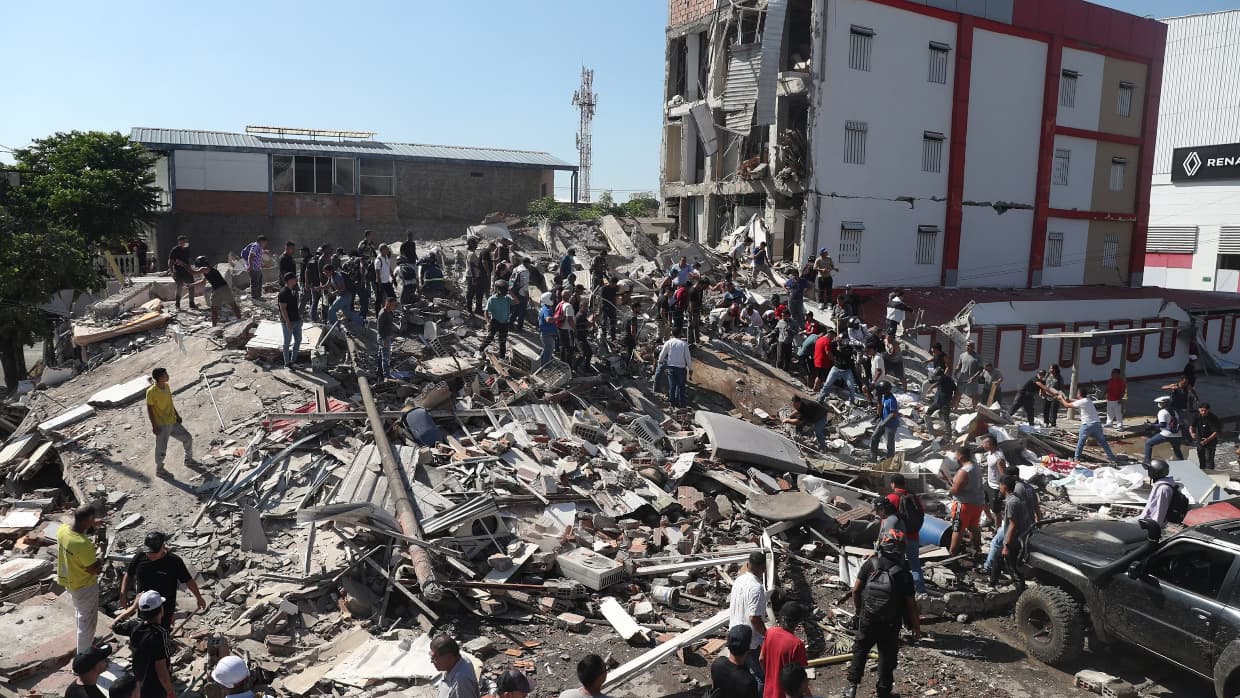
As the roof and walls collapsed around them, Carlos tells me, they crowded into a doorway and hugged one another. Somehow, they made it down five floors and into the street – without a scratch. Their home is a pile of rubble. Yet miraculously, they are alive.
Amidst tears, I call my niece Lina. She tells me that her house, too, has been destroyed. By then, videos are flooding the internet: buildings folded into clouds of dust, streets buried beneath concrete, terrified families searching for one another.
The 7.4-magnitude earthquake struck western Colombia with devastating force. The death toll climbs into the hundreds. Thousands are injured or missing, many trapped beneath collapsed buildings. Electricity, water and communications fail across large areas.
I sit in Jerusalem, staring at images of streets I know. The distance creates a sense of helplessness. I can only keep dialing, sending messages, praying, and waiting for the next fragment of news.
Jewish law prescribes a blessing upon experiencing an earthquake: “Blessed are You, Lord our God, King of the universe, whose strength and power fill the world.”1 The blessing does not explain the tragedy. It acknowledges that we are small, life is fragile and the world is charged with a power beyond our control.
Another thought presses upon me: Why has this happened, and why now?
Only three days earlier, Abelardo de la Espriella had been inaugurated as Colombia’s new president. On the first business day of his administration, the earthquake struck.
The timing is impossible to ignore. Jewish tradition states that an earthquake can accompany the ending of one government and the beginning of another.2
Colombia was undergoing this transition. Under former president Gustavo Petro, Colombia had severed diplomatic relations with Israel, expelled Israeli diplomats, and moved toward opening an embassy in Ramallah.
The new president, De la Espriella, campaigned on an opposite vision. “Colombia will restore and strengthen its relationship with the State of Israel like never before,” he declared. “Israel can count on Colombia as a loyal friend and steadfast ally.”
After his election victory, De la Espriella pledged to recognize Jerusalem as Israel’s capital and move Colombia’s embassy to Jerusalem. On the day of the earthquake, he recognized Israeli sovereignty over the Golan Heights.
Of course, no one knows the heavenly accounting of any natural disaster. Yet Jewish tradition encourages us to use moments of upheaval to shake something within us.
The Talmud3 offers haunting imagery of an earthquake: When God sees Jewish suffering among the nations, Divine tears fall into the sea, causing the earth to tremble. This is obviously not a scientific explanation. It’s a spiritual image of a country reexamining its direction, while the earth shook.
As a recent convert to Judaism (a journey I chronicled on Aish.com), the earthquake carries deeply personal resonance. It struck a region populated by many descendants of Bnei Anusim (conversos), Jews forced to convert during the Spanish Inquisition. Large numbers of Sephardic conversos settled in Colombia’s Paisa region. Across the centuries, some families quietly retained fragments of Jewish memory in surnames, customs and stories whose origins they could no longer explain.
In recent years, small communities of Bnei Anusim have begun returning to full Jewish life. One such community has emerged in my hometown of Pereira. Many of its members are my friends.
One viral video from the earthquake shows a congregation in Pereira reciting “Shema Yisrael” during the morning services, while everything shakes. This was filmed at the home of my friend Devorah, where I’ve spent many Shabbats.
The image moved me: descendants of Jews once forced to whisper their faith, now proclaiming God’s unity aloud, while the earth moves beneath them.
The Colombia earthquake coincides with the beginning of the Jewish month of Elul, leading to Rosh Hashanah. In synagogues each morning, we sound the shofar.
Maimonides describes its message: Awake from your sleep! Arise from your slumber! Turn inward examine your direction in life.4
The shofar is like a controlled earthquake. It shakes souls instead of buildings. It interrupts the familiar rhythm of life and forces the question we spend most of the year avoiding: If everything I take for granted were suddenly stripped away, what would remain?
For my brother’s family, this question is no metaphor. As they stood in the street, shaken to the core, they understood with immense clarity what matters most.
Rosh Hashanah is called the Day of Judgment because all humanity passes before the Creator.5 Yet judgment is not solely about the past. It is also about possibility. What kind of person will I become in the year ahead? What will I rebuild? Which foundations will anchor the life I want to create?
From Jerusalem, I can already hear the shofar’s call, even before it is blown. Wake up! Do not postpone the life you are meant to live. The ground beneath us is never as permanent as it seems.










I read somewhere that many conversos took on surnames of fruit trees. Pereira, meaning pear tree, being the name of your hometown, I suspect that the original inhabitants may gave been conversos.
Who created geology? Not G-d? Billions of coincidences, you think? Does that make sense? Is not every law of geology proof of the Creator?????
Too many "coincidences" in Colombia and Israel alike for this to be a totally random occurrence.
What am I to understand from the fact that a pro-Israel leader was just elected and on hist 1st day an earthquake hit? It seems quite negative.
I have just checked, and apparently the earthquake occurred a couple of hours BEFORE recognition of Israeli sovereignty over the Golan was announced. Actually, it seems almost miraculous that at such a time the president could still be able to concern himself with such a matter.
I understand your thought, because I had a similar fear that non-Jews in particular would see it as a "sign" against Israel. But perhaps, since the earthquake seems to have been concentrated in a mostly Jewish area, it is a call to come home to Israel?
And mostly damaged property while leaving the people intact.
May they be able to rebuild and grow from this terrible tragedy.