 Unity: The Driving Force Behind the Jewish People


6 min read
4 min read
4 min read
4 min read





As the National Ballet of Canada turns 75, founder Celia Franca’s great-nephew is celebrating her life and the Jewish family she came from.
The National Ballet of Canada, one of the world’s leading ballet companies, just turned 75. It’s celebrating with a special season, including performances of original choreography by its founder, Celia Franca. Aish.com caught up with Celia’s great-nephew, Zusha Goldin, who has created a deeply personal tribute of his own, one that highlights Celia’s Jewish family and life.
“I grew up hearing stories about Celia, my glamorous aunt,” Zusha Goldin says.
Zusha’s own childhood looked nothing like his great-aunt’s world. The youngest of 11 children, he grew up in a close-knit Orthodox Jewish family in Brooklyn’s Crown Heights neighborhood, far from the glamour of Canada’s National Ballet. Yet his family was intensely proud of Aunt Celia. “I knew her through photos and stories from my mother.”
When Zusha’s oldest brother married, Aunt Celia came to the wedding, and Zusha remembers the whole family excitedly going to meet her and catch up.
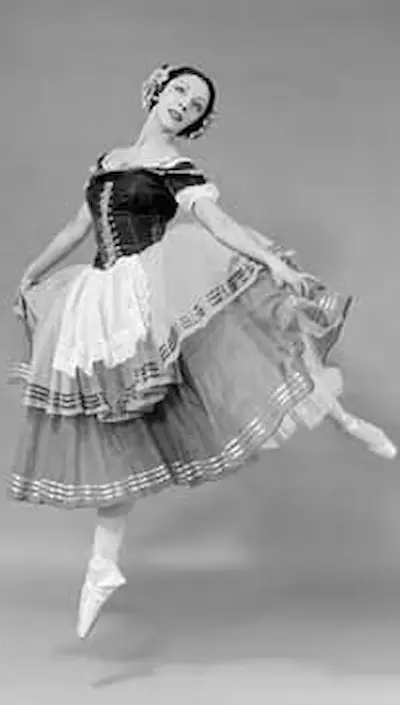
Now a photographer in Los Angeles, Zusha is honoring Aunt Celia’s life and legacy with Becoming Celia, a photographic recreation of her life. His sister Devora bears a striking resemblance to their great-aunt and served as his model for the series.
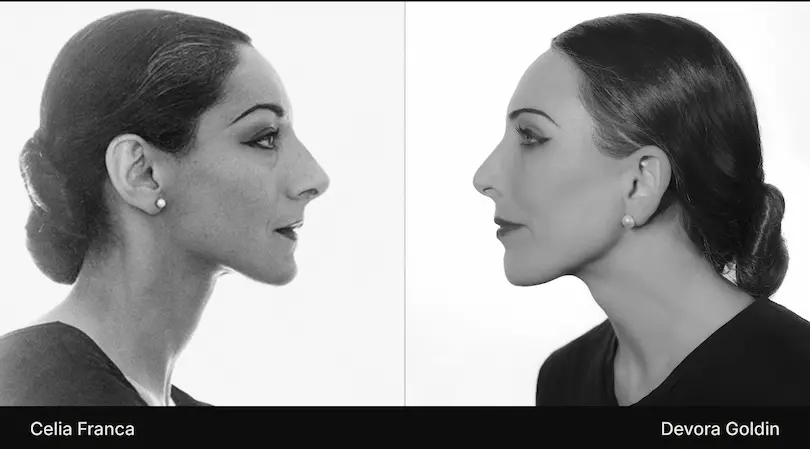 Photo by Zusha Goldin
Celia grew up far from the polished world of ballet. Her parents immigrated to London from Poland and changed their name from Frankelstein to Franks to sound more English. Her father worked as a tailor, and the family spoke Yiddish, like most Jews in London’s impoverished East End at the time. She later said her family had never even heard of ballet.
Celia showed remarkable artistic promise, but her family couldn’t possibly afford specialist arts schools. Instead, Zusha discovered, a group of British Jewish philanthropists changed her life. When she was nine, they awarded her a substantial scholarship to study at the Royal Academy of Dance.
Her benefactors belonged to the Jewish Education Aid Society, which still helps promising Jewish young people in Britain further their education. It was founded by a Jewish fraternal organization, the Order of Ancient Maccabeans, a “friendly benefit society in Britain whose members are Zionists.” Founded in 1896, the Maccabeans are open to all people “of the Jewish faith who declare themselves adherents to the Zionist movement,” and the group still exists in England, offering help to poor Jews.
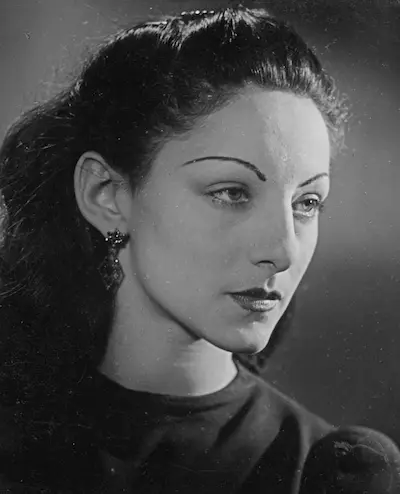 Celia Franca
Celia thrived in ballet school. In 1936, at 15, she joined the renowned Ballet Rambert, changed her last name to Franca, and quickly became one of the company’s most talented members. She worked closely with the rising choreographer Antony Tudor, dancing in the first performances of his Dark Elegies, now recognized as a landmark ballet. At 17, Celia choreographed her first ballet, Constanza’s Lament, set to the music of Beethoven.
At twenty, Celia was hired by Sadler’s Wells (today the Royal Ballet), where she starred in numerous ballets and choreographed two works. During World War II, the arts were a lifeline for millions of Londoners bombed almost nightly by German planes. Celia was proud that she never canceled a performance: “Air raid sirens would go off in the orchestra pit if the planes were coming over from Germany and it was always so satisfying to find that really nobody in that audience ever got up to go to the shelter.”
In her mid-20s she became soloist and ballet mistress with the Metropolitan Ballet, choreographing the very first ballets the BBC ever commissioned for television. She had a photographic memory and could effortlessly recall and picture even the most complicated movements. Over her career, Celia made tens of thousands of meticulous drawings, planning every step of the ambitious ballets she created.
The late 1940s were a time of intense artistic ferment in Canada. A group of philanthropic Toronto women set out to build a national ballet company and asked Ninette de Valois, the acclaimed ballerina who founded England’s Sadler’s Wells Ballet, for advice. Her legendary reply: “Celia Franca, if you can get her.”
Celia arrived in Toronto in 1950 and built a ballet company in record time. She took an office job at a downtown department store to support herself while recruiting dancers. Within ten months, the National Ballet of Canada was up and running. Its first performance took place in November 1951.
“I remember when I first came to Canada in 1951, there were really not too many ballet schools across the country and those we had, most of them…the teachers didn’t know very much about the training of ballet dancers,” Celia later recalled. She helped launch summer ballet programs and teacher training courses and founded Canada’s National Ballet School, dramatically raising the standard of ballet across the country. “We were young, when you don’t get discouraged. You were so eager to get your teeth into a great challenging job and to me that was a great joy.”
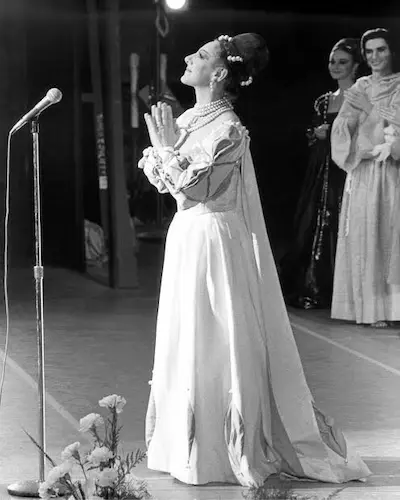
Celia started out as the company’s principal ballerina but encouraged others to take her place, stepping back from that role in 1959. She brought in new works from Canada and abroad, mounted ambitious productions and tours, and recruited dancers from around the world. By 1964, the company had moved into the 3,100-seat O’Keefe Centre in Toronto. (Celia starred in the first performance there, John Cranko’s Romeo and Juliet.) She could be dictatorial and harsh, but she also championed younger artists. “I think I was destined to run a ballet company and push people around,” she once said, calling her years building the company “one continual fight.”
Celia retired in 1974 and passed away in 2007. Zusha notes that while she didn’t live a traditionally observant life, she always had a strong Jewish identity: “As she got older, most of her friends were Jews.” She loved the Jewish foods of her childhood, especially gefilte fish (poached ground fish patties, a staple of Eastern European Jewish cooking).
Aunt Celia has become a major inspiration for Zusha as he builds his own career as an artist. “I felt a really strong pull towards her,” he says, and he began learning everything he could, talking with family, friends, even Celia’s former neighbor. Like Celia, Zusha has charted his own path, finding contacts and mentors in the photography world and moving on his own to a new city, Los Angeles. When he hits obstacles and setbacks, “I ask ‘what would she do?’”
Zusha was especially struck to learn that a grant supporting Jewish artists made his great-aunt’s career possible. Since Hamas’s deadly October 7, 2023, attack on Israel, which killed about 1,200 people and took more than 250 hostages, Zusha has become an activist too, calling out antisemitism and raising money for Jewish artists.
On October 6, 2023, Zusha was in Jerusalem, photographing and filming ordinary people on a city street about their lives for an online project. As Hamas’s attack unfolded, he was flooded with vicious antisemitic comments online. Rather than back down, he channeled his inner Aunt Celia and turned the experience into a powerful photography exhibit. Dozens of people posed holding poster boards with the hateful comments Zusha had received written on them, showing viewers what many Jews face online every day.
 Zusha Goldin, right, receiving an award from ADL CEO Jonathan Greenblatt
Later, as Zusha watched doors close for Jewish artists amid widespread anti-Zionism and antisemitism, he founded Artists for Unity, a group that helps Jewish creatives network and “embrace their identity” as artists. “Institution-building runs in our family,” he says, noting that besides Aunt Celia, another relative founded Europe’s largest hairstyling school in the 1800s.
As the National Ballet of Canada marks its 75th year, it’s spotlighting Celia Franca’s lasting legacy. Zusha hopes Becoming Celia complements those efforts by drawing attention to Celia’s Jewish family ties, her fearlessness, talent and determination, and the way her family carries on her love of the arts.
 Photo by Zusha Goldin
“When I was 17, my sister bought me my first camera,” Zusha recalls. She was working as a teacher’s aide and earning very little, yet she scraped together enough for a professional camera. “I believe in you, and you always wanted to do this,” she told him. Today that same sister, Devora, is the star of Becoming Celia.
“I want people to know that no matter where you come from or what your background is, if you have a vision or you have a dream, you can make it come true,” Zusha says. He credits Aunt Celia with teaching him that “even though it can feel hard, that doesn’t mean dreams can’t come true - you just have to work to find a solution.”