








 As Jewish as a Ham Sandwich
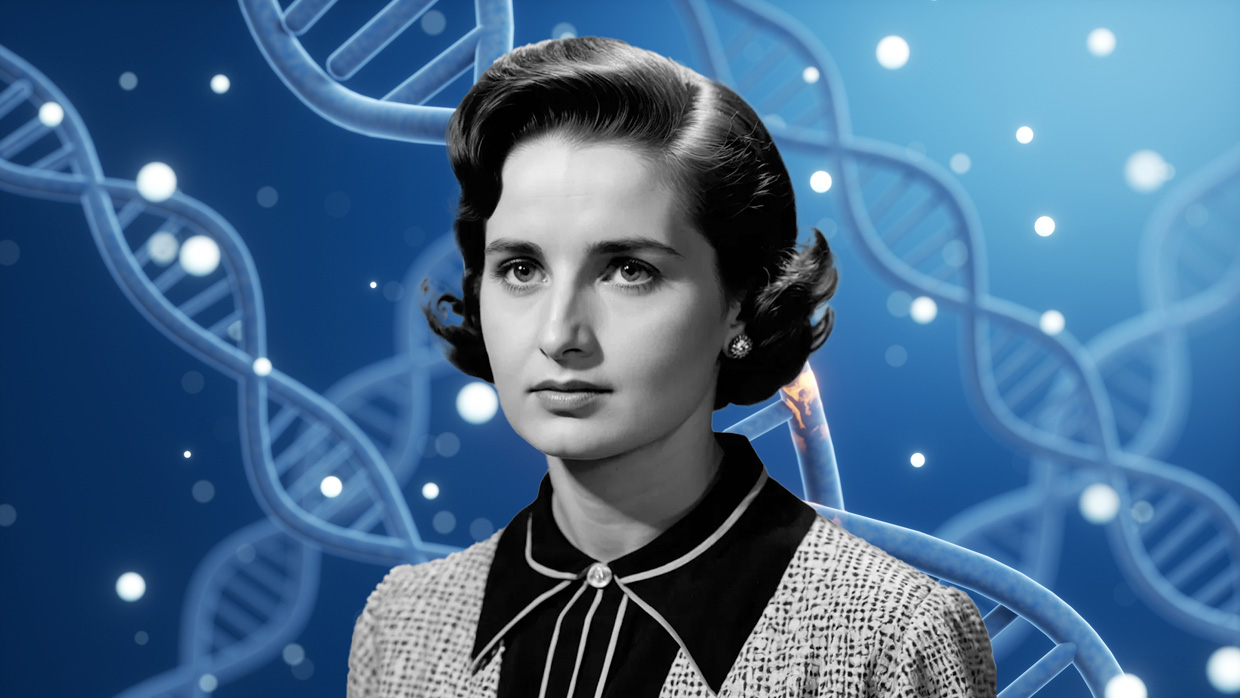






Controversy persists over Rosalind Franklin’s role in unlocking the molecular structure of DNA.
Ask any schoolchild “Who discovered the double helix molecule of DNA?” and their response will be Francis Crick and James Watson. After all, along with Maurice Wilkins, they all won a 1962 Nobel prize for that discovery.
But is that answer totally accurate? Did sexism and prejudice account for overlooking another scientist?
Rosalind Franklin was born into a distinguished Jewish family in the Notting Hill neighborhood of London on July 25, 1920. Her father held positions in both a bank and a publishing house and her mother volunteered for charitable work in their community.
Rosalind displayed exceptional scholastic talent from a young age and attended a private day school in West London at six. When she first encountered the concept of God, she immediately questioned the assumption that God was a male.
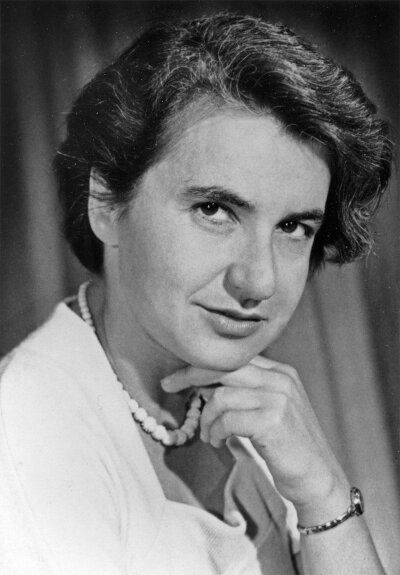 Rosalind Franklin
She progressed to St. Paul’s Girls’ School, excelling in math, science and languages, and became fluent in German, Italian, and French. By the time she graduated, she had earned six academic distinctions.
When she was 17, her passion for science earned her a 1938 fellowship to Newnham College, Cambridge where she joined the Chemistry Society and Archimedians Math Club.
After graduating in 1941, Franklin joined the British Coal Utilization Research Association, focusing on the microstructure of coal molecules. She found that variations in these molecules predicted their suitability for different tasks, leading to advancements in gas mask filter technology for the British Army. She also aided the war effort by volunteering to shelter civilians during air raids.
By the time she was 26, Rosalind had published five papers on her coal research.
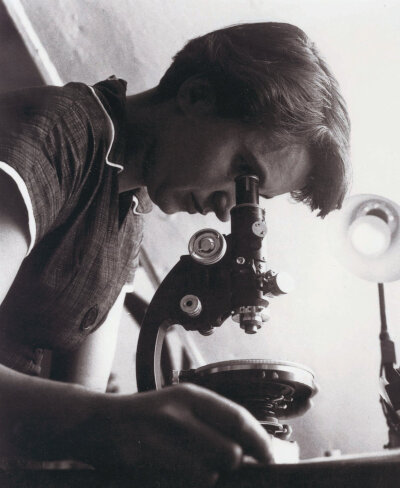
Post-war, Franklin moved to Paris and took a position at the Laboratoire Central des Services Chimiques de L'Etat, where she became an expert in X-ray crystallography, or the use of photography to explore otherwise invisible molecular structures through X-rays.
She moved back to London and a research position at King’s College in 1951 and applied her X-ray crystallography expertise to study living organisms and DNA. The head DNA researcher was Maurice Wilkins and they never really hit it off. Wilkins referred to her as “our dark lady”.
The first time they met, Wilkins thought she was a secretary. Their working relationship never really meshed and he clashed with Rosalind because he expected her to be his assistant and not pursue independent DNA research. In fact, they led separate research groups with separate projects on DNA.
Colleagues around the world were also doing DNA research – Linus Pauling in California, and Francis Crick and James Watson also in London.
At the time, the scientific community somewhat understood that DNA carried a genetic code to act as a blueprint for organisms to differentiate and grow. But a full knowledge of how DNA worked and how it was structured was far from known.
The series of DNA images Rosalind saw with her X-Ray crystallography camera were outstanding. Her best photo was an X-shaped image she titled “Photo #51”. She addressed a scientific conference on her research and shared her unique photos. One of the audience members at her presentation was James Watson.
And this is where Rosalind’s story begins to go sideways. Working conditions at King’s College had become uncomfortable for the brilliant female scientist. She never really felt included in their academic community. After work, her male colleagues retired to pubs that excluded women. Most of the King’s staff had their lunch together in the Senior Common Room, but Rosalind was angered when she learned that women were excluded from eating there.
The uncomfortable working conditions and her clash with Wilkins led her to leave King’s for another job. Before she left, she wrote a detailed executive summary for King’s highlighting the key achievements of her X-Ray crystallography research and photos.
Somehow, James Watson and Francis Crick ended up with the executive summary of her research, and Wilkins probably shared Rosalind’s “Photo #51” with them. But seeing Rosalind’s groundbreaking image was enough for Watson and Crick to have an epiphany.
Watson later wrote: “The instant I saw the picture my mouth fell open and my pulse began to race.”
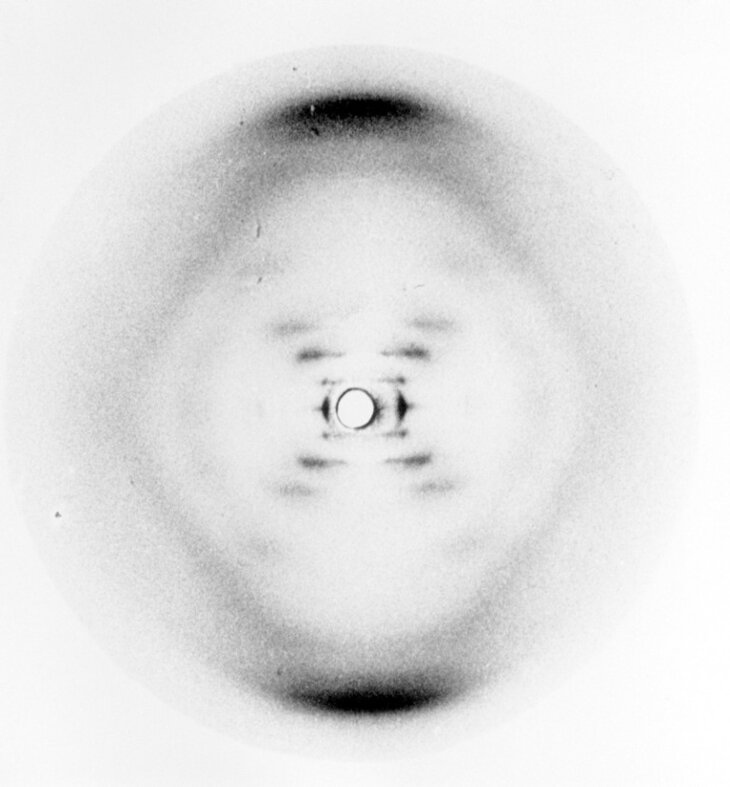 Photograph #51, Credit: King's College London Archives/Science Photo Library
Watson and Crick analyzed Rosalind’s mathematical research and photo to theorize that the geometric shape of her coiled images had to be a pair of spirals, or a “double helix”. They saw how this shape could split evenly down the center and replicate itself. The two men had now developed an accurate representation of the DNA molecule and the key to understanding genetics.
In 1953 the big story in the scientific community was Watson and Crick’s publication of a fresh model of the DNA code that included Franklin’s “Photo #51” and portions of her research. To the world, Watson and Crick discovered the structure of the double spiraled DNA molecule and its role in heredity. While Wilkins was recognized as one of the researchers, Rosalind Franklin's contributions were neither credited nor mentioned.
Rosalind died of ovarian cancer in 1958 at the young age of 37. Four years later, Watson, Crick, and Wilkins won a Nobel Prize for Physiology or Medicine in 1962 for their discovery of the double helix. Rosalind’s role as a catalyst and contributor to Watson and Crick was never disclosed. She had always presumed that the three had made their “discovery” independent of her findings.
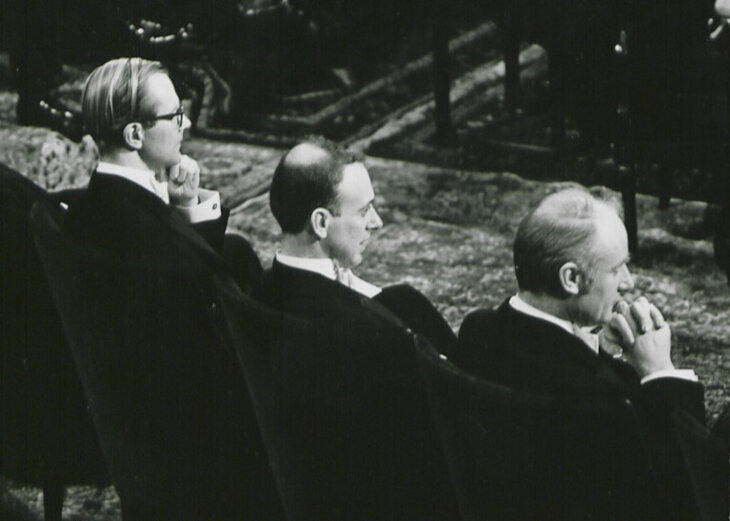 Maurice Wilkins (left), James Watson and Francis Crick at the ceremony for the 1962 Nobel Prize in Physiology or Medicine.Credit: King’s College London Archives
Her role in the discovery of the double helix came into a new light when Watson published a book in 1968 about the discovery. Some of his quotes in “The Double Helix” are incredible to read.
“She was a belligerent, emotional woman unable to interpret her own data. Clearly, Rosy had to go or be put in her place, there was no denying she had a good brain. If she could only keep her emotions under control, there would be a good chance that she could really help. She was not unattractive and might have been quite stunning had she even taken a mild interest in clothes. This she did not.”
Her legacy is shrouded in a complicated cloud of controversy, moral, legal, and ethical questions.
Was Rosalind Franklin robbed of receiving the Nobel Prize? Was her crucial role in deciphering the structure of DNA downplayed because it was deemed secondary to the work of Crick and Watson? Is scientific advancement driven by individual breakthroughs or a series of incremental contributions? Did Crick and Watson appropriate her research without proper acknowledgment? Was their usage of her findings aligned with accepted academic standards?
To what extent was her omission from scientific recognition influenced by her gender? How much of her exclusion was rooted in underlying biases of sexism, misogyny, and antisemitism?
Historians have pointed out that the rules of the Nobel Committee worked against her.
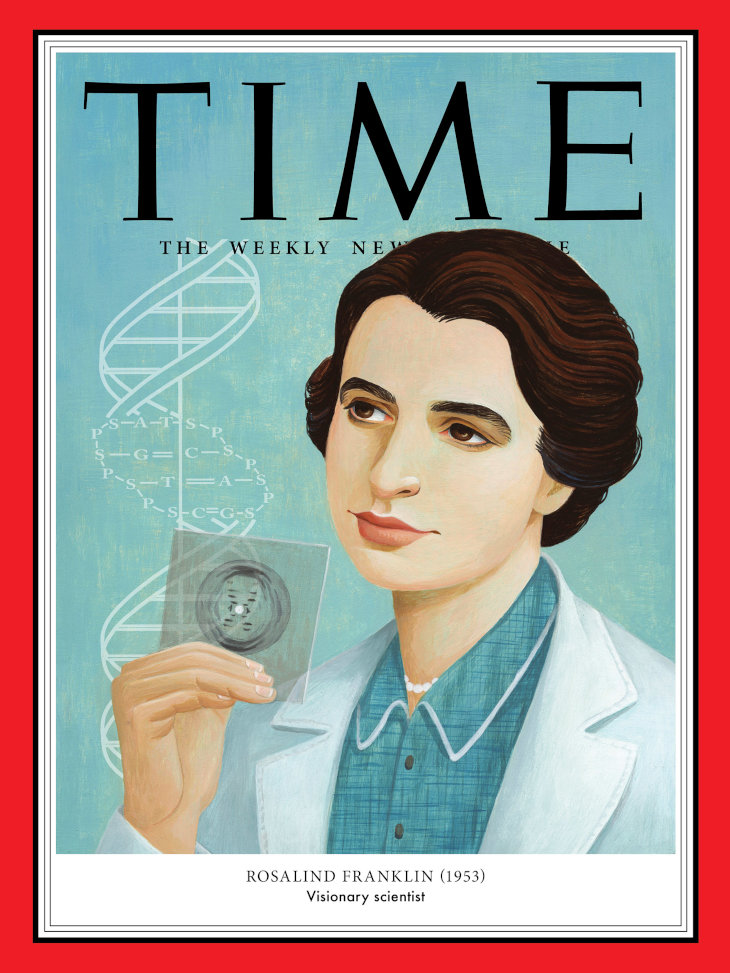
When Watson, Crick, and Wilkins won their Nobel Prize in 1962 the rules limited no more than three winners for a single Nobel Prize. At the time, there was a provision in place to allow the awarding of an additional posthumous Nobel Prize, but that feature was eliminated in 1974. This effectively eliminated Rosalind from future consideration.
In 1998 the National Portrait Gallery of London hung Rosalind’s photograph to join a grouping with those of Wilkins, Watson, and Crick.
The Chicago Hospital-College of Medicine was renamed in 2004 as the Rosalind Franklin University of Medicine and Science.
In 2015, Nicole Kidman starred in “Photograph 51”, a play about Rosalind at the Noel Coward Theater in London.
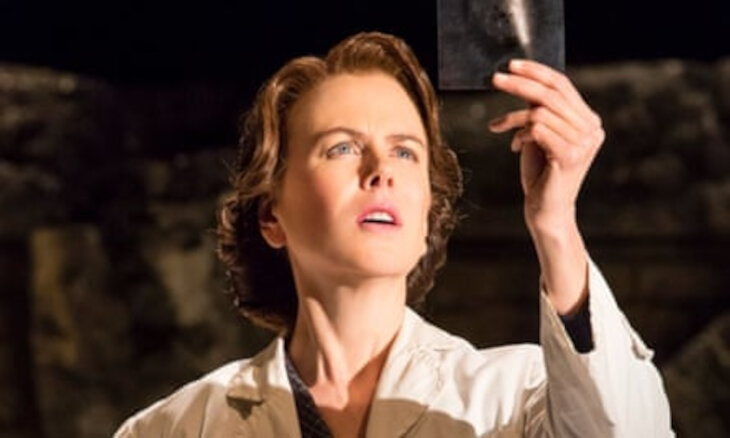 Nicole Kidman in the play “Photograph 51”
In 2023, “Double Helix”, a musical opened in Sag Harbor, New York setting Rosalind’s life story to music.
Another honor came from the European Space Agency who named their ExoMars Rover the “Rosalind Franklin”. The name was chosen by a panel of experts out of 36,000 entries. The ESA’s mission to Mars was set for July 2020 and is now delayed until 2028 because of the Russian invasion of Ukraine.
ESA Director General Jan Woerner eloquently paid tribute to Rosalind Franklin when he said, “This name reminds us that it is in the human genes to explore. Science is in our DNA, and in everything we do at ESA. Rosalind the rover captures this spirit and carries us all to the forefront of space exploration.”











The thesis that
Rosalind Franklin was mistreated is true, but the issue was the structure of the DNA molecule, not its discovery. Watson aknowledges this is later writings.
There are many interesting details about the complex relationships between the main participants in the DNA race in the Howard Markel
s book:The Secret of Life: Rosalind Franklin, James Watson, Francis Crick and the Discovery of DNA’s Double Helix`.Is that a real cover of Time or a fake? Unexplained, it only contributes to the dishonor you report.
yes, of course it's real
My mother was also incredibly intelligent and did 2 degrees at night school having left school at 14. One was physics, chemistry and maths, the second was in chemistry. She failed to get a first as she couldn't translate the compulsory German paper. She worked for the Dutch government in London during WWII and was recognised as the brilliant woman that she was. However, after the war she wanted to do research in silicons but as a married woman she wasn't allowed to. Even if she hadn't been married, I doubt that she would have been allowed as there were all of the second class men who needed a job. I deliberately didn't go into science because of the way that women were still regarded in the 1970s/1980s. In fact, women still are.
This article reminds and outrages me of how unfair the workplace has been to women historically. To be a brilliant jewish woman as Rosalind Franklin and having doors blocking her from full entry must have been humiliating. I hope she continues to receive posthumously some of the recognition that was due her in her lifetime.
Unfortunately, even until recently, women were never considered equal to men in science. "As late as 1999, women who succeeded in science were called 'exceptional' as if it were unusual for them to be so bright." I suggest reading the book "The Exceptions: Nancy Hopkins and the Fight for Women in Science". It's a very well written book and a real eye-opener.
The Double Helix is wrong: there is no mutual twisting of the two strands -- they run in parallel. I proposed a different model, it is described in the article
https://www.researchgate.net/publication/339106477_DNA_the_Double_Helix_or_the_Ribbon_Helix
Rosalind Franklin was pretty much right. As Aaron Klug wrote,
Her notebooks for the winter of 1952—53 show her considering a variety of structures including sheets, rods made of two chains running in opposite directions...
A long overdue tribute to a great scientist.
Even though - Jews make-up a large proportion of Nobel winners. This kind of displacing of Jews - was not limited to incidents like this - in medicine either. Research discovered that - the designer of the Volkswagen/Porche cars - was originally a Jew - Josef Ganz - who was also left out of the limelight.