




 Trump's Shabbat Proclamation and America's Founding Promise

4 min read
4 min read
5 min read
4 min read


3 min read


Through gratitude, memory and presence, Judaism reveals how to root happiness in blessing rather than pursuit.
Joy is elusive. We chase it in possessions, achievements, and experiences, only to find it slipping through our fingers. Judaism offers a different truth: joy is not pursued, it is built. Its foundation is gratitude.
The poetic and psychologically profound mitzvah of Bikkurim, offering of first fruits, sheds some light. After months of labor, a farmer brings his harvest to the Temple in Jerusalem and makes a formal declaration. This is no tax and no tithe. It is a ritual of memory and gratitude, personal and profoundly national.
The farmer recites a sweeping history, ancestral exile, slavery in Egypt, divine redemption, and arrival in the Promised Land. Only then does he offer his fruit. It is not just food. It is memory you can touch, history you can taste. Blessing rooted in suffering, watered by promise.
The Torah then commands: “And you shall rejoice in all the good that God has given you and your household.” (Deut. 26:11)
This is not an afterthought. It is revelation. Gratitude produces joy. By tracing our blessings back through time, we cultivate the emotional soil in which joy grows.
Modern psychology echoes this. Gratitude shifts our focus away from fear and scarcity toward abundance and connection. Even simple gratitude practices consistently boost well-being more than material gains or fleeting pleasures. Gratitude interrupts the brain’s negativity bias and makes space for joy.
When happiness is a pursuit, it always feels just out of reach. The endless pursuit feeds a consumer economy where spending is the engine, but satisfaction is always delayed. The result is a culture that consumes more than any nation in history, yet struggles with rising depression, anxiety, and record prescriptions of SSRIs. Jewish wisdom cuts through this cycle. Joy is not purchased, it is practiced. It doesn’t come from pursuit but from presence.
Gratitude is a discipline. Through rituals like the first fruits, blessings after meals, and beginning each day with Modeh Ani, gratitude becomes action, regular, deliberate and enduring.
The Mishnah asks: “Who is rich? One who rejoices in their portion” (Ethics of the Fathers 4:1). Richness isn’t measured by possessions but by the capacity to create joy from what we already have. The emphasis is not on the portion itself but on the act of rejoicing.
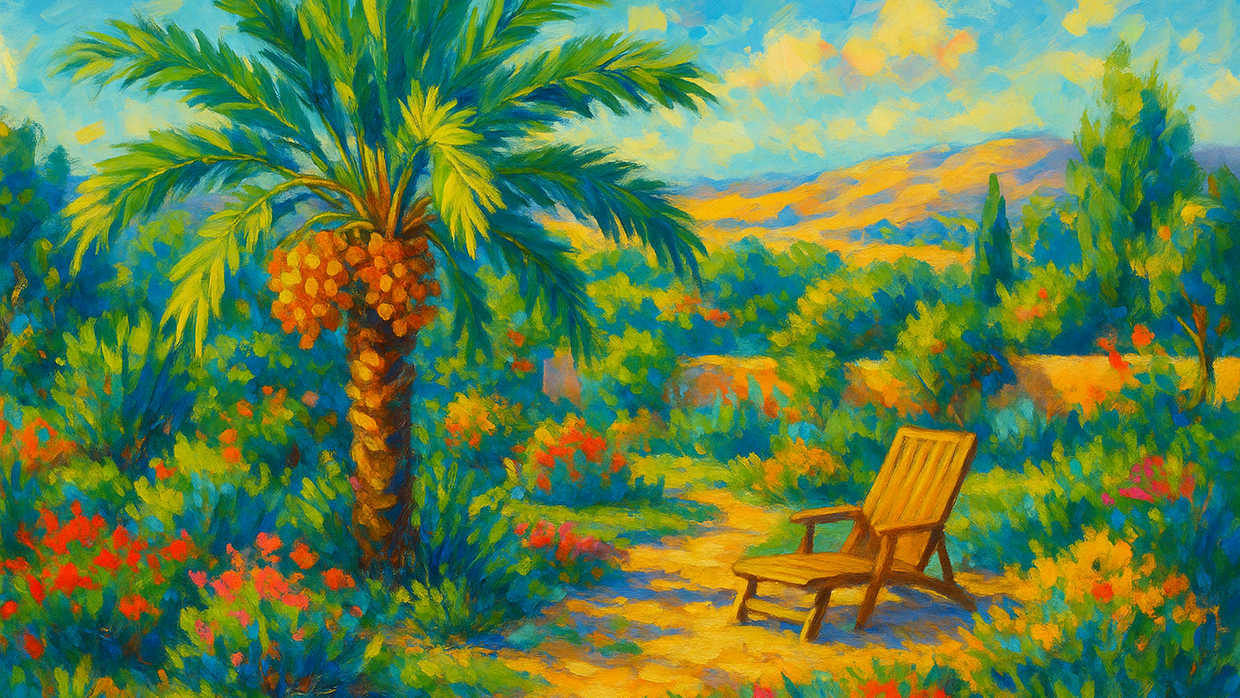
I’ve been thinking about this a lot recently. My family just moved to a modest home in Israel. It is not large, yet it has a yard, a patch of earth with a date tree. And when I see that tree, I feel what the first fruits is trying to name because I am the grandson of a Holocaust survivor. My grandmother did not wander in Aram. She wandered through Bergen-Belsen and Auschwitz. She was enslaved by the Germans. Half her family was murdered. Yet through some improbable, divine orchestration, I now live in the land she could barely imagine.
She survived and we returned. And I, her grandson, have not only freedom but a date tree of my own in the Promised Land.
These are my first fruits.
Judaism trains us never to take life for granted. That is a challenge for our generation. We can book a flight to Israel, visit the Western Wall and plant a tree with the JNF – and still forget how extraordinary it is “to be a free nation in our land.” The first fruit refuses to let us forget. It opens our eyes to how unlikely, orchestrated and blessed this moment truly is.












Yes beautiful and it is within all of our grasps.
Beautiful reminder- thank you!!
Wonderful to read. My first thought was that in fact Yehudi, Jew, from יהודה, Yehuda, means part gratitude, as the simple word Toda תודה, and praise. (הודו (ליהוה כי טוב. Thank - and praise- God for he is good. Same root. I guess we carry these notions in our very millenarian soul DNA.
I love the JNF also.