







 Those Shameful Thoughts and What They Really Say about You

5 min read
7 min read





Chasing happiness can backfire. Dr. Tal Ben-Shahar shows why embracing pain, reframing stress, and practicing gratitude unlock a deeper, more fulfilling life.
As a student and teacher in the field of happiness studies, people often assume I’m always happy. Surely, someone who has dedicated himself to studying the science of happiness has it all figured out, right? The reality is a happy life doesn’t mean being happy all the time. In fact, to understand happiness it’s equally, if not more, important to accept and embrace painful emotions.
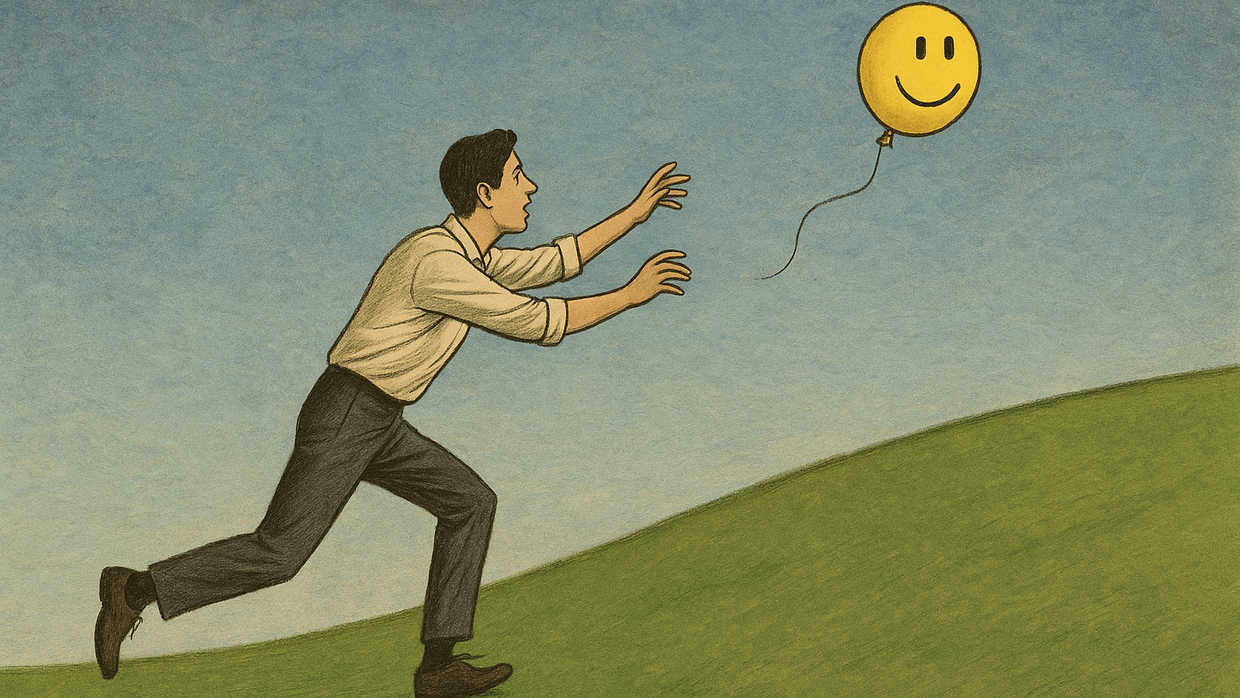
Therein lies the paradox of happiness.1 We know it’s a good thing, but at the same time research shows that people who pursue it are more prone to depression. In other words, their quest for happiness makes them less happy. So if not happiness, what then should we strive for?
I’ve found answers in my 25 years as a positive psychologist, examining and conducting research using questionnaires or brain scans like EEGs and FMRIs in labs, from New York to Beijing.
Happiness, it turns out, is best pursued indirectly. Just think of the sun. Observing it with the naked eye is unpleasant — painful, even. Yet when Isaac Newton experimented with letting sunlight pass through a clear glass prism, he discovered the rainbow of colors that make up the whole. We are more successful finding happiness when we break it down into its elements.
What makes positive psychology different from traditional psychology is that instead of trying to fix what’s wrong, we focus on what works.2 Here, I’ll explore three major metaphorical colors of the rainbow, the elements of happiness.
Sadness, anger, disappointment, guilt, fear, frustration, envy — these emotions can be painful. There are only two kinds of people who do not experience them: psychopaths and dead people. If you’re experiencing painful emotions, we can deduce you aren’t a psychopath and you’re alive. And that’s a good place to start.
Those who don’t know how to weep with their whole heart, don’t know how to laugh either. — Golda Meir, Prime Minister of Israel, 1969–1974
Feeling bad isn’t a bad thing, but in our society it’s not exactly something we are taught to feel proud of or to embrace. Scroll through your social media and you might get the sense that everyone is doing great — much better than you are. We don’t post about the fight we had with our partner last night, our children’s tantrums, or our jealousy over an acquaintance’s picture-perfect vacation. Instead, we portray ideal versions of our lives and ourselves, and we get distorted expectations because of it.
Some of the best advice I ever got was from our pediatrician. Six hours after my son David was born in Boston, our pediatrician, Dr. Shapira, came to check on him and my wife. Just before he left the room, he paused. “Over the next few months, you’re going to experience every single kind of emotion to the extreme — extreme joy, extreme frustration, extreme love, and extreme anxiety. It’s fine, it’s natural, and we all go through it.”
After about a month, for the first time since my wife and I connected at the Bnei Akiva youth movement at the age of 14, someone else was getting more attention than me. I noticed I was starting to feel some envy toward David. Normally, I might have judged myself. What kind of person is jealous of their newborn son? But because I had Dr. Shapira’s words in my mind — “it’s fine, it’s natural, and we all go through it” — essentially giving me permission to be human, I accepted the emotion and it passed, making room to feel love for my son.
What we resist persists. When we embrace unpleasant emotions, they flow through us and leave.
When we repress and suppress painful emotions, they intensify. When we acknowledge them and allow them to flow through us, they don’t overstay their welcome. What we resist persists. When we embrace unpleasant emotions, they flow through us and leave. So how can we better embrace the full scope of our emotions? Consider any of the following: keeping a journal, venting to a friend, speaking to a therapist, or having a good cry. With acceptance, we have control to choose the best course of action.
So if we want to experience happiness, we must allow ourselves to also experience unhappiness. Indeed, the research backs this up. To understand why this contrast is so essential, think of the last great biography you read, watched, or listened to. I often say the best self-help books are biographies. They include the ups and downs, the weaknesses and strengths. And it’s no coincidence that the Torah is filled with biographies and stories about people who make mistakes, experience painful emotions to their extremes, and move ultimately forward with acceptance.
Those stories teach us perspective. When we see the high points of someone’s life juxtaposed with their lowest lows, we gain insight about how acceptance of our emotions, trust, and a plan of action combine for a meaningful life.
You’ve likely heard by now that stress isn’t good for you. “Stress a Silent Killer,” “Your Heart’s Worst Enemy,” news headlines warn.3 The World Health Organization says we’re dealing with a stress pandemic and governments around the globe are taking steps to address it.
“The amount of information we take in each day has rapidly increased over the years.4 Research shows that in 2011, Americans absorbed five times more information each day than they did 25 years earlier. This equates to roughly 174 newspapers of additional information.”
But what if I told you that stress is not the enemy? Through decades of research, my colleagues and I have found that stress can actually be good for us. Take your exercise routine, for instance. You go to the gym and lift weights to stress your muscles so they’ll grow bigger and stronger. This is antifragility, a concept introduced by Nassim Taleb, in practice. Resilience is the phenomenon of putting pressure on a system and seeing it bounce back once that pressure is lifted. Antifragility goes a step further: The system actually grows stronger from stress. The same idea applies to psychology. The science of happiness teaches us there are conditions we can put in place to increase the likelihood of growing from hardship.
We grow stronger from stress, but it’s essential to have bouts of recovery.
So if stress isn’t the problem, why is it making us so sick? Again, think of the gym analogy. If you lift weights every day and never give your body time to recover, chances are you’ll get injured. If we don’t prioritize recovery, we suffer.
The goal, then, is not eliminating stress from our lives completely. It is energizing our lives with periods of recovery when we meditate, spend time with a friend, take a walk around the block, work out at the gym, or share a meal with family. These bouts of recovery can look different. A colleague of mine once worked with a Wall Street firm. The organization was seeing high levels of burnout, sick employees, turnover, and a lot of stress. My colleague suggested that every two hours the company’s workers take 30 seconds to close their eyes and take three deep breaths. They set reminders, determined to fix their stress pandemic. And what do you know — those 30 seconds, or micro-breaks, as psychologists call them, might seem insignificant, but with consistency they make a big difference. So do mid-level breaks, like a good night’s sleep. Research out of Stanford, UC Berkeley, the University of San Diego, and UC Riverside has shown the benefits of sleep for both mental and physical health.5
Or think of God — He took a day off. We too can get more done in six days than in seven. With rest, we’re more creative, more productive, and happier. Lastly, there’s macro-level recovery. This is the kind of rest you get from taking a vacation, and U.S. workers aren’t getting enough of it. A staggering number of people say that even while on vacation they spend about an hour a day working.6
Mindfulness is another way to foster antifragility. Professors Jon Kabat- Zinn and Richard Davidson conducted a study in which people who had never meditated before were put on an eight-week program.7 By the end of the study, with meditation they found anxiety levels had plummeted, and participants were more social, friendly, generous, and kind to other people. Even more incredible, when the researchers collected blood samples from the group, they found the meditators actually strengthened their immune systems. These benefits were equal regardless of whether the students meditated for as much as 50 minutes a day or as little as twice a week.
All this psychological research reinforces something that Judaism has been teaching for thousands of years. Our tradition is constructed around recovery. Brachot, reciting blessing, help us on a micro-level. They provide a chance to pause in the day-to-day rush; beyond a 30-second micro-break, they connect us with meaning.
Likewise, Shabbat gives us mid-level recovery every single week, rain or shine. Then there are longer, macro-level opportunities for recovery, like holidays. We take time off, slow down, and adhere to nature. Each of these traditions also encourages mindfulness — the importance of being in the present moment.
But it’s not only breaks that are important, it’s also how we approach a task.
The Jewish idea of doing actions with intention, kavanah, emphasizes the value of being present. Kavanah is the act of directing our attention to an action so it is done with purpose and meaning rather than in a rote, mechanical manner. If we cannot be present, if our mind is elsewhere, we will not enjoy the blessing of the moment and will miss the joy it can offer.
Embracing painful emotions and giving ourselves the recovery time to process and meditate on them is critical — but how do we then cultivate pleasurable emotions? The answer is gratitude.
Gratitude is essential to cultivating pleasurable emotions.
Research shows that keeping a gratitude journal makes us happier and healthier. Even spending one minute a day — or one minute a week — to write down what you are thankful for can have remarkable benefits. Or you can go even further, and write a gratitude letter.8 The founder of the field of positive psychology, Marty Seligman, once asked his class to write a letter of gratitude and then share it with the person they wrote it to. He said that in his 40 years of teaching, he had never encountered a more positive experience. So I tried it with my own students.
John was a big guy, playing on the Harvard varsity football team. I could see him all the way at the back of the lecture hall where he’d take his seat every day. But a week after I had assigned the gratitude letter, instead of filing out of the room when class was over he made an appointment to visit me during my office hours.
The next day, the football star sat in my office, visibly uncomfortable. He told me he had written his letter to his father and read it to him over the weekend. “After I read my father the letter, my father hugged me for the first time since I was eight years old.”
That’s why my favorite English word is appreciate. It has two interconnected meanings. Its first definition is to say thank you for something, but its second meaning is increasing value. When you appreciate the good, the good appreciates. Too often we forget the miraculousness of day-to-day life. In his research on terminally ill patients, Irvin Yalom, professor emeritus at Stanford, commonly heard things like “for the first time in a very long time, I truly appreciate my life.” The challenge for us as humans is not to wait for something external and tragic to happen to appreciate what’s inside us and around us. It’s not hard to do, but we need reminders. Rituals such as our family Shabbat dinner go around can provide them.
Gratitude is a powerful thing. As a family, every Shabbat dinner we go around the table and say one thing we are grateful for and a kind act we did or observed in others. If nothing comes to mind, we make one up. It’s important for all of us to hear for one simple reason: We often take for granted the goodness around us. “The basis of the Torah is gratitude,” said Rabbi Berel Wein. “Gratitude to our parents, teachers, elders and even to governmental authorities. The attitude of Judaism towards life generally is that everything is really a privilege, even life itself. It is easier to deal with the challenges that life impresses upon us if one views it from the vantage point of privilege rather than of entitlement and rights.”9
We’ve explored the benefits of gratitude, recovery, and wholeness. Yet the real challenge is putting them into action. In his book The Effective Executive: The Definitive Guide to Getting the Right Things Done, consultant and educator Peter Drucker discusses the importance of introducing behavioral change as rituals.
Consider which prism is especially important for you at this stage in your life — giving yourself permission to be human, providing yourself with recovery time from stress, or focusing your attention on the good. Next, find a manageable action you can regularly take — something small — to put this priority into practice. Go for the low-hanging fruit.
Introduce these ideas as rituals day in and day out, and your neural pathways will change. When your neural pathways change, your behavior will change. When your behavior changes, the behavior of those around you will change too. If you increase your levels of well-being, you are not only impacting the quality of your own life, but you are impacting the quality of all those who you encounter. Happiness is contagious.
Excerpted from the new anthology The Art and Practice of Living Wondrously, published by Maggid Books and Momentum Unlimited. The book features original essays by 37 world-renowned experts who explore what science & Jewish tradition teach us about relationships, mental health, well-being, raising resilient kids & being an agent of hope. Click here to order.













Thank you for this
This article has come to me just at the right time. I needed to read that sadness anxiety etc. is not a brick wall that is impassible.
Like many in Israel and around the world, this continuous war in Israel, both internally and externally, has played havoc on my perspective on life generally and personally.
I became ill with Shingles and Impetigo in July and suffered greatly. But the silver lining ( now that I’m cured? Appreciation for being able to do, what seemed so insignificant and gratitude for my life and a renewal of both for my family and friends.
In reading this article, I find an affirmation of what I have experienced from those much wiser and more learned than i. That has been a huge boost to me.this article is giving me the pointers to improve my life view. .
MAKEWAVS (NY license plate I saw)
=============================
I wonder what the car owner had in mind, but maybe he or show, was thinking about the value of WAVING to people. This is something I have been trying to do, all the time, since Covid came. It really is uplifting, and I find many people wave to me, before I wave to them. It cheers me up and opens me to show appreciation and respect to others, all the time.
"ASSUME A VIRTUE IF YOU HAVE IT NOT" Hamlet
YES!!! And every blessing we make throughout the day is a chance to experience joyful gratitude!
Thank you, Tal, for demonstrating the numerous ways in which positive psychology and Judaism intersect to guide us in implementing the profound wisdom of our tradition.