







 The Quiet Erasure of Jewish Artists in America

10 min read
6 min read





Discovered in a cave in Afghanistan, the oldest intact book written in Hebrew is going to be displayed in the new exhibition at the Museum of the Bible, opening on September 24th.
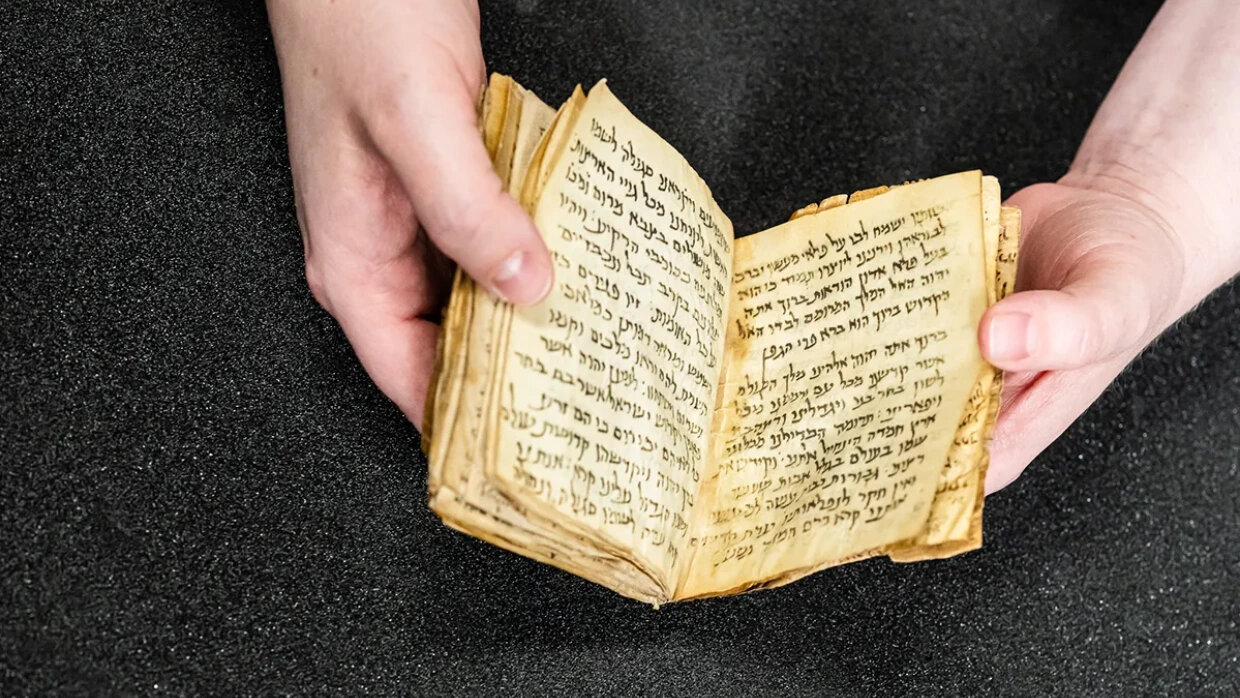
Called Afghan Liturgical Quire (ALQ) by researchers, the book was dated to the 8th century CE.
A quire is a manuscript that looks like a modern-day book. Earlier manuscripts are scrolls, where each subsequent page is sewn to the previous page. In order to read the next page, the reader needs to unroll the scroll. In a quire, the pages are folded and sown together at the folds so that the reader needs to turn pages, just like in printed books today. Unlike in a scroll, writing appears on both sides of each page.
Though earlier Hebrew manuscripts have been discovered, they are written as scrolls, such as the Dead Sea scrolls. The ALQ is the earliest manuscript that is shaped as a quire, or a book.
Written in Hebrew script easily readable today by anyone familiar with Hebrew prayer books, the ALQ contains Shabbat prayers, liturgical poems, and parts of the Passover Haggadah.
The ALQ was discovered in a cave in Afghanistan. Herschel Hepler, Museum of the Bible’s associate curator of Hebrew manuscripts and curator of the ALQ exhibition, says, “According to my 8 years of research and work with contacts in the region, we believe it was discovered in one of the Bamiyan Valley’s caves by a Hazara man who was moving foodstuff and supplies in summer 1997.”
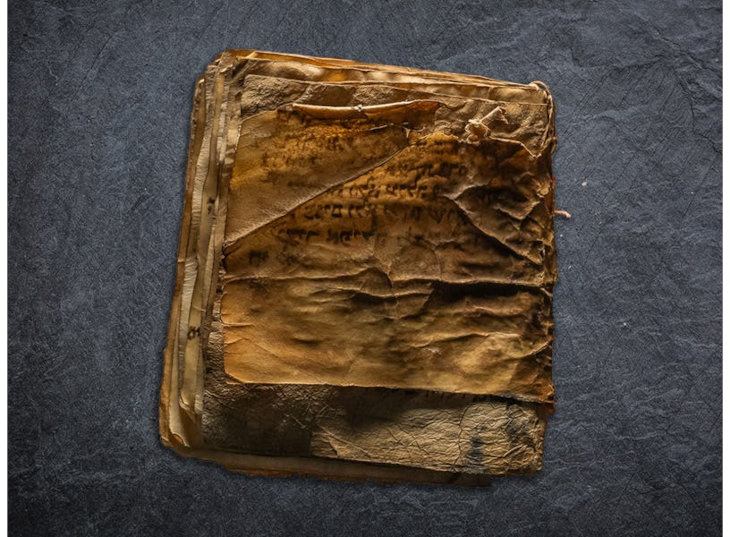 Front cover of the Afghan Liturgical Quire, the oldest Hebrew book.
Hazaras are a persecuted ethnic minority in Afghanistan. They protected the ALQ as a sacred book until it was taken out of Afghanistan in 2001.
Originally, scholars thought that the manuscript was part of the Cairo Genizah. In 2013, Hobby Lobby purchased the ALQ from an Israeli dealer under that assumption. But when Hobby Lobby donated the ALQ to the Museum of the Bible in 2015, the museum’s scholars realized that the new acquisition was much more significant than they’d thought.
Hepler calls the discovery “a gamechanger.” He says, “The ALQ’s significance is multifaceted. Dating to the 700s, it is the oldest Hebrew codex ever discovered. It’s Sabbath morning prayers, piyyutim (poems) for Sukkot, and partial Haggadah (mysteriously written upside down) predate Amram Gaon’s standardizing of a Siddur in the mid-800s. It predates the other two earliest Haggadahs, the Dropsie Haggadah and a Haggadah manuscript at Jewish Theological Seminary, by more than 200 years. Its content and structure offer a whole new dataset for scholars in Jewish liturgy and Hebrew codicology.”
In the upcoming exhibition, Sacred Words: Revealing the Earliest Hebrew Book, the ALQ will be on public display for the first time at the Museum of the Bible in Washington, D.C.
It took much interfaith and international effort to put together this exhibition. Hepler says, “[D]uring these complicated times, this sacred book brought together Afghan Jews, democratically elected officials from Afghanistan, and Museum of the Bible to ensure safe access for everyone, especially the displaced Afghan Jewish community.”
At the exhibition, the visitors will hear surprising stories from Afghanistan and the Silk Road. In addition to the ALQ, visitors will see Mishnah fragments from the Cairo Genizah that date to 841, a Haggadah manuscript that dates to circa 1000, the exquisite Prato Haggadah, and a 2nd century Budda Head that the King of Afghanistan gave President John F. Kennedy in 1963.

Hepler says, “Guests will see how sacred books are respected and beloved by Christians, Jews, and Muslims, exemplified here by Afghanistan officials who made sure this sacred book remained accessible in Washington D.C. It seems only fitting that a small book of prayers would initiate such a beautiful interfaith partnership. We are grateful to the Afghanistan officials and our Afghan Jewish community partners—the Afghan Jewish Foundation, the American Sephardi Federation, and Congregation Anshei Shalom of Jamaica Estates (the only Afghan synagogue in the United States).”
In the Middle Ages, Afghanistan was home to a thriving Jewish community. Information about the community’s daily life was discovered in what researchers call the Afghan Genizah – a collection of about 250 documents detailing the lives and business dealings of the Abu Nezer family residing in Bamiyan, a commercial center located on the famous Silk Road.
The city of Bamiyan was destroyed during the Mongol invasion in the 13th century. Historians presume that the Jewish community was destroyed as well.
Among the Afghan Genizah collection are Biblical and Talmudic texts in the original Hebrew, a Biblical commentary in Persian, legal documents in Aramaic and Persian, and a merchant’s account book.
The collection was discovered in a fox cave in Afghanistan by local villagers. Part of the collection was acquired by the National Library of Israel of 2013, where it is currently located.
In the first half of the 19th century, many Persian Jews escaping persecution and forced conversion relocated to Afghanistan. They lived in the cities of Herat and Kabul. However, the Jews in Afghanistan faced increasing persecution and pogroms.
The majority of the Jewish community left Afghanistan in the 1960s. Most Afghan Jews moved to Israel. Some moved to America and Europe.
After Taliban’s takeover of Afghanistan, only a handful of Jews remained in the country. They were threatened and persecuted, and the last Jews left Afghanistan in 2001. Currently, no Jews remain in Afghanistan.
When Jews left Afghanistan, they left behind synagogue buildings and Jewish cemeteries.
The Jerusalem Post reports that Muslim residents of Afghanistan have been involved in restoring Jewish sites.
In 2013, Osnat Gat, an Afghan Jew living in New York, received a message from a Muslim engineer from Herat, Afghanistan, offering to assist with restoration of Jewish sites in Herat, including the cemetery where Gat’s ancestors are buried.
At first, Gat was suspicious of her correspondent, but after additional communication, she was convinced that the offer had been sincere.
Gat mobilized the Afghan Jewish community in New York, and many of its members contributed to the project. She worked with both the U.S. and the Afghanistan government to obtain the necessary permits. After five years, the cemetery was restored in accordance with Jewish law.










Some here have expressed doubt at the provenance of this object.
Where and when and by whom was it dated?
Also, are there any DNA, mRNA studies done on Pashtoons; the technology and the ethnic databases are readily available to the academic community.
The Museum of the Bible says, "A detailed exploration of the ALQ’s provenance is available upon request." Feel free to contact them and let us know what you find out!
From what I've seen, DNA studies on the Pashtoons did not show any connection to Jews, but I haven't researched the topic.
I contacted them and asked them. They would get back to you in hours. They did not reply for days. I reminded them. No response. Who told you they would? Sadly, it gives the impression they're making money from a fake and know it.
Sorry, but from the many writings I have seen and worked with, this is not 8th century script but much later (500-900 yrs old). The nosah (text) does seem to be the old Eretz Yisrael texts as found in the genizah and other sources so you find very little similarities to Rav Amram. It might be worth your time to compare it Rav Saadia's Passover Kiddush and Hagadah and also to "Siddur Paras" (available on HebrewBooks.org).
Are some Afghans from the lost 10 tribes or not, if they are they are scared to be found out in this Muslim country it is kept a big secret but some Jews in Israel think this is a fact
I was with a group of Israeli Jews for about 3 years online with Pashtuns in Afghanistan & we discovered over 60 commonalities that we share with with Pashtuns, including an amulet in Pashto that reads "Shoma' Ysroel." I took time, but after some months we became pretty close, with some wishing to return. Their old name is "Bani Israel." Ironically, Saudi Wahabi money flowed into Pashtuns to build school to indoctrinate SOME of them into Wahabi Islam so they'd more readily become international terrorists.Through discussions, though, "things change."