




 Indigenous Peoples Call Israel the World's Greatest Decolonization Story




9 min read


Long before American women could be found in corporate boardrooms, Regina Margareten led a major US company and transformed kosher food.
The matzah company Regina Margareten built – and the countless works of charity she engaged in – shaped modern Jewish life. The incredible Matzah Queen deserves to be remembered today.
Born in 1863, Regina grew up in the small Hungarian city of Miskolc, which was approximately 20% Jewish. Regina’s parents, Jacob and Mirel Chaya Horowitz, were devout Jews. Miskolc was a center of Hungarian Jewish life: it had the highest percentage of Jews of any town in Hungary, and boasted several Jewish schools and a thriving religious community.
Regina married Ignatz Margareten. Despite the vibrant Jewish life in Miskolc, Regina and her family couldn’t ignore the pervasive antisemitism which spurred hundreds of thousands of Jews to flee Europe for safety in the United States.
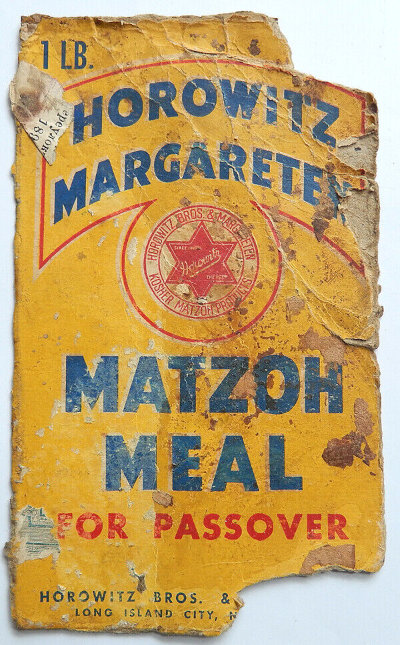 Box from 1900, being sold on Ebay
In 1882, a 14-year-old Christian girl named Eszter Solymosi disappeared in the Hungarian town of Tiszaeszlar, about 45 miles east of Regina’s home in Miskolc. Local Jews were accused of killing her in order to use her blood in Jewish rituals and concealing her body. In a trial that spanned over a year, 13 local Jews were accused of taking part in this grizzly so-called murder. (Eszter’s body was never found.)
Though the Jews were eventually acquitted, this outrageous blood libel stirred up anti-Jewish hatred across Hungary. Riots broke out in 1883 in many Hungarian cities and towns. That same year, while she was pregnant with her first child, Regina and Ignatz, as well as Regina’s parents, made the decision to leave their homes, sailing to America and settling on the Lower East Side of New York.
Many Jewish immigrants called the United States the “Goldena Medina,” or Golden Land; some said that the streets in the US were paved with gold. Regina and her family were part of a massive tide of Jewish refugees: New York’s Jewish population swelled from about 80,000 in 1880 to one and a half million just 40 years later.
New York’s Lower East Side was transformed. Hundreds of synagogues, Jewish charities, Jewish schools, and other community institutions sprang up. Large numbers of penniless immigrants toiled in sweatshops and lived in tenement buildings where they did “piecemeal” work, sewing pieces of clothes for the larger factories.
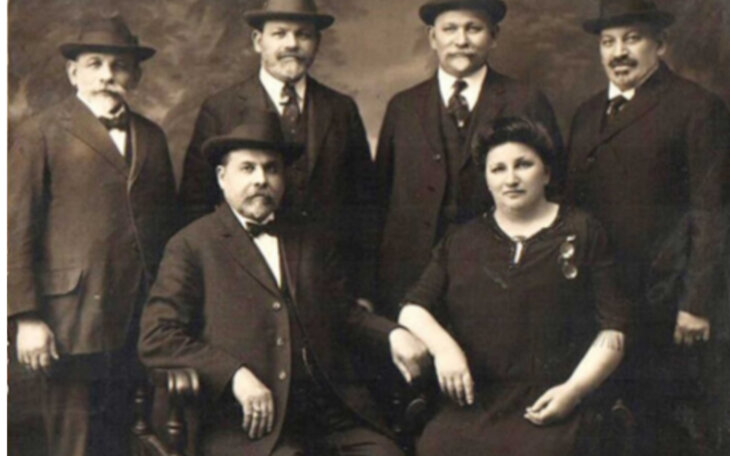 Founders of the Horowitz Brothers & Margareten matzah bakery. Standing, left to right: Joseph Horowitz, Leopold Horowitz, Moses A. Horowitz, Samuel I. Horowitz. Seated, left to right: Ignatz Margareten and Regina Margareten.
Social campaigner Jacob Riis described the poverty that was typical in New York’s Jewish community at the time: “I have found in three rooms father, mother, twelve children, and six boarders. They sleep on the half-made clothing for beds. I found that several people slept in a subcellar four feet by six, on a pile of clothing that was being made.”
Despite the desperate conditions of the Jewish community, Jewish religious and cultural life flourished. In 1898, a reporter from Harper’s magazine described the crowds of people who packed New York’s two new Yiddish-language theatres: “Night after night I have seen the two Yiddish theatres swarmed with men, women, and children largely from the sweat shops.” Despite their poverty, these newcomers were determined to make their new home of New York City their own.
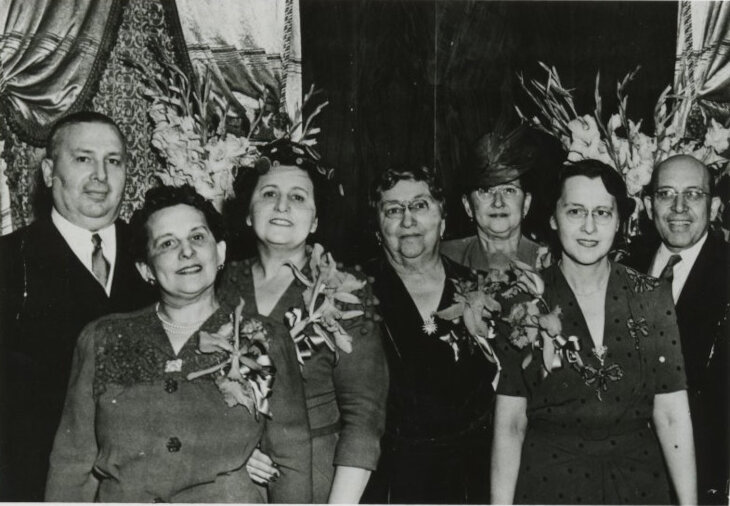 Regina Margareten (center), with her six children. Louis E. Schecter Collection, JMM 1974.21.9
Regina and her husband opened a grocery store on Willett Street in the Lower East Side. They carefully adhered to Jewish traditions and made and sold kosher food. It was a grueling existence. In the evenings, Regina attended night school classes to learn English. In time, she and Ignatz would have six children.
In addition to cleaning their home and making their grocery store kosher for Passover, Regina and her husband decided to bake matzah. Initially, they baked matzah only for their family. But they saw matzah baking as a public service, ensuring that New York Jews could have kosher matzah during Passover and that all their customers could enjoy the high standard of keeping kosher which Regina and her family kept.
Baking matzah is an arduous undertaking. Historian Jonathan Sarna describes what it was like to bake matzah in the 1800s (a process very similar to how kosher matzah is still made today).
The process…must be completed within 18 minutes… One person…measured out the flour. Another worker poured cold water into the batter. Then the mixture underwent a multi-stage process of kneading and rolling, usually performed by women. Next, the dough was scored or perforated, placed on a rolling pin or a long pole, baked…in a very hot oven, and sent off to be packed. Any dough not mixed, baked, and out of the oven within 18 minutes was, of course, discarded. All the rolling pins and poles were then carefully sanded and wiped. The paper on the tables was changed. The workers washed their hands to get rid of any remaining dough. And the process started all over again…
By the time Regina and her husband began making matzah, mechanical rollers were common. These eliminated some of the labor of rolling out the matzah dough, but each part of the rollers had to be thoroughly cleaned between batches to ensure that no pieces of matzah had become lodged in any nooks or crannies which could render the entire matzah not kosher for Passover.
Newsreel from the 1930s of baking matzah on the Lower East Side
Regina and Ignatz’s matzah proved wildly popular. Customers trusted their high religious standard and enjoyed their delicious matzah. Within a few years, Regina and Ignatz gave up their grocery store and began baking matzah full time, working with Regina’s brothers Joseph, Leopold, Moses, and Samuel. Together, they incorporated a new business they named the Horowitz Brothers & Margareten Company.
At first, they rented a bakery and made all of their early matzah entirely by hand. Regina lit the bakery fires and kneaded the dough. In later life she used to tell her children that when she first started out, she only saw the light of day on Shabbat, the only time she wasn’t working.
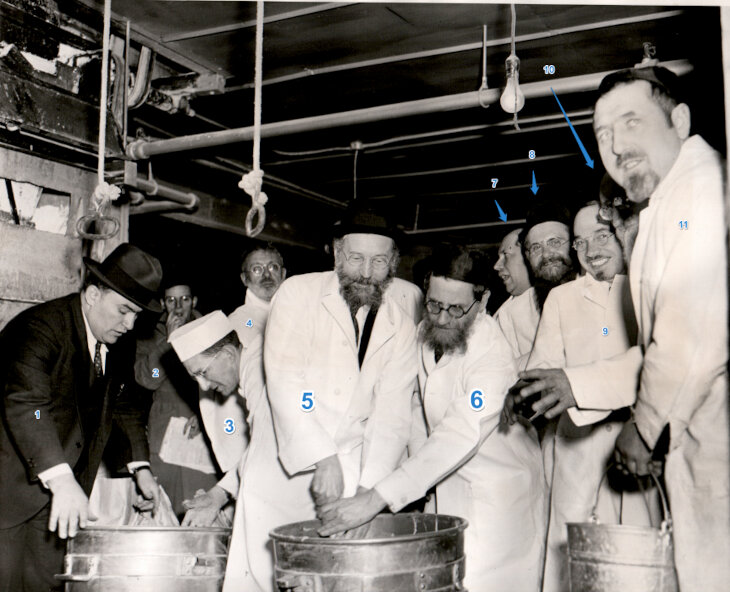 Preparing the dough at the Horowitz Margareten Matzah Bakery, March 13, 1937, Credit: Institute For Judaic Culture and History (IFJCAH)
Horowitz Brothers & Margareten grew every year. When they first started out, they typically used 50 barrels of flour. By 1932, they used 45,000 barrels of flour. That year, the company grossed about one million dollars, a staggering amount that Regina surely never dreamed of when she first settled in New York.
Regina became a company Director and was involved in every aspect of the business as it grew. She insisted that not only did the matzah she and her family produced embody the highest levels of kashrut but that it tasted delicious as well. One of her major innovations was mixing wheat that was grown in three different states. This diversity, Regina believed, resulted in a tastier product. Each morning the first thing Regina did was taste a sample of the matzah currently being baked to ensure that it was up to her high standard, repeating this process throughout the day. Workers dubbed her the “Matzah Queen” and respected her high standards and patience with her colleagues.
When radio advertising took off in the 1940s, Regina advertised her matzah on air, speaking Yiddish and English.

Regina was forward-thinking, insisting that the company expand into kosher-for-Passover noodles, pastries, and other Passover items. She innovated in marketing and advertising, and oversaw the expansion of Horowitz Brothers & Margareten out of the Lower East Side and into a large factory in Long Island City. She also liaised with union representatives and ensured that employees were paid well and were happy working for her family business. After Ignatz died in 1923, Regina became the company Treasurer as well as a Director.
For Regina, the material success she and many other American Jews were blessed with was merely a means to an end. She encouraged her fellow Jews to help their brethren and to participate in building the State of Israel. In her radio addresses, she thanked the United States for giving Jews “freedom, prosperity, and happiness we have here,” so that American Jews could use these gifts to help the wider Jewish community, including Israel.
Beggars visited the factory often and Regina had a policy that they were always given food or money. Regina invested heavily in a host of Jewish charities, eventually becoming a patron of over one hundred different charitable groups. A few on which she spent a large amount of time included her synagogue Beth Midrash HaGadol Anshei Hungary, a Jewish school in New York, a society which provided indigent students with new clothes during Passover; and the Nashim Rachmonioth Society, which helped poor pregnant women provide for their children.
As Nazism rose in her native Europe, Regina did all she could to encourage Jews to leave and settle in the United States. She gave countless recent immigrants jobs in the Horowitz Brothers & Margareten factory. In 1924 she visited relatives in Hungary and, along with family members, bought a coal mine in the Hungarian city of Edeleny to provide local Jews with jobs and a source of income. During the Holocaust, she sponsored many Jews so that they could escape to the United States.
Regina remained vibrant until she was 96 years old. During the last pre-Passover busy season of her life, when she was 95 years old, she arrived at work at 8:30 am each morning and worked until 7 in the evening.
When she turned 80 in 1942, the New York Times profiled her and noted that she was the “gayest dancer at (her birthday) party.” Eleven years later, when she was 91, the newspaper again wrote about her, describing her as “a sturdy, mentally alert little woman.” She passed away in 1959 at the age of 96. She had transformed the kosher food industry, changed the way Americans shopped and prepared for Passover, and helped make kosher food mainstream. (In 1990, Horowitz Brothers & Margareten was bought by Manischewitz. That company was later sold to a private equity firm and today is owned by Bain Capital.)
Regina left behind over 400 relatives with whom she was still in touch. She often said that her three main values were legacy, family, and community. In her long life, she lived up to these lofty goals, leaving the food industry, the wider Jewish community, and her beloved family enriched.











This is a wonderful, encouraging story for anyone to read and take to heart. I can only imagine how many descendants Regina and Ignatz and the Horowitz Brothers left behind them, to carry on their names, their story and their good works. ✡️
Such s nice story! Great to hear this history.
Love the history, respect the family. I would suggest one update to the article, these days the brand is owned by Kayco, a Jewish family business with similar roots.
My grandmother told me that her father insisted on only Horowitz-Margareten matzos for Pesach (this is going back to the 1920s). She said that people in the know knew that the H-M family were the most trustworthy when it came to kashrus.
I have fond memories of my Aunt Rebbish whom I knew as a child. We would stuff envelopes of the H&M calendar under her supervision.
One correction - the box of Matzoh Meal pictured could not be from 1900. It says on it "Horowitz Brothers and Margareten". That name was given only sometime in the 1920s. Also, it says on the bottom of the box Long Island City. I don't know when the bakery moved there but it could not have been before the 1930s, and probably later.
In any case thank you for the write up.
First of all the Matzoh baking business was established by her father, my great grandfather Jacob Horowitz who come to America with his daughter and four sons in the early 1880s. It was then that Jacob Horowitz established the matzoh bakery. Jacob died in 1885 and his wife Miril Chaya continued to run the business for the next 34 years (!) Miril Chaya died in 1919 and her children Regina (Rebbish), Joseph, Leopold (Levi) Moses and Samuel Isaac (my grandfather) inherited the business. All five of the children were involved in the matozh bakery which was located on East 4th St. on the Lower East Side of Manhattan.My father, Dr. Edward Horowitz (author of How the Hebrew Language Grew) grew up in the home which was on top of the bakery.
Beautiful story of your amazing family. Thank you for your post.
Thank you for the lovely article about my Aunt Rebbish as we called her (actually my father's aunt). Permit me to make a few historical corrections on the article, which in no way reduce the impact of Aunt Rebbish.
My maternal grandfather, Abe Horowitz, was president of Horowitz-Margareten for decades. He used to send us free matza, gefilte fish and chocolate matza before Pessah every year. So I guess I am a chip off the old matza. Judy Siegel-Itzkovich
Thank you, as always, Dr. Miller for this treatise. I new knew any of it!
I grew up in Queens NY and we often drove by the Horowitz and Margareten factory in Long Island City on our way to and from Manhattan. The smells were heavenly! I also knew members of the extended Horowitz family (surname Ginsberg) and a few great grandsons (surname Horowitz). My husband, who grew up in Sunnyside, recalls accompanying his father on pre-Passover shopping trips to the Horowitz and
Margareten factory. Historically, my family preferred purchasing Horowitz and Margareten products to Manischewitz, and I continued the same tradition in my family while we lived in the NY area. They've virtually disappeared now, except for matzoh, matzoh meal, and a few related products, but the bright yellow boxes with the bright blue text and design still signal Pesach to me!
Wonderful story. I remember as a child those boxes of matzot. A true eshes chayil.
I so touched by this story and so proud of her achievements as Jewish Woman but
it left me wondering why the brand has disappeared either entirely or at the least
very hard to find anymore. I thought it was a family business but of course,
the company may have been sold. It was quality, better than anything on the shelves now.
Regina Margareten was my great-great grandmother. Her son, Jacob I Horowitz, was her tenth child and my grandfather. My grandmother used to send us a huge box of H-M products every year before Pesach.
I now live in Los Angeles, keep kosher, and have 11 grandchildren who are observant, both in Los Angeles and Jerusalem. I would like to think that Regina would be proud.
I’m sure she’s smiling down on you.
Love this story. What an amazing woman of valor!
Wonderful story. Thanks for sharing !
My great grandmother would make fresh donuts from scratch and give the “donut holes” to anyone that was in need or poor. She was not “Yiddish,” but kind to everyone.