Click here to buy
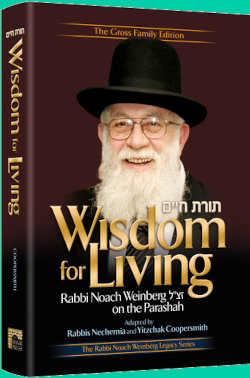
Wisdom for Living
Rabbi Noah Weinberg on the Parashah





With the kiss of God, Moses, the greatest Jewish leader in history, leaves this world, and the Chumash comes to an end. As a tribute to the person who brought us the Torah, let us take a closer look at what made Moshe a great leader and try to apply those timeless principles to our own lives.
To understand Moses’ ascent to greatness, we need to refer back to Exodus: "It happened in those days that Moshe grew up, and he went out to his brothers and observed their burdens; and he saw an Egyptian man striking a Hebrew man, of his brethren. He turned this way and that and saw that there was no man, so he struck down the Egyptian and hid him in the sand" (Exodus,1-12).
Since the previous verse (v. 10) already informs us that “the boy grew up,” these two verse must be describing Mose’s spiritual growth, with each phrase conveying additional insights into his trajectory.
Moses grew up in the palace of Pharaoh, in the lap of luxury and royalty. By leaving the palace, Moshe pushed himself beyond his comfort zone. He transcended the familiar and had the courage and grit to wade into unknown territory that was replete with risks and challenges. It is never comfortable to be a leader, and if you do not consciously decide to forgo a life of comfort you will resent the burdens that leadership entails.
Moses was raised as Pharaoh’s adopted grandson, yet he cast his lot with the downtrodden nation Pharaoh was enslaving. His ability to embrace these battered slaves as "his brothers" represents an enormous spiritual journey on his part, one that involved recasting his entire identity and transforming his vision of the world. Leaders need to be fiercely independent, to think out of the box, and to provide a compelling vision that will galvanize the nation and inspire change.
Rashi explains that Moshe directed his eyes and his heart to feel distress over the Jewish people. It is an active choice to fight your natural self-centeredness and genuinely feel another person’s pain. And feeling that pain is the linchpin that motivates you to act.
As an illustration, imagine it is 1941 and you find out that thousands of Jews are being herded onto trains and transported to a concentration camp. Would you drop everything you are doing and try to save some Jewish lives?
When this scenario is presented to an audience, invariably only a smattering of people raise their hands. The vast majority would do nothing.
Now change the scenario slightly: Imagine it is 1941 and you are from a small town in Eastern Europe. Your parents have sent you to North America to study or work and you discover that your entire hometown – your parents, grandparents, siblings, neighbors – are all being herded onto a train headed toward a concentration camp. Would you drop everything you are doing and try to save their lives?
No question, of course you would.
What is the difference between the two scenarios? Objectively speaking, does it make any difference if the woman sitting on that train is your mother or some other Jew’s mother? Jewish people are heading toward a concentration camp! The reality is exactly the same in both scenarios. The only difference is that when it is your family on the train, you feel the pain, and you lose sleep at night. The reality of the situation compels you to take responsibility and act.
The ramifications of this are sobering. If people do not put in the effort to transcend their self-absorption and feel the pain of others, they would, in all likelihood, turn their heads away from a holocaust and not do anything to help. They would just go about their lives, oblivious to reality.
In order to properly structure our priorities and accurately perceive reality, we must feel the pain of our brethren and truly care about their well-being, both physical and spiritual. Imagine it was your brother or sister engaged to a non-Jew – there is no question you would be motivated to act. Feeling another’s pain is the key to leadership, because it means you have no agenda other than what is good for the people. This selflessness builds trust between you and others and determines the degree to which they will follow your lead.
Before taking decisive action, Moses first looked to see if there was anyone else tackling the job. He was prepared to move aside if someone was already on the scene, since he was not asserting himself out of a need to boost his own ego. His sole concern was ensuring that the problem at hand be dealt with effectively; his personal role was irrelevant.
Humility is the essence of being an effective leader, because it allows you to rise above your self-interest and do what Hashem demands from you. Since a person driven by ego is more concerned with his quest for power than with the well-being of the people he is ostensibly leading, it is only a matter of time before he loses the respect of the people.
Humility also enables a leader to tap into a power far greater than his own. The humble leader has the courage to tackle daunting challenges because he knows that ultimately, the outcome of his efforts hinges not on his power, but on Hashem's. And that courage, in turn, engenders charisma.
Many people entertain the misconception that humility means being meek and self-effacing. Imagine the most humble person in the world walking into the room. In your mind's eye, whom do you picture? Chances are it is a timid, anxious person that no one really notices. Yet the Torah tells us, "Now the man Moses was exceedingly humble, more than any person on the face of the earth" (Bamidbar 12:3). Imagine Moses walking into the room. His incredibly powerful presence would cause every head to turn. It is no accident that the most humble of all people was also the greatest leader. When the ego is out of the way, a person can become a conduit for God’s power.
Moses took responsibility and acted boldly and decisively. He understood the true meaning of the Talmudic principle that each person must say, “Bishvili nivra ha’olam – the world was created for me” (Sanhedrin 37a). Each of us is responsible for the entire world; we are God’s caretakers. If we see a problem, we cannot pass the buck. Leaders know that greatness comes through shouldering responsibility. As the cycle of reading the Torah comes to an end and we begin Genesis anew, let us turn our hearts and minds to the great challenges and opportunities Hashem has placed squarely upon each of us: "The hidden are for Hashem, our God, but the revealed are for us and our children forever, to carry out all the words of this Torah" (Deut. 29:28).