







 What Repentance Really Means in Judaism



12 min read
9 min read
5 min read
11 min read




Recently freed hostages are revealing extraordinary stories of courage, faith, and the unbreakable Jewish spirit that carried them through the darkest depths of captivity.
Wounded and tortured, 20-year-old Israeli tank soldier Matan Angrest was dragged into Gaza, the only survivor from his tank crew after the October 7th Hamas attack. Throughout his two years of captivity, he stood up to his captors and asserted himself as a proud Jew.
Matan recalls, “I demanded tefillin, a prayer book, and a Tanakh. Somehow, they brought them. From that day on, I prayed three times a day — morning, afternoon, and night. It gave me strength. It protected me.”

As a soldier, Matan was subjected to especially severe torture. His mother, Anat, says, “He remembers being beaten so badly that he lost consciousness. They covered him with black sacks and dragged him away.” In addition to physical torture, Matan was subjected to psychological torture: he was told that Israel had given up on him, that Hamas was going to conquer Israel, and that his maternal grandparents were dead.
Upon his release, he was greatly relieved to discover that they were alive. Despite such brutal treatment, Matan refused to break, says Anat.
For most of his captivity, Matan was held with Gali Berman, who was also released in the recent ceasefire. Gali had a copy of the Torah and they read it together repeatedly. Matan says, “I know every Torah portion by heart.”
At one point, Matan was held together with Keith Siegel, who was released in a hostage deal in February 2025. Keith recalls that Matan maintained a positive attitude. He says, “Matan and I were held in a small, sealed room, without light. Matan kept a good mood, despite what he went through. We kept each other strong, and we laughed together.”
For the last four months of his captivity, Matan was held alone in a small, dark tunnel, under special guard. When asked how he managed alone in the tunnel, Matan replied, “I tried to remain optimistic. I sang to myself… I prayed three times a day. My faith strengthened me very much.”
Doctors at Ichilov Medical Center, where Matan recuperated for four days after his release, reported that despite severe physical wounds, Matan’s spirit remains strong.
 Matan eulogizing his commander Daniel Peretz at his funeral
Two days after his return from Gaza, Matan told the IDF Chief of Staff Lt. Gen. Eyal Zamir that he would like to return to active duty in the IDF. That same day, Matan left the hospital to attend the funeral of his tank commander, Daniel Peretz, who was killed on October 7th. Peretz’s body was kidnapped by Hamas and returned as part of the ceasefire deal.
At Peretz’s funeral, Matan delivered a heartfelt eulogy and promised the family, “Everywhere I go, he will be with me always.” He also stated that he is ready to go back to Gaza to retrieve the body of another member of his tank crew, Itay Chen, that is still held by Hamas.
Matan’s faith sustained him throughout his ordeal and continues to guide him as he recovers. As he says, “Even in the deepest tunnels, the soul can’t be taken captive.”
Only 19 at the time of Hamas attack, Rom Braslavski refused to flee from the Nova festival, where he worked as a security guard. He stayed to help others escape, to take care of the wounded, and to prevent the terrorists from kidnapping the bodies of the dead. Rom fought terrorists by throwing rocks at them and encouraging others to do the same.
Rom’s mother, Tami, says, “He did not see fear. He did not see death. He only saw one thing: how he could help, encourage, and save as many people as possible.” Unfortunately, Rom’s rescue efforts were brought to an end by about 3 p.m., when he was captured by terrorists from the Islamic Jihad.

Throughout his two long years of captivity, Rom clung to his faith. Released hostage Sasha Trufanov, who was held together with Rom for some time, reported that Rom would begin each morning with reciting the Modeh Ani and Shema prayers, thanking God for keeping him alive.
In Gaza, Rom was held in harsh conditions, deprived of food and basic necessities. In the beginning, he was shackled by all four limbs in a tiny room and given only half a piece of dry flatbread and a bit of rice each evening.
Starving and desperate for food, one day Rom managed to break free of his shackles and tried to cook some pasta. The gas wasn’t working, so he started a fire with a book and some clothes he found in the apartment. Unfortunately, the neighbors smelled fire and banged on the windows. Afraid for his life, Rom hid under a bed as dozens of Gazans stormed into the apartment.
His mother says, “He felt them above the mattress. They saw the shackles, realized a hostage was there, and began searching.” Rom feared that he would be lynched by the angry mob. He remained in his hiding place, praying. Unexpectedly, his captor arrived, and the crowd dispersed. His captor did not punish him.
Rom’s captors also applied psychological torture, telling him that Iran had bombed Israel and nearly destroyed it and that 3,000 soldiers had died.
The captors also pressured Rom to convert to Islam, promising more food and better conditions. Rom absolutely refused, telling them, “I am a strong Jew!” His mother says, “Rom insisted on preserving his Jewish identity. The moment he came back, he put on tefillin.”
From the Sheba Medical Center, where Rom is recuperating, he recalls, “The only thing that gave me strength was knowing that everyone around me wasn’t Jewish, and that the reason I was there was simply because I’m a Jew.”
Rom’s message to the Jewish people is, “we need to go back to being a united people. People should start keeping mitzvot and understand what it means to be Jewish. Look at what happened to me, what they did to me, just because I’m a Jew. That means a Jew should understand he is in a higher place, different from someone who isn’t Jewish. We need to strengthen Judaism, and I hope the people of Israel remain united.”
Like Rom, 21-year-old Bar Kupershtein worked as a security guard at the Nova festival and refused to abandon his post when Hamas attacked. A paramedic, Bar cared for the wounded and assisted in their evacuation until he was kidnapped and taken to Gaza.
In Gaza, Bar was starved, beaten, and tortured. His mother, Julie, shared, “He tells me the stories and I sit across from him crying, realizing my son is strong, a hero, and there’s no one like him in the world. He told me: ‘Mom, they beat me, but I didn’t feel it — my body was frozen.’ He said it was all in the mind, as if he trained his brain not to think about the pain at all — and he survived.”
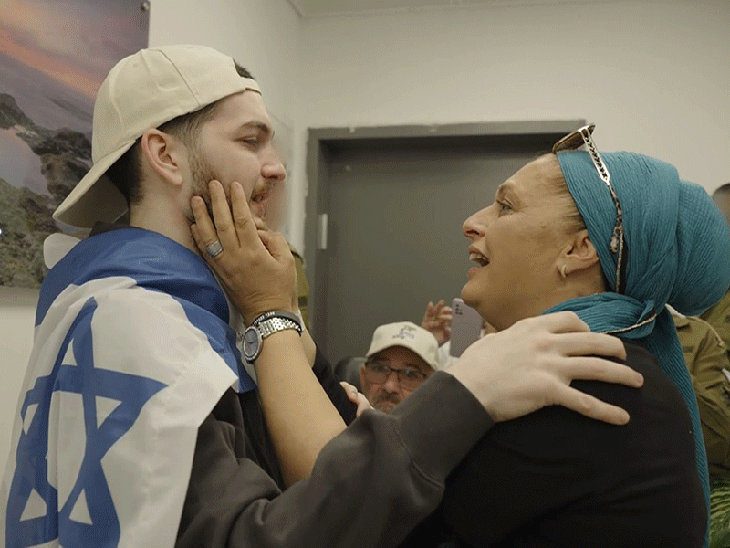
Throughout this horrific ordeal, Bar never lost hope. He always tried to help others. Julie says, “He has golden hands. He fixed the electricity, dug the waste pit, built them a water channel, made a small area in the tunnel where they could sit alone when things were hard.”
Bar experienced many life-threatening situations and felt that he was saved by miracles. “He took upon himself a mitzvah of charity, and told himself that he had 200 shekels in his wallet at home, and when he got out of captivity he would donate it — and that would save him,” says Julie.
Bar tried to keep other mitzvot as well. This past Yom Kippur, he fasted and recited the prayers he remembered.
When he was released, he surprised his family by requesting a pair of tzitzit to wear. His mother shares that Bar’s connection to Judaism strengthened in captivity. Before, “[he] had faith, he was somewhat traditional — but not like [now]. There were Muslims there who prayed to the Creator as well, and they observed all the holidays and fasts, and he said if they’re doing it, then he also wants to be close to the Creator.”
Julie concludes, “A person in darkness, in the inferno — I think the first thing is to connect with the Creator, to try and save yourself somehow. He had a dialogue with God. He would say [the] Shema [prayer] often, he prayed, and recited a chapter of Psalms he knew by heart.”
Bar says that what gave him the most strength in Gaza was the song Afilu B’hastara, a favorite of his mother’s, written over two centuries ago by Rabbi Nachman of Breslov. The lyrics state that God is found even in the darkest places. In captivity, Bar used to sing this song to himself over and over again. After his release, a video circulated showing him singing this song together with his family.
In a powerful video message posted by StandWithUs, Bar addresses the world after his release. “I want to thank everyone who prayed, supported, and never gave up,” he says. “Most importantly, I want to thank the Creator of the World, our Father in Heaven.”
Stories of other released hostages’ strength and faith are still coming out.
Eitan Horn, 37, of Kibbutz Nir Oz says that this year, he fasted on Yom Kippur for the first time in his life while held in Gaza tunnels.
Matan Zangauker found a worn book of Psalms in the tunnels and used it for daily prayer.
Segev Kalfon requested to watch the release ceremony of a fellow hostage, Ohad Ben Ami, in February 2025. Happy for Ohad, he pictured his own release ceremony, when he would stand on the stage, surrounded by terrorists, and shout the Shema prayer for the whole world to hear.
After his release, thankfully without a ceremony, Segev shared. “In the darkest place, I succeeded in seeing the light.” He tells of faith that sustained him throughout his captivity.
As the released hostages recover and speak out, we have much to learn from them.









I am so happy and proud of them I prayed for them every day!
and the world still thinks these Hamas animals are freedom fighters.
I guess there is no atheist in foxholes or in this case no atheists in the terror tunnels of our enemy, that is the hostages survived by faith and belief in Hashem, and anyone else in these circumstances
Show the Hostages How Much You Cared!
Many people took on extra mitzvos, chassadim, tehillim, etc as a zechus for the hostages to be freed. Now that the hostages have been released BH, a book is being compiled listing what Klal Yisroel did on their behalf.
The goal of the book is threefold: Firstly, for the hostages to see how intensely Klal Yisroel cared and stormed the Heavens on their behalf. Second is for each of us to learn from each other and be inspired with ways to grow and improve. Last is for us to realize how united we really are and that it is possible our joint efforts came together to generate a yeshua.
To enter a submission to be included in the book, email maaseigevurah@gmail.com
Please indicate if you would like to be anonymous
awesome and important article
Thanks for sharing their story. It gives me more reasons to Love more our Creator. Shalom!
Amazing! They gave me inspiration and more kavanah/intent when I daven. Thank you for posting this article.
I am immeasurably inspired by their strength 🇨🇦