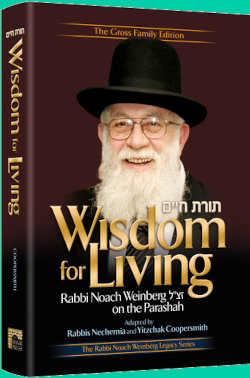
Click here to buy
Wisdom for Living
Rabbi Noah Weinberg on the Parashah



6 min read


For on this day (Yom Kippur) He shall provide atonement for you to cleanse you; from all your sins before Hashem shall you be cleansed. (Vayikra 16:30)
When done correctly, teshuvah (repentance) is so powerful, it wipes your slate clean and restores your relationship with God. As the Rambam states, “A baal teshuvah (one who has repented) should not consider himself distant from the level of the righteous because of the mistakes and transgressions that he committed. This is not true. He is beloved and desirable before the Creator as if he never transgressed” (Hilchos Teshuvah 7:4).
God relates to him as if he never transgressed. His sin is expunged from his past. How do we attain this incredible change? We have all experienced genuine charatah, regret, and the next thing we know we are back making the same mistake, stuck in the same rut as before. How do we attain real, lasting teshuvah?
The Chovos Halevavos teaches us the method, delineating seven steps one must take prior to doing teshuvah (see Chovos Halevavos, Shaar Hateshuvah, Chapter Three). Before you go through the actual four steps of teshuvah – namely, stopping the transgression, regret, viduy (confession), and resolving to never do it again – you must implement these crucial steps to ensure lasting change.
Let us illustrate with a transgression we are all guilty of – bittul Torah, wasting time from Torah learning. Think about all the time you waste in every single day, and how much that adds up to every week, every month. It is mind-boggling. But in order to do teshuvah for this misdeed, you must get very specific. Thinking about all the time you have wasted is too broad and too overwhelming. It will not mean anything. Focus on one concrete instance, when you sat there talking about nonsense with a friend, killing time. You were shmoozing with Yankel while your study partner was waiting for you, and you took those five minutes and destroyed them.
Now focus on those specific five minutes of wasting time.
You have no chance of changing unless you stop rationalizing and call a spade a spade: bittul Torah is akin to murdering life! You are opting out and quitting, and in the end committing suicide in installments. It is a desecration of life itself. Do not sugarcoat it. You transgressed. Now face it. And what is even worse is that you knew you were transgressing. You did it willfully. Not only that, you were actually rebellious. Underneath it all you said to yourself, “God, I don’t care. I’ve got to waste some time. What does Hashem expect from me?”
You have to feel the gravity of the transgression; otherwise, you cannot do teshuvah.
After accepting that you did something wrong, focus on the fact that you are going to get punished for wasting those five minutes; your time in Gehinnom (Hell) just got longer.
Each transgression has consequences. Face the reality: you are going to be punished for this.
The Chovos Halevavos takes it one step further: realize that the punishment is already on its way. The bullet has been fired. There is no escape. The missile has left its silo and it is headed right for you. There is no way you can avoid it. The punishment is not something hanging in balance to be decided about in the future; it is already on the way!
Feel that reality. You cannot escape it.
Realize there is only one way to save yourself from punishment, and that is by doing teshuvah. You have wasted time – those moments are irrevocably squandered – yet Hashem, in His kindness, is giving you a miraculous way out. You can breathe life back into those moments you killed. Whew! Teshuvah creates forgiveness, wipes away the sin, and can actually turn a transgression into a mitzvah. Feel the reality of this amazing kindness.
The Chovos Halevavos explains that in order to do teshuvah, it is necessary to understand why you transgressed. Why did you waste the time? What was the yetzer hara promising you that tripped you up? Perhaps he was telling you, “Just squander these five minutes doing absolutely nothing, opting out of life for a few minutes, in order to bounce right back with a surge of life. Stop learning and get that cup of coffee you so desperately need so you can really sit down and learn!”
The yetzer hara, the evil inclination, is a master of seduction, promising us all sorts of dubious benefits. But if you pause for a moment you will see he is a liar. How will talking utter nonsense for five minutes enable you to accomplish as you’ve never accomplished before?
What did you think you were going to gain by listening to the yetzer hara? He was selling you on getting comfort, a space in the day where there is no pain, no work, no effort or worries, just mindless comfort.
After clarifying the proposed benefits, consider what it cost you. Contrast what you gained with what you actually lost. That bittul Torah made it harder for you to learn. You broke your momentum, and now you have to battle to get back into it. So you actually made it harder for yourself in the long run. But worse than that, what you really lost was your self-esteem. Living like a zombie, even for just a short time, chips away at your self-respect. You are squandering your potential and you know it.
Now think about what you would have lost if you had not wasted those five minutes. An illusion of pleasure. And what would you have gained if you had not listened to your yetzer hara and wasted that time? Self-respect. The pleasure of exercising your free will and eternally connecting to the Infinite through Torah. You would have gained a sense of invigoration that comes through living meaningfully and plugging into the wisdom of God’s Torah.
Now you have the clarity you need to make the concrete decision to change. You know it is worthwhile. The next time you feel like wasting time, fight that urge. Now you are prepared to stand in front of Hashem and say “Ana Hashem, chatasi, avisi, pashati; I made a mistake. I knew it was wrong. I was rebelling. I wasted fifteen minutes, and much more. I’m sorry; it was so stupid of me. Please forgive me. And I’ll never do it again, if You help me.”
By using these seven steps you have a chance to transform your Yom Kippur into a real opportunity to make lasting changes.