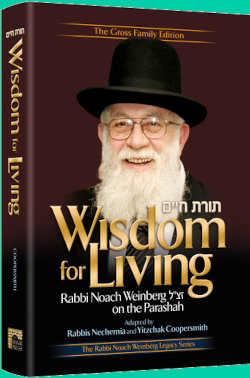

Click here to buy
Wisdom for Living
Rabbi Noah Weinberg on the Parashah



10 min read


"You shall not take revenge and you shall not bear a grudge against the members of your people; you shall love your fellow as yourself; I am God" (Vayikra 19:18).
The Sages (Yerushalmi, Nedarim 9:4) identify one mitzvah as the fundamental principle the entire Torah is based on: “You shall love your fellow as yourself."
To properly understand how to fulfill this crucial mitzvah we must answer the following four questions:
Obligating love strikes us as impossible. Yet it is actually something we all do.
Imagine a son telling his father, “I hate my sister!”
No father is going to respond, “That’s fine, it’s okay if you hate your sister.” He is far more likely to say, “Don’t talk that way! You have to love your sister!” We know our children should love each other, even if one took the other’s eraser, or iPod, or sweater without asking. Nothing should get in the way of their filial love.
The father is not merely suggesting that the brother love his sister; he is demanding it. It is not just preferable for children to love one another, just as it is not optional for parents to love their children. But do we actually go about loving a sibling, or a child?
Parents love their children naturally, you’ll answer. But what if their child turns out to be an obnoxious brat? "It doesn't matter," you say. "They'll find something to love about him no matter what."
We define love as the emotional pleasure of appreciating the virtues of another person and identifying them with those virtues. With our children, we are naturally committed to focusing on their virtues and minimizing their shortcomings. "My son has a heart of gold. So what if he’s a little hyper?” Therefore we love them, no matter what.
The reality is that the emotion of love is a decision: if we choose to focus on other people's virtues, we will love them, but if we choose to focus on their faults, we will be repelled by them.
This understanding of love is the basis of a healthy marriage. When a couple marries, they appreciate each other's virtues and begin to build a loving relationship. Yet today almost 50% of all marriages end in divorce, and many of those who stay married are not exactly living in bliss. When they first got married they were madly in love. What went wrong? They stopped focusing on each other’s virtues, taking them for granted, and instead focused on their spouse’s flaws and the subsequent disappointment they caused.
Every person is a mixture of virtues and faults, but what we choose to focus on and identify the person with is entirely up to us. When the Torah obligates us to love it is instructing us to identify people with their virtues. Consequently, this is something that can indeed be commanded.
The Greek concept of love is symbolized by Cupid, who flits around and shoots an arrow into two unsuspecting people. Presto! Bob and Sue are now head over heels in love! The Western view of love, which comes from the Greek concept, sees love as an accident that you "fall" into. It either happens or it doesn't; it’s not something you can control.
However, be forewarned: as easily as you "fall in love," you can just as easily fall out of love. If Bob's love for Sue is not based on a commitment to appreciate her virtues, then when the stresses of married life grow, the following could easily happen. One day, after taking his wife for granted for years, Bob is staying overtime at the office working on a big project with his secretary, Jane. Suddenly Cupid sneaks up behind him and without warning shoots another arrow into him. Boing! Bob has now fallen in love with Jane.
Bob sheepishly returns home and explains to his wife, "I'm sorry, I fell in love with my secretary. But it's not my fault, I wasn't looking for it, it just happened since that rascal Cupid shot me!" Out goes the wife and in comes the secretary.
If love is not something you can actually choose, then all you can do to stay married is hope that Cupid does not shoot you. Is it any surprise that the divorce rate is so high?
Contrast this with the relationship between parents and their children. No sane parent ever comes home one day and tells his children, "I've fallen in love with the neighbors' kids. They don't cough at night and they get better math scores. Sorry, but you kids are out. The kids next door are moving in."
We don't "fall out of love" with our children because we understand that loving them isn't a "happening." We don't stop caring about our children just because they annoy us. We accept the obligation to love them despite the fact that they are often far more aggravating than our spouses!
If we carried this same type of commitment into our marriages, our love would continue to grow and deepen over time, just as it does with our children, enabling our marriage to not only withstand the winds of time, but to thrive.
Resentment poisons love. Someone wrongs you, and for months you cannot see them without recalling how they hurt you. This grudge colors your perspective and renders you completely incapable of seeing the good in this person. Your resentment brews and your desire to even the score and take revenge grows, preventing you from loving the person.
If you want to love your spouse, your parents, or anyone else for that matter, you have to let go of any resentment you have towards them. This is why these two prohibitions precede the mitzvah of loving our fellow Jews.
Letting go of our resentments is not easy, but if we see the person who hurt us as part of us, our resentment disappears. Imagine accidentally cutting your finger while slicing a carrot. Would you take the knife from your right hand and deliberately slice your left hand in revenge? Of course not, because your other hand is you, and hurting it is only hurting yourself.
Humanity is ultimately one. Taking revenge on someone else is as self-destructive as slicing your other hand with a knife, and that is one reason why the Torah says to love your neighbor "as yourself." Seeing the other person as yourself will remove the resentment that is impeding your love.
Unfortunately we often do not realize how we are all connected on our own, and it often takes an outside force to get us to appreciate that we are indeed one people. For example, the Nazis did not differentiate between different types of Jews. In their eyes we were all one people. When Hamas terrorists murdered three boys learning in Gush Etzion, the entire Jewish world united. It did not matter what type of kippah they wore; everyone felt that these were "our boys." During the times in life when we recognize this as true, hold on to that perception because it is the ultimate cure against the destructive effects of resentment.
The Jewish people have a rich repertoire of stories that powerfully inculcate Torah principles in our children. Every Jewish child used to hear the following story that shows us the power of loving another "as yourself."
At the time of the Roman Empire, two Jewish boys had grown up together in Israel and become very close friends. Eventually, they moved far apart – one was living under Roman control, and the other under Syrian control. Yet despite the distance between them, they remained dear friends.
Once, when the fellow from Rome was visiting Syria, he was falsely accused of being a spy. He was brought to the Syrian emperor, and eventually sentenced to death.
While being led out to be executed, the Emperor asked him if he had any final requests. "Please," he begged, "let me go back to Rome to settle my affairs and say goodbye to my family. Then I'll return to be executed."
The Emperor laughed. "Are you crazy? What guarantee do I have that you'll come back?"
He answered, "I have a friend living here in Syria who will stand in my place until I return. He will be my guarantor. If I do not come back, you can execute him instead."
The Emperor was intrigued. "This I've got to see. Okay, call your friend."
His friend in Syria was summoned and sure enough, he agreed to stand in his friend's place in prison, and risk being killed if his friend did not return on time.
The Emperor was so startled by this arrangement he agreed to let the man from Rome return home. "I'll give you 60 days," the Emperor said, "but if you're not back by the dawn of the 60th day, your friend is dead."
The fellow from Rome raced home to say goodbye and put his affairs in order. After a hectic time and a lot of tears, he started back in plenty of time to reach Syria before the 60 days were over. But in those days they sailed galleys, and at times you could sit for days waiting for the right wind to come. As luck would have it, there was no wind for several days, the boat was delayed, and by the time he arrived back in Syria, dawn of the 60th day was breaking.
As agreed, the jailors took the friend in Syria out to be executed.
Executions were gala affairs, and by early morning the crowds began to swell. Then just as they were about to execute him, the friend from Rome came running in, yelling, "Wait! I'm back. Don't kill him! Kill me!"
But the Syrian friend protested: "You can't kill him. He came too late. I'm the guarantor. You've got to kill me instead!"
Each one was equally adamant. "Kill me!" "No, kill me instead!" The executioner didn't know what to do. The crowd was in an uproar!
Finally, the emperor convened a meeting with them in his private chambers. He turned to the two of them and said, "I'll let both of you go free on one condition – that you make me your third friend!"
This is why the verse "Love your neighbor" concludes with the statement, "I am God." Because when there is unity and friendship between people, it is so precious that God so to speak wants to be part of it. He becomes the third friend.
In summary, love is a decision to focus and appreciate another person's virtues. Therefore, it can be commanded. In order to love, we need to let go of resentment by appreciating that we are all connected. When we unite in love, Hashem Himself joins the union. Drop resentments: ”Do not take revenge and do not bear a grudge;” choose to love: “Love your neighbor as yourself;” and God will dwell with you: “I am God."