








 Those Shameful Thoughts and What They Really Say about You
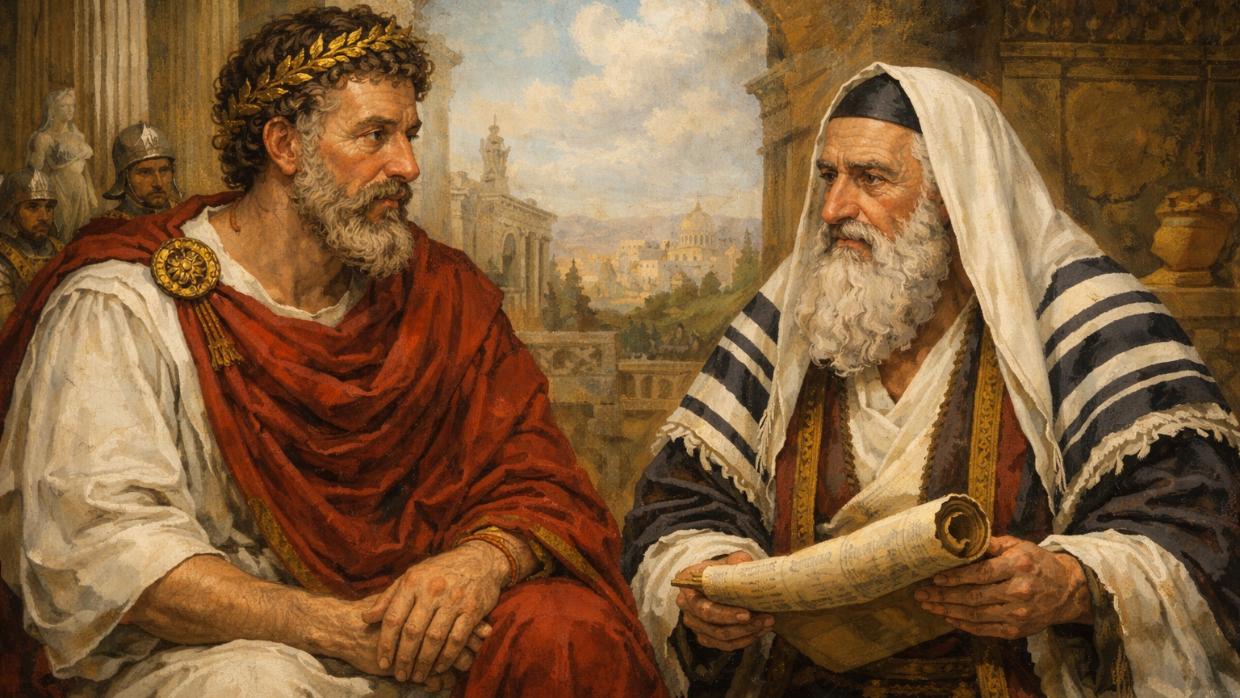






Stoic philosopher-ruler Marcus Aurelius left a surprising imprint on Jewish history and philosophy that continues to be felt today.
Nearly 2,000 years after his death, Marcus Aurelius—Roman emperor, military commander, and philosopher—remains an unlikely fixture on modern bestseller lists. Ruling at the height of Rome’s power, he never set out to be a public author, yet he continues to attract readers by the millions. His Meditations, a collection of private reflections written in Greek and never intended for publication, is still printed, sold, and widely quoted with remarkable enthusiasm.
Aurelius wrote these reflections over many years while shouldering the burdens of empire: defending Rome’s borders, waging prolonged wars, and managing the daily demands of governing the ancient world. Today, his Stoic insights are promoted as guides to resilience and self-mastery, and Meditations is regularly praised as a timeless manual for living well. Time magazine has even described it as “a self-help classic,” a distinction few Roman emperors could have imagined earning.
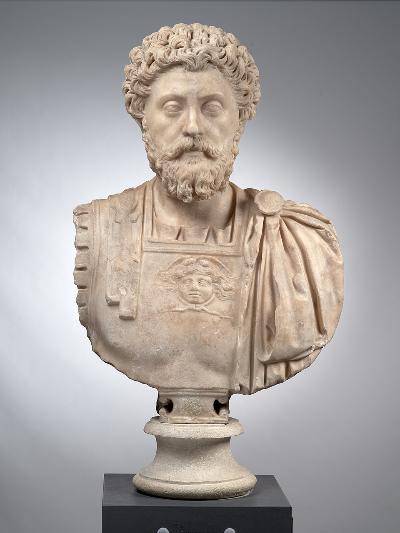 Marble bust of Roman Emperor Marcus Aurelius (By Daniel Martin - Photothèque du musée Saint-Raymond, CC BY-SA 4.0, https://commons.wikimedia.org/w/index.php?curid=97131451)
From the lens of Jewish history, Marcus Aurelius’ reign was consequential. Here are Jewish facts about this fascinating Roman philosopher-king.
Emperor Marcus Aurelius’ full name was Marcus Aurelius Antoninus, and Jewish tradition identifies him with the benevolent Roman ruler Antonius mentioned in the Talmud. (Some scholars equate Antoninus with different Roman leaders, including the Emperor Elagabalus.)
According to tradition, the future emperor Antonius developed a deep affection for the Jewish people as an infant, following an extraordinary episode involving his mother and the great Jewish leader Rabbi Shimon ben Gamliel II. At the time, Rabbi Shimon ben Gamliel and his wife had a newborn son, Yehuda, whom they circumcised in defiance of the Roman Empire’s harsh decrees restricting Jewish life. Summoned before Roman authorities, the couple traveled to Rome with their baby.
Rabbi Shimon ben Gamliel was renowned for his wisdom and kindness among Jews and Gentiles alike, and along the journey many people offered assistance—including Antonius’ mother. In a daring act, she exchanged her own infant son with Yehuda.
When Rabbi Shimon ben Gamliel and his wife presented the baby Antonius before the Roman judges, the authorities were astonished: the child was not circumcised. The couple was released, and on their return journey the newborns were switched back. At that moment, the two mothers pledged that their sons would remain lifelong friends.
Antonius later became Emperor of Rome, succeeding his uncle in the year 161 CE. Yehuda, meanwhile—now Rabbi Yehuda, known simply as “Rabbi” because of his greatness—succeeded his father as Nasi, leader of the Jewish people in the Land of Israel, in 163 CE. As distinguished leaders of their respective worlds, Rabbi and Antonius maintained a close relationship, bound by a shared love of philosophy. The Talmud describes Antonius seeking Rabbi Yehuda’s counsel on matters of governance.
The period of Marcus Aurelius’ rule is often described as a golden age of Jewish life in the Land of Israel. Roman authorities generally allowed Jewish life to continue with little interference. During this time, Rabbi Yehuda the Nasi established a major yeshiva in Beit She’arim in the Galilee, which became a leading center of Jewish intellectual life. While Marcus Aurelius ruthlessly persecuted Christians in the Land of Israel, he did not target Jews in the same way.
Marcus Aurelius is known to have visited the Land of Israel on more than one occasion. One of his first acts as emperor was to wage war against the Parthian Empire (in present-day Iran, Iraq, and Central Asia), using the Land of Israel as a forward base from which to rally troops. Roman soldiers returning from these campaigns brought plague with them. Marcus Aurelius took steps to protect Jews in the Land of Israel, ensuring they were not scapegoated by soldiers or others.
At the same time, the later Roman historian Marcellinus recorded that Marcus Aurelius harbored negative views of the Jews, writing that he considered them “to be worse than” a number of other despised minorities. In 175, Avidus Cassius, Rome’s governor of Syria—which included the Land of Israel—declared himself emperor. Many local Jews supported his rebellion. Marcus Aurelius crushed the revolt with extreme brutality, killing Cassius along with many of his Jewish supporters.
When Marcus Aurelius was eleven years old, he adopted the distinctive dress of ancient Roman philosophers. After a youth spent exploring philosophy and the arts, he embraced the ancient Greek philosophy of Stoicism as a guiding principle for his life.
“Stoics think that each of us are finite, limited beings,” explains Prof. Ralph Wedgwood, director of the School of Philosophy and professor of philosophy at the University of Southern California. “There are a few things we can control and other things we can’t control, and we should keep track of those things and have different attitudes toward those domains. That’s the goal of life: to have this accurate understanding and to be guided by it.”
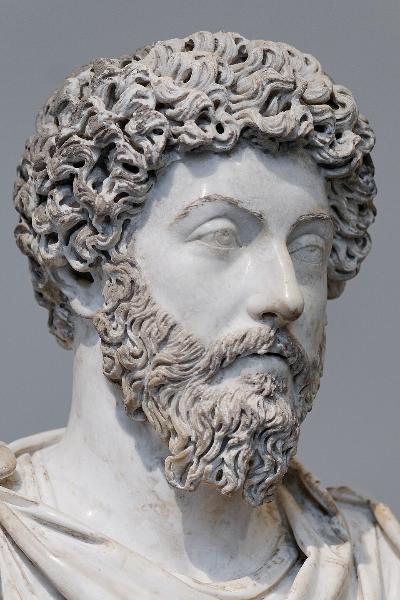 Bust of Marcus Aurelius, AD 161-169, Metropolitan Museum of Art, New York (© Marie-Lan Nguyen / Wikimedia Commons / CC-BY 2.5)
Stoicism regards emotions such as fear, anger, and grief as “irrational” distractions from what truly matters. Marcus Aurelius subscribed to the Stoic ideal that a state of tranquility—ataraxia in Greek—should be humanity’s highest goal.
Some aspects of Stoic philosophy find parallels in Jewish thought, including curiosity, a willingness to learn about the world around us, and self-awareness. Yet Judaism diverges from Stoicism in fundamental ways. Where Stoicism emphasizes an unalterable fate, Judaism stresses the power of human action: each person can shape their own life and influence the world through choices, acts of kindness, Jewish learning, charity, good deeds, and prayer.
Judaism teaches that each individual has a unique and burning purpose to fulfill. Entirely absent from Stoic philosophy—and from Marcus Aurelius’ Meditations—is the Jewish conception of the Divine, and the understanding that every person is an equally vital part of the universe, entrusted with a mission that only they can carry out.
Nearly 2,000 years later, Marcus Aurelius remains a figure of enduring fascination. Seen through Jewish history and thought, his life highlights both meaningful connections and deep contrasts—offering insight into why his ideas still resonate, and where Judaism charts a very different path.













I find the baby swapping story hard to believe.
What evidence do you have to say that it is not true?
I would trust Talmud over historians - they change their story every now and then.
I find this article incomplete.
did marcus aurelius have a home near the home of judah ha nasi in ha gagil, with a secret tunnel connecting the two homes? did they communicate in code using fruits and vegetables who names in aramaic were similar to the words they wanted to share in their messages? todah!