


 An Open Letter to Billy Crystal






According to the verse (Exodus 30:19), the function of the laver (kiyor) in the Tabernacle was to allow Aaron and his sons to wash their hands and feet before doing the service. I understand that it was proper to wash their hands, but why their feet as well?
Thank you for raising the interesting issue. The simple answer is that the priests served barefoot in the Tabernacle and Temple. If you look at the special clothes made for Aaron and his sons (Exodus 28), they did not include footwear – and a Kohen (priest) was not allowed to wear any more clothes than the Torah prescribed. (The Temple in fact included a heated room for the priests to warm up in during the winter, called “beit ha’mokeid” – “house of the hearth.” Even so, the commentators observe how taxing serving in the Temple was on the health of the priests, walking barefoot on the Temple’s cold stone floor while consuming large quantities of meat (see Bartinura to Shekalim 5:1).) In any event, since the priests served barefoot, their feet had to be washed and cleansed just as their hands.
The reason the priests served barefoot was because the Temple grounds themselves were holy. It would have been disrespectful to wear shoes above such ground. Likewise, when Moses had his first prophetic encounter with God at the Burning Bush – actually at Mount Sinai, God told him to remove his shoes because the ground on which he stood was holy (Exodus 3:5). The same occurred to Joshua shortly after the nation crossed the Jordan (Joshua 5:15).
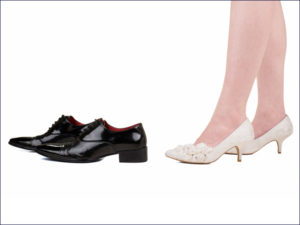
There are also two deeper interpretations of the significance of shoes which I have seen. One is that shoes represent man’s physical body. Just as a person’s shoes cover his feet, so too his body serves as the “clothes” housing his soul. In truth, a human being’s soul is so lofty it cannot truly reside in its body. Only the absolute lowest part of man’s soul is inside his physical form. Most of it dwells in Heaven far above. The same is true of shoes: It covers only the lowest part of man’s body and so is a precise metaphor for the body’s relationship with the soul. Thus, when Moses was told to remove his shoes, just as he was selected to lead the Jewish people, God was conveying to him that to assume such a role he would have to separate himself from his body and his physical half (Ruach Chaim 1:1). So too the Priests in the Temple understood that to serve God in the Temple, they would have to entirely devote themselves to their spiritual sides.
A different idea is as follows. Man’s shoes represent his mastery over the physical world. Not only are shoes themselves classically made of animal skins, of leather, but when man wears them, he treads upon the physical earth – the inanimate, the plants, and even the living. Wearing shoes is thus an act of domination – which is an aspect of humanity, and which as all qualities, can be used properly in the right context. Such a quality, however, is exactly what the Priests must not exercise when they serve in the Temple. They must realize they are servants alone, completely subservient to God, and dominating nothing else (R’ Yosef Zvi Salant, Be’er Yosef; see this link).
→ Ask the Rabbi a Question ← Click here to comment on this article