 Passover and the Crisis of Jewish Identity



6 min read
12 min read
5 min read
10 min read



12 min read


Every wave of new technology produces the same response from experts: this will destroy quality. They're partly right. And partly protecting something else entirely.
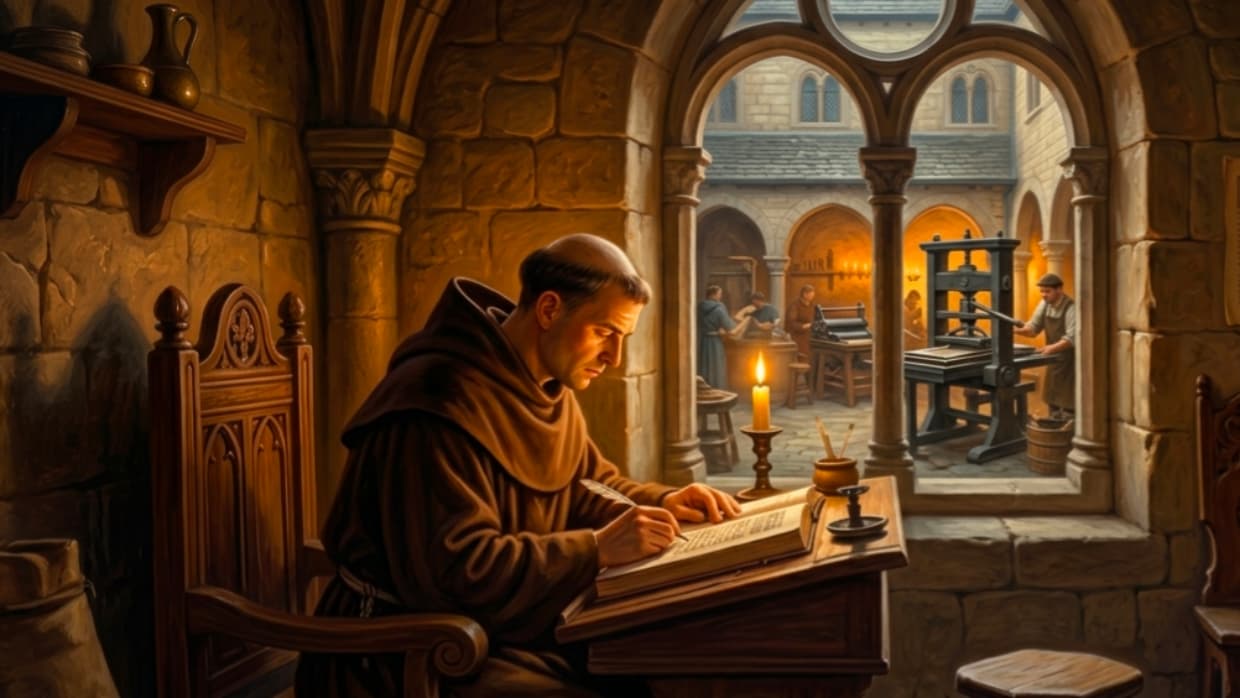
In 1492, a Benedictine abbot named Johannes Trithemius sat down to write a treatise defending the ancient art of manuscript copying against a dangerous new technology. He argued that hand-copied text on parchment would outlast printed text on paper by centuries. He made the case that the labor of copying Scripture was itself a form of prayer, a devotional act that no machine could replicate. He was, in the most literal sense, a gatekeeper making his last stand.
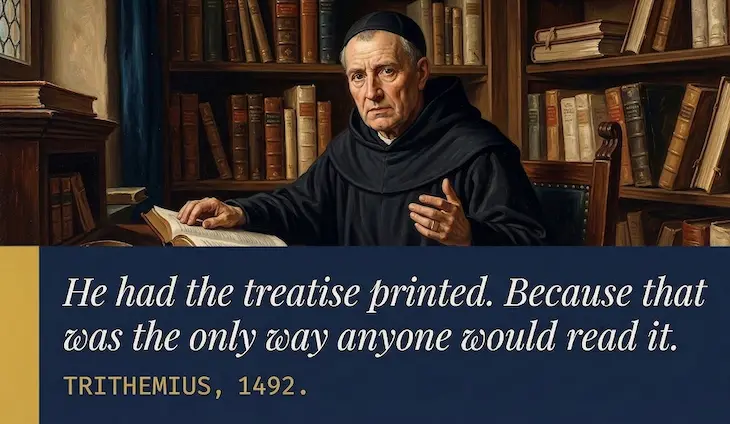
He had the treatise printed.
Because that was the only way anyone would read it.
This is the central irony of every wave of democratizing technology: the experts who argue most forcefully against the new tool are often already using it. And yet their concerns are not always wrong. They are just incomplete. The question is whether we have the honesty to hold both truths at once, and the courage to choose freedom over the familiar cage.
Trithemius was not a fool or a reactionary. He was the abbot of the Benedictine monastery at Sponheim, a serious scholar who expanded his abbey’s library from 40 books to over 2,000. He understood what the printing press could do. He used it constantly for his own work. Thirty printed editions of his writings appeared during the 15th century alone.
And yet in De Laude Scriptorum, written in 1492, he made a case that deserves to be read carefully rather than dismissed. He wrote: “The word written on parchment will last a thousand years. The printed word is on paper. How long will it last? The most you can expect a book of paper to survive is two hundred years.” ¹
He was not entirely wrong. Early printed books on paper were genuinely less durable than manuscript text on vellum. This was a real quality concern, not a projected one. Parchment manuscripts from the 8th century still exist today in near-perfect condition. Many early printed books did not survive two centuries.
But Trithemius was also defending something beyond durability. He was defending a way of life, a role, an identity built around being one of the few people in Europe who could produce a book. And when his own monks at Sponheim disagreed with him, when they found the task of endless copying “both irksome and pointless” and finally rebelled against his regime in 1505, forcing him to leave the monastery, what was lost was not the books. The books kept coming. What was lost was his position as the indispensable guardian of them.
In 2001, Jimmy Wales launched an online encyclopedia that anyone in the world could write and edit. No credentials required. No editorial board. No gatekeeping of any kind. The professional response was swift and confident: this was obviously inferior.
Encyclopedia Britannica had spent 250 years building a model around credentialed experts, rigorous editorial review, and institutional authority. The idea that anonymous volunteers writing for free could produce anything comparable was not a serious proposition.
In 2005, the journal Nature published a peer-reviewed study comparing Wikipedia’s accuracy on scientific topics directly against Britannica’s. The difference in error rates was not statistically significant.
The experts were right that some Wikipedia articles were poor. They were right that the model produced uneven quality, that anyone could write anything, that the floor had dropped dramatically. What they could not see was that the ceiling had not dropped with it. The tool gave access to thousands of people who happened to know things that no paid editorial team could have recruited. A retired volcanologist in New Zealand. A Talmud scholar in Brooklyn. A working cardiologist in Bangalore. The gate had kept them out not because their knowledge was insufficient but because the infrastructure of credentialed publishing had no way to reach them.
Wikipedia was not an isolated event. The pattern ran through photography a decade before Wikipedia. When smartphone computational photography arrived, and Sony and others built intelligent auto-modes that produced technically beautiful images without manual settings, professional photographers split into two camps. Some said the auto-mode image is flat, it has no intentionality, the craft is in the decisions the camera is now making for you. They were right about some images. Others said anyone who makes a stunning image made a stunning image, full stop. They were right about others. The tell, then as now, was when the critique stopped being about the specific photograph and started being about whether the photographer had suffered sufficiently to deserve it.
Paul Théberge documented the pattern in 1997, studying how digital music tools were reshaping not just who could make music but what making music meant. As one academic review summarized his central argument: “MIDI signifies a democratization of the musical marketplace, with technology as both a response to musician needs and a driving force that musicians must contend with.”²
The specific domain changes. The dynamic does not.
The technology does not just respond to what practitioners need. It reshapes what being a practitioner means. Every generation of tool-makers hands the next generation a question: now that access is no longer the barrier, what will you do with that?
The pattern is running again, right now, in two places simultaneously.
Software engineers who spent years learning architecture, debugging, and systems design are watching non-engineers ship working products using Claude Code, Cursor, or Copilot. There are solo founders today running products with tens of thousands of users, built over a weekend, with no engineering background, carrying real technical debt quietly underneath. The product works. The users love it. The architecture is a ticking clock. Both of those things are true simultaneously.
Copywriters who built careers on voice, strategy, and the craft of persuasion are watching AI produce serviceable copy in seconds. In both cases, the gatekeepers face the same two-part question Trithemius faced: is my objection about quality, or about identity?
This moment has a name. Call it Expertise Asymmetry Collapse: the point at which a new tool closes the gap between what an expert can produce and what a newcomer can produce so rapidly that the expert's identity cannot absorb the change at the same speed. The quality gap narrows. The identity gap does not. And in that space between them, the gate goes up.
On vibe coding: most AI-assisted products do carry real technical debt. Insecure architecture, no error handling, unmaintainable logic, hidden fragility at scale. These are not projected concerns. They are documented. A non-engineer who does not know what they do not know can ship a product that works until it very visibly does not.
The Wikipedia model produced millions of articles of genuine value and also millions of articles that should not exist. Both outcomes came from the same open gate.
On AI copywriting: most AI copy is generic. It lacks the specific voice, the earned insight, the emotional precision that converts at the margins. A prompt is not a brief. A generation is not a strategy. The craft carries real invisible knowledge that the tool does not yet fully replicate.
Both of these things are true. They deserve to be said plainly.
Here is where honesty gets harder.
When an engineer dismisses a working, user-loved product because the builder skipped the suffering, the objection is no longer about the code. When a copywriter rejects AI-assisted work that is genuinely sharp because the process offends them, the objection is no longer about the writing. The critique has shifted from “this is weak” to “you did not earn this.” And “you did not earn this” is not a quality metric. It is a gate.
Real quality loss: Democratization produces real mediocrity. New tools multiply the 90% alongside the 10%. Craft carries invisible knowledge that access alone cannot transfer.
Projected quality loss: When the critique shifts from the work to the path, it is no longer about quality. Effort justification is not a standard. The gate is protecting identity, not craft.
Trithemius used the press while arguing against it. The question is not whether his durability concern was real. It was. The question is whether he could tell the difference between defending parchment and defending his position as its guardian. The evidence suggests he could not. His monks could.
The Hebrew word emet, truth, is spelled aleph, mem, tav (א-מ-ת). The first letter of the alphabet, the middle letter, and the last. Complete truth - from start to finish. Not partial truth dressed as the whole.
Partial truth here looks like: “this tool produces mediocrity.” Complete truth looks like: “this tool produces mediocrity, and I am also protecting something beyond quality, and I have not been fully honest about which objection I am making at any given moment.”
Holding both is uncomfortable. It requires a specific kind of courage to say: yes, the quality concern is real, and also, some of my resistance is about what happens to my identity when the gate I guarded opens. Trithemius could not say that. His monks had to say it for him, with their feet, in 1505.
This is not a failure of character. It is a failure of honesty that can happen to anyone who has built their life around a scarce skill. The invitation is not to stop caring about quality. It is to tell the truth about which concern is which.
Expertise Asymmetry Collapse is not a threat to craft. It is a threat to the story you have been telling about yourself. Those are not the same thing. Emet requires knowing the difference.
The Israelites left Egypt and almost immediately began to grieve it.
“’We remember the fish we ate for free in Egypt,’ they said” (Numbers 11:5). They were standing on the other side of the sea, liberated, and they were mourning the food of their captivity. The prison had been terrible. The food had been familiar. And familiar, after long enough, feels like home.
The word for freedom in Hebrew is not chofesh, release from constraint. It is cherut, the freedom to act from your deepest values, from truth, rather than from your fear. The Exodus was not merely physical liberation. It was the shedding of a slave identity that had become comfortable. The hardest part was not the sea. The hardest part was the 40 years of learning to want something other than the familiar prison.
The expert who cannot release the gatekeeping role is in the same desert. Free to create, to teach, to build at a higher level than the tool can reach. And still grieving the hierarchy. Still mourning the Egypt where being one of the few people who could make a book, make a record, write a line of code, made you indispensable.
The breakthrough available to the expert is not to stop caring about quality. It is to stop confusing quality with scarcity. When Trithemius’s monks left the scriptorium, the Word did not become less sacred. It became available to more people. That is not a diminishment of the sacred. That is its purpose.
And the breakthrough available to the newcomer is symmetrical. Now that the tool gave you access, are you willing to develop the judgment that access alone cannot give you? Wikipedia's best articles were not written by the first person who had access. They were written and rewritten dozens of times by people who cared enough to go back. The tool gave access. The quality came from what people chose to do with that access once the gate was open. Those are not the same thing, and collapsing them is its own kind of dishonesty.
The tool lowered the floor. The craft raised the ceiling. Both are necessary. The question is whether you have the honesty to know which one you are working on at any given moment.
Teshuva is commonly translated as repentance, but the word means return. A turning back toward your truest self. Not self-punishment or erasure. Return.
The return available in this moment, for anyone who has built a career around a craft that is being democratized, is not to abandon the craft. It is to return to why you loved it in the first place. Was it the scarcity? Or was it the making? Was it the gate? Or was it what was on the other side?
If it was the making, the tool is good news. The floor just dropped. More people can begin. You can go further. You can teach. You can do the work that requires judgment the tool does not yet have, and you can do more of it, and faster, because the parts that were only ever about process are now handled.
If it was the gate, the grief is real. And the invitation of Passover is to grieve it, fully, and then walk through the sea anyway. Because on the other side is not the absence of craft. It is craft no longer defended by scarcity. Craft that stands on its own. Craft that earns its place not because it was hard to access but because it is genuinely worth accessing.
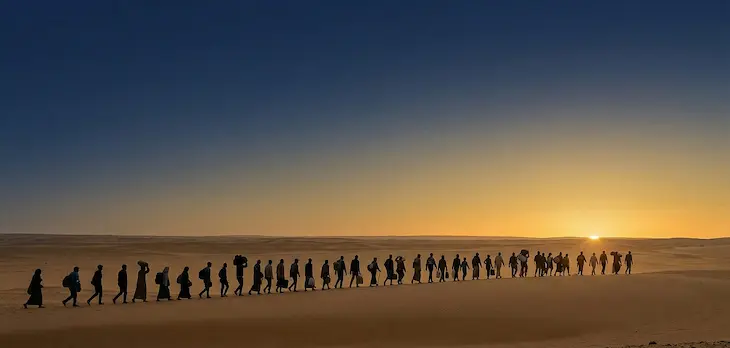
Trithemius was right that something was dying. The age of the pious monastic copyist was over. He could feel it. What he could not see, because grief does not allow you to see clearly, was what was being born. The Reformation. The Renaissance. The Scientific Revolution. Hundreds of millions of people who could read. Books in every language. Knowledge that had been locked in monastery libraries for a thousand years, free.
Every wave of democratization is a Passover moment. Something is dying. Something is being born. The question is whether you will let the grief become the destination, or whether you will tell the truth about what you are actually grieving, and walk through.
The gate was never the point. What you were guarding was.
Footnotes