







 Seven Reasons for Hope on October 8
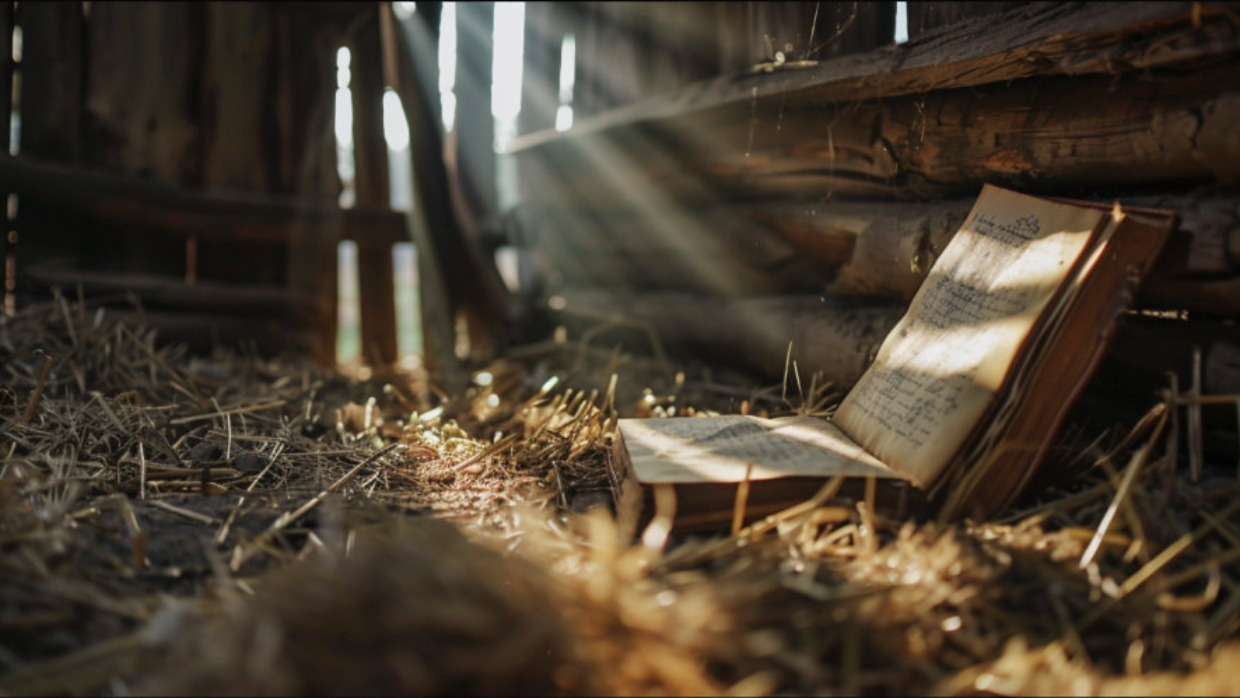






When David Engles translated his mother’s diary from Yiddish to English, written while hiding in a barn, he finally met the mother he’d barely gotten to know.
David Engles was born in a Displaced Persons camp in Italy shortly after World War II. His family moved to New York when he was three years old. His childhood memories are “pretty much a hole,” especially regarding his mother, who’d been in and out of hospitals and passed away when he was nine.
But there was one tangible object that kept her memory alive – his mother’s diary that she’d kept while in hiding during the Holocaust. His father made sure to save the diary for him. Later, when it was published in Yiddish, his father wrote, “All these years, I have taken good care of the notebook, wanting to keep it with me until my son David was mature enough to be able to read it, and most important of all, to be able to understand what his mother had been through.”
Dr. Engles had read his mother’s diary as an adult, but it wasn’t until he decided to translate it into English 20 years ago that he felt that he “first ‘met’ my mother and got to know the kind of person she was.” He shares:
It’s an extraordinary book… You really get to know her because, first of all, when she writes, she makes you feel that you’re there, with her. And then she lets you know who she is, because she doesn’t know if she is going to come out of there alive, so she is just pouring out her thoughts, her heart. And she was a very intelligent woman… She had her own opinion about things, didn’t listen to other people. And it turned out she was right on a lot of decisions she made.
David’s mother, Ruth Leimonzon Engles, grew up in the large Jewish community of Vilna, Lithuania. Before World War II, 60,000 Jews lived in Vilna. Only 2,000 of them survived the war. Ruth was among them.
Ruth’s father was a pharmacist and her mother was a midwife. Thanks to her father’s business connections, as a young adult Ruth got a job at a Polish wholesale cosmetic and pharmaceutical firm, where she began as an office worker and moved up to become the city and province representative.
Though Ruth’s boss had antisemitic leanings, he respected Ruth for her intelligence and hard work. Her boss’s wife befriended Ruth and later played an instrumental role in Ruth’s survival, hiding her in her own home and helping Ruth escape from Nazi-occupied Vilna shortly before the liquidation of the ghetto.
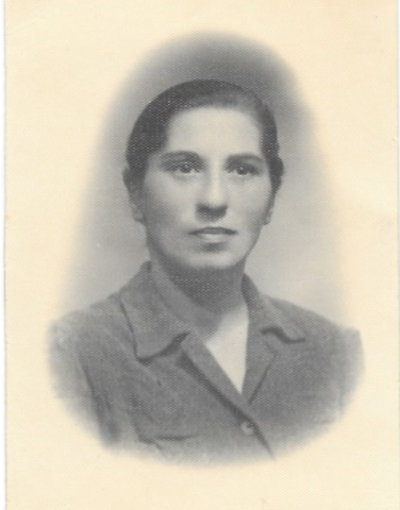
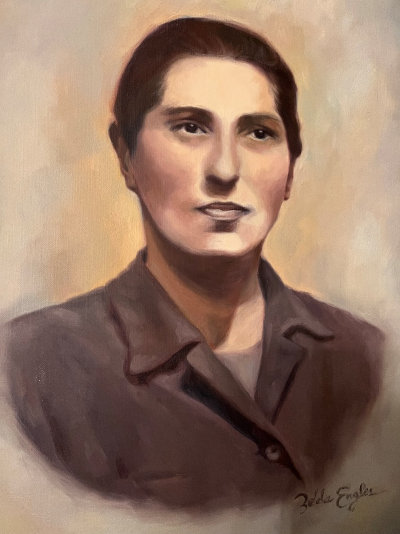 Portrait of Ruth Engles
Two years before the German attack on Lithuania, Ruth married Tzalel Trakinski. The couple didn’t have any children. In her diary, Ruth describes her first husband, “His loving, ever-smiling face would calm me so much. His always calm and easygoing manner, the exact opposite of me, would work wonders on me, like balm.”
A few days into the German occupation, Ruth’s husband was captured by the Gestapo, and she never saw him again. Throughout the war, she had been hoping against hope that he’d somehow survived, but sadly, that was not the case.
Ruth was left alone. In her diary, she recalls, “I still thought that I could wait for Tzalel, and that he would eventually return. So I wanted to keep everything the way he had left it. I began to look for ways to save the furniture.”
Ruth describes her efforts to save or sell her possessions as the Nazis were confiscating everything they could. A week later, Ruth was evicted from her home and sent to the newly formed ghetto, together with the rest of Vilna’s Jews.
A Christian peasant woman in the village of Simanuvka agreed to hide Ruth in her barn, without her husband’s knowledge. She hid there for 10 months.
In the ghetto, Ruth struggled to survive, but it was becoming clear to her that the Nazis were not planning to leave any survivors among the ghetto residents. Ruth escaped from the ghetto and went to her former boss’s wife. She realized she wouldn’t be able to stay there for long. Her hostess arranged for Ruth to leave Vilna and go to a farm. A Christian peasant woman in the village of Simanuvka agreed to hide Ruth in her barn, without her husband’s knowledge.
Ruth stayed in the barn for close to ten months, from September 27, 1943 until July 19, 1944, when the area was liberated by the Soviet army.
The stay in the barn was fraught with danger. Often, Ruth had to lay motionless in her hiding place, covered by straw, in fear of being discovered. Even when she could walk freely around the barn, she could only peek into the outside world through cracks or loose boards.
After 232 days in the barn, Ruth got hold of a notebook. She begins her diary with the following words:
At last, I have gotten a notebook in which to write. I have a pencil. I will try. Maybe it will make it easier to push through the days. It’s hard for me. As soon as dawn breaks, my first thought is: how does one endure until the end of the day? It feels as if I am trying to push a boat against the current. By nightfall, I am truly so tired that I feel as if I have done the most strenuous work.
In the diary, Ruth shares her strategies for living through each day:
A condemned person knows that he has a specific time to be in prison. He subtracts the time that has already passed and so he knows how much time he has left. For me it is quite different. I am constantly counting. Never before did I keep track of the days so precisely, the dates and the months … I … make it easier on myself, dividing the time into weeks and waiting from one Shabbat to the next.
Throughout the diary, Ruth shares her hopes and her fears, brutally honest about her despair and bouts of tears, and yet optimistic that she might still survive and rebuild. She wrote:
In the beginning, I used to cry continuously. But I realized that this would not do. I would accomplish nothing in this way. After all that I have been through, such a condition can lead to madness… If I have actually managed to save myself, then I must hold myself together. I have to control my nerves and rule over them, not they over me. To a certain degree, I have managed to do this.
On the coldest winter days, shivering from the cold, I would talk to myself like this: I am really cold, freezing cold—despite the felt boots and fur jacket, my feet have frozen—but soon it will be Shabbat again, and another week will have gone by. Maybe next month will be warmer. Winter, after all, does not go on forever; it will end. And the time that has passed will not return. It is, after all, closer to the end, I would tell myself, singing various songs and deluding myself with illusions about the future, promising myself, as a reward, mountains of gold. I tried in every way to distract myself so as to free my thoughts from the harsh reality.
Towards the end of her stay in the barn, as Ruth listened to the sounds of the Soviet victory over the Nazis, she allowed herself to think about her future. Yet, she was hesitant to leave the barn. She wrote:
The truth is that I could have crawled out already by now, but I don’t have any place or any person that I need to rush to get to. Let it quiet down a little bit. I don’t want to just hang around in the village. People would now look at me [a live Jew] in amazement, just as if I was some kind of rare, wild beast that had run away from a dense forest. Besides that, there are still thugs roaming around. It’s better to stay here a little longer, instead of taking a chance that I might have to crawl around again.
At that point, Ruth’s greatest fear was loneliness. She had no way of knowing if there were any other survivors from the Vilna Jewish community. On the last day in the barn, Ruth wrote: “When all is said and done, you have to crawl out eventually… After all that I’ve been through, I should be totally unemotional. And yet, I cannot control myself. My heart is soaring in the air.”
Back in Vilna, Ruth was delighted to encounter her late husband’s friend, Lazar Engles, who had lost his first wife and two daughters. Ruth and Lazar got married and had one child, David. In the Yiddish publication of the diary, Lazar wrote about those years, “Ruth was happy and lived with the hope of beginning a normal life.”
Upon Lazar’s brother’s invitation, the family moved to the United States, where David grew up.
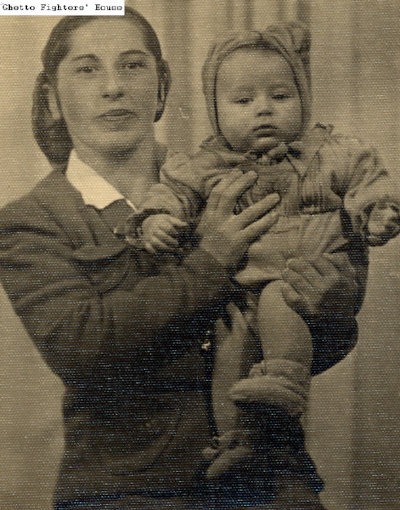 Ruth Engles and her son David, in a DP Camp in Italy, 1946
The harsh winter spent in the barn affected Ruth’s health. For the last two years of her life, she was in and out of hospitals, until she passed away in 1955, at age 45.
Yet, Ruth’s legacy lives on. David Engles married Eva, also a child of Holocaust survivors. Together, they have two children, 15 grandchildren, and several great-grandchildren. All of them are proud observant Jews, living in Israel. They are involved in Jewish education and outreach.
In his introduction to the English translation of his mother’s book, Dr. Engles quotes his wife, Eva, speaking about Holocaust survivors:
Because they had the courage and conviction to continue with their lives, raising their children in a traditional Jewish home, they are not merely survivors, they are victors. And all the millions of Jews living today, who are descendants of the Holocaust survivors, are a testament to the statement that they are all victors. Whenever the world tries to eliminate us, we come back even stronger.
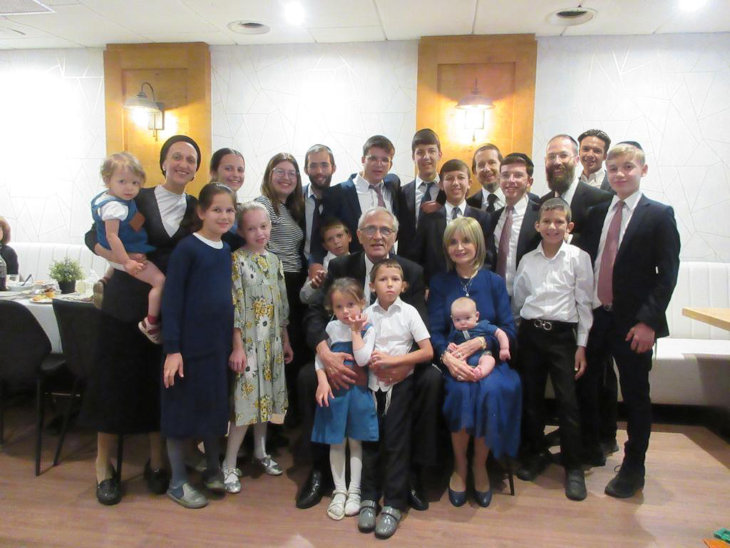 Victors’ descendants
Ruth’s inspiring diary, Written in a Barn: The Diary of a Young Woman from Vilna, is available from the Yad Vashem’s online bookstore at https://store.yadvashem.org/en/written-in-a-barn-the-diary-of-a-young-woman-from-vilna and at Amazon.com









This story is beautiful, and really inspired me. The strength she had for the present and future is truly impossible to believe. Thank you.
Beautiful, what a wonderful story.
Amazing
Most interesting story
Thank you for sharing this!
It's an amazing book about an amazing woman.
What an amazing story. So important that it is being shared!
Beautiful article. I am also a child of Holocaust survivors whose parents continued to be religious. They had the privilege of having many grandchildren, great grandchildren and great great grandchildren who are following in my parents' path.
I never considered myself or my husband A"H victors. Thank you for that boost.