







 Those Shameful Thoughts and What They Really Say about You

17 min read
12 min read




A soldier ran 8 miles in wet clothes to join the fight. A mother drew terrorists away from her child. David Kramer sees ancient Jewish heroes living again.
David Kramer’s new book, History’s Greatest Comeback: How the Ancient Stories of the Bible Are Unfolding in Israel Today, draws parallels between the heroes of the recent war and Biblical heroes, tracing the arc of Jewish history and a vision for a brighter future.
David tells the story of Avichail Reuven, a soldier whose family had come to Israel from Ethiopia. On October 7th, Avichail was home for Shabbat. David says, “He put his clothes in the wash, and he is with his family, and they get news of what’s happening. Avichail didn’t have a car. He just packed up and said, I’m going. He took his clothes out – they were still wet – and he literally ran 8 miles to the south of Israel. He never knew where he was going; he just ran. He was so determined to get there and to help, and I think just that act alone is incredible.”
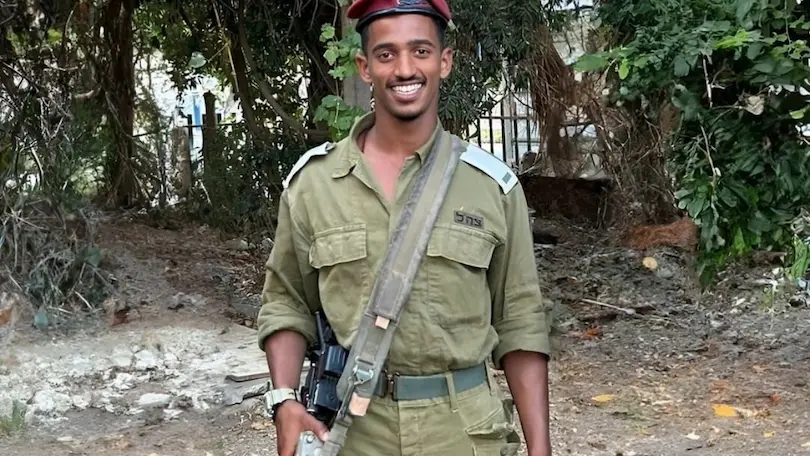
Eventually, Avichail reached the Zikim army base and was instrumental in retaking the base from terrorists. He went on to serve for the next three years, fighting in Gaza. “Today, he’s been promoted to quite a high-ranking officer,” says David.
To David, Avichail’s story parallels that of Patriarch Abraham, who went through many trials and “never knew what the end would be. They all had an element of life and death, and he never knew that he was going to make it at the end of the trial. That faith, knowing that no matter what, I'm going to do it because that's what God wants from me, I think that's exactly what motivated Avichail. He never knew whether he was going to make it at the end of the day, but he went through everything just to help his brothers and sisters, knowing that God was going to be with him.”
Another example of a modern-day heroine is Yarden Roman-Gat, whom David compares to the Biblical Queen Esther, who “didn’t seek heroism, it found her. She could have remained silent,” but she chose to act.
Similarly, when on October 7th, Yarden, her husband Alon, and their three-year-old daughter were abducted from their home, Yarden chose to act. As the terrorists holding them neared the Gaza border, Yarden “handed her daughter to Alon and ran in a different direction, diverting the terrorists so her husband and child could escape,” wrote David.
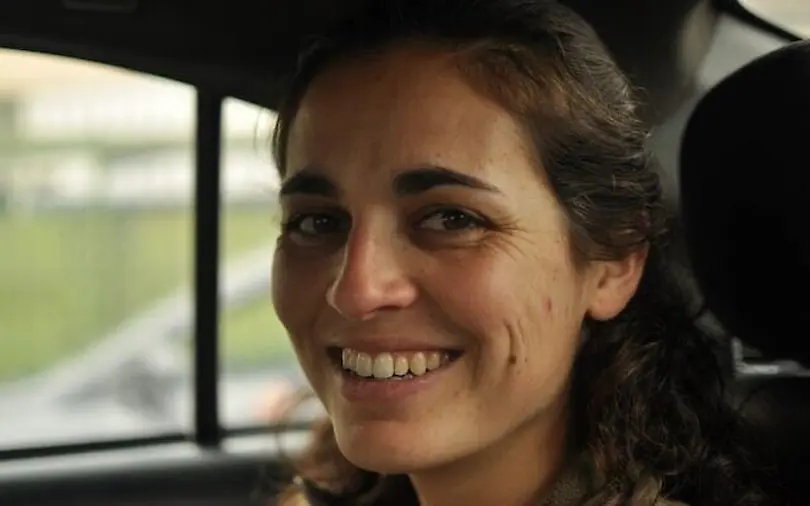
Though Yarden was captured and spent two months in captivity in Gaza, her husband managed to escape to safety with their daughter.
David was inspired to write his book at the funeral of Corporal Daniel Perez, a South African-born tank commander killed in battle on October 7th.
Originally from Johannesburg, South Africa, David has known the Perez family for decades. Daniel’s father, Rabbi Doron Perez, currently president of the World Zionist Organization, had been David’s youth counselor back in South Africa, and David has maintained a close relationship with him ever since.
In his book, David compares Daniel to the Maccabees, who “taught us that true bravery has never been measured by weapons or might but by conviction alone.” Like the Maccabees, fueled by conviction and commitment to protect his people, Daniel fought against a much stronger enemy.

David tells Daniel’s story: “On October 7, Daniel commanded his tank at the Nahal Oz outpost, one of the first and hardest-hit positions in the Hamas onslaught. For two hours and sixteen minutes, Daniel and his crew fought against overwhelming odds.” They saved dozens of lives. “Daniel was a real hero,” says David.
After Daniel was killed, his body was abducted by Hamas terrorists and taken to Gaza. At first, it was not known whether Daniel was still alive. In March 2024, his blood-soaked uniform was discovered, and the rabbinate declared Daniel’s death, based on the amount of blood. David says, “I remember being at his first funeral, where there were thousands of people that came from all over.”
When Daniel’s body was released two years later in the last hostage exchange, an announcement came out that there would be a second funeral. David recalls, “Because I'm close to the family, I said, I better go. I don't know how many people will come to the second funeral. And when I got there, I just couldn't believe it. Again, there were thousands of people who came from all over the country. I remember standing among Daniel’s friends, these boys who had become warriors and led the war throughout these years. In front of me was the former chief of staff, Herzi Halevi, talking to the father of Hirsch Goldberg Polin, another hostage who was murdered in captivity. I could only imagine what they were saying to each other. And then in front of me was the president of Israel, and the generals, and other dignitaries.”
The most poignant moment of the second funeral was when “Matan Angrest walked in,” recalls David. Matan was one of Daniel's tank crew members, captured alive and taken to Gaza on October 7th and released only three days earlier. “There was a moment at this funeral that was just transcendent,” says David. “There was something that I'd never experienced before.”
 Matan Angrest giving a eulogy at Daniel Perez’s second funeral
Looking around the military cemetery at the graves of other fallen soldiers, David “was overcome with this incredible sense of pride: pride in what this little tiny nation has achieved, pride in the fact that this country's so resilient and so strong, and that we got through. And more than that, I felt, we've got one of the most incredible stories to tell.” David’s new book is full of such inspiring stories.
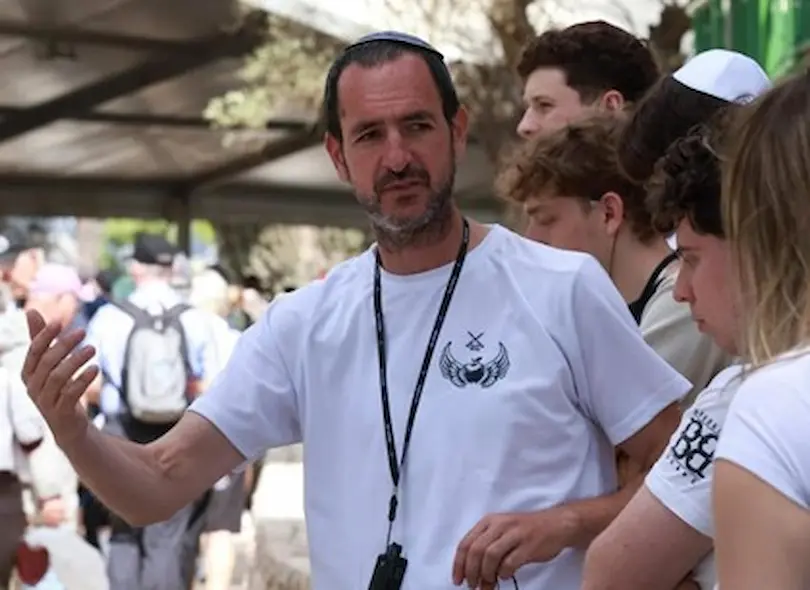 David Kramer leading a group of students at Daniel Perez's grave
For the front cover of his book, David selected a kalanit, the red flower that grows throughout the south of Israel. “You could only imagine what this little flower witnessed on October 7th, when thousands of terrorists came over the border,” says David. “This little flower was trampled on, but it has grown again. It's back in the thousands in the south of Israel, just like the Jewish people. Throughout the years, that's been our story. People have tried to destroy us, to trample us, to cancel us. And yet, year after year, the Jewish people keep coming back.”
David applies the same principle to the Jewish communities outside of Israel. After a terrorist attack, whether in America, Britain, or Australia, “the Jews are back in synagogue the next week, they're lighting Shabbat candles, they're lighting Chanukah candles,” says David. “Our stories are eternal. We have a covenant from God with Abraham, and even though we've been through many hard times, we keep coming back, and God willing, it should continue.”
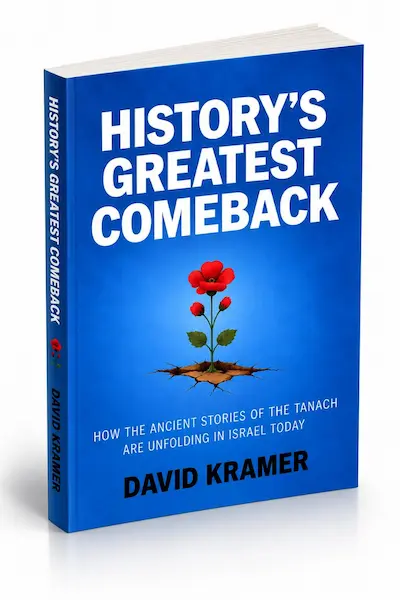 David Kramer's new book
David, who works as an educator, is hopeful when it comes to Israel’s future. “We look at the Torah, the messages I’ve tried to bring across in the book, and we know that the end of the story will be good,” he says.
He adds, “We're living in one of the most incredible times in this country! We just have to open our eyes and look at what's happening around us. What we've achieved in this country is unbelievable. Today, for the first time, there are more Jews living in Israel than anywhere else in the world. We have an economy that defies economics.”
The secret of this success, explains David, “is that the Jewish people stay together, unified. King David taught us that unity is a national strategy. To him, it wasn't just a value. He understood that in order for us to survive and reach our destiny, we have to be united. And I think that's the greatest challenge that we face in Israel today, and no one is exempt from this, is how do we look beyond ourselves and make sure that, even though we might disagree with each other, that we still, at the end of the day, can sit around the table and live together. That's going to be the secret of our survival.”
David’s practical advice for achieving unity is to “just smile at people. Greet people warmly. When we meet other types of Jews, we have to open ourselves up a little bit to them, say hello to them. We just have to embrace them and show them a bit of warmth.”











For those of us who are not Jewish, we wonder how Israel’s survival can be attributed to a resilient people…rather than to their faithful Lord God.
Absolutely! Jewish resilience, whether or not individual Jews will admit it, is rooted in faith and Divine Providence.
Where can I get a copy of David Kramers new book? History's Greatest Comeback.
I see it's available on Amazon (in my case, Canada) in paperback.