







 The Red Cross’s Jewish Problem


17 min read
8 min read




My Babi’s treasured Book of Psalms is more than an old book. It’s a time machine.
Sitting on my shelf is a precious treasure. While its pages are starting to brown and its letters starting to fade, its words still jump off the pages and fill my heart every time it catches my eye. Because it’s more than just an old, used book. It’s a time machine.
My Babi, Chaya Esther Bruckstein, was born on August 15, 1913. She grew up in a beautiful, spacious and ornate home in Bustina, Hungary (now Ukraine). Later in her life she would wistfully tell us, “We were so very wealthy.” Her family was prestigious and prosperous and Babi’s childhood was filled with plenty—the most beautiful dishes and décor, servants who took care of everything, even a separate guest house on their large estate.
It was a hospitable and warm home too, rich with Torah values and acts of kindness, attracting all different types of guests. Some were recuperating from illness while others were visiting Rabbis from all over Europe. Her family, including six siblings and over 60 first cousins, was loving and close-knit, a robust, beautiful family steeped in Jewish tradition. It was during those early days, and then later in 1938 when she and her husband had their first child, that she would open up her Book Psalms and recite the words of Hallel and Thanksgiving for all the good she was given and for the blessings in her life.
Like so many others, one day her warm, pleasant life was shattered. She, her husband and their 5-year-old daughter were rounded up together with her extended family and community, and taken to Auschwitz.
Standing on the platform, a man in prison garb came up to her and instructed her, “Give your child to the old lady next to you right now.”
As she was standing on the platform, waiting to be told in which line she should stand, an unfamiliar man in prison garb came up to her and instructed her, “Give your child to the old lady next to you right now.”
My Babi, disoriented from the long and arduous train ride, followed his orders and handed over her child to her mother-in-law, never to be seen again. As the days went on, starved and exhausted, Babi would find inner reservoirs of strength that she never knew she had. It was there, in Auschwitz, that she would see her father for the very last time, across a fence in the men’s camp, and not know who he was, until he called out to her in a weak voice, saying, “Don’t you recognize me Hajnal? It's me, your Opu.”
A little while later, while in Ravensbruck, her sister and cousin would task her each day with dividing up the measly rations they would get, because she was the oldest and wisest and had deep compassion and integrity. It was there that her younger sister felt helpless and hopeless and shared her plan to throw herself against the electrocuted barbed wire to end her agony. My Babi was the one who, despite being just as beaten down and tired, pleaded with her sister, encouraging hope, faith and will to survive. It was there that she cried out to God, from the depths of her suffering, quoting the same Psalms from her parched lips that she once sang from a full heart: “Mima’amakim kirasicha Hashem – Out of the depths I have called You, God.”
After being liberated and reuniting with the few scattered members of her family, her realization of how many people were lost was daunting. Among the living was her first cousin, a wonderful man she had her eye on earlier in her life and had wanted to marry, but her parents had not allowed it at the time. They both found themselves at a mutual cousin’s home in Romania and they decided to get married.
Together they grieved the life they once had, he too having lost a wife and son in Auschwitz.
Together they grieved the life they once had, he too having lost a wife and son in Auschwitz. It is there that they committed to put one foot in front of the other and look towards the future. There was nothing left for them in their hometowns and it was time to move on.
They had a baby, my father, secured visas, and came to America to start a new life, but the hardships continued. They arrived in Ellis Island with battle scars, empty pockets and an unfamiliar language. They were able to get jobs in a garment factory, sewing clothing. My grandfather had no idea what he was doing. He was a brilliant man but his talents and skills were not in the sewing and fabrics trade. He would slowly and painstakingly try to do his work, but struggled to finish his pile. My grandmother would not let him get fired. She would spend those days working quickly and tirelessly to do his workload in addition to hers, in order for him to save his job and his self-respect.
It was here, replanted in a new world, with nothing but hope for the future, that she called out with those same prayers that had accompanied her this far, King David’s Psalms: “Ezri me’im Hashem – My help comes from God.”
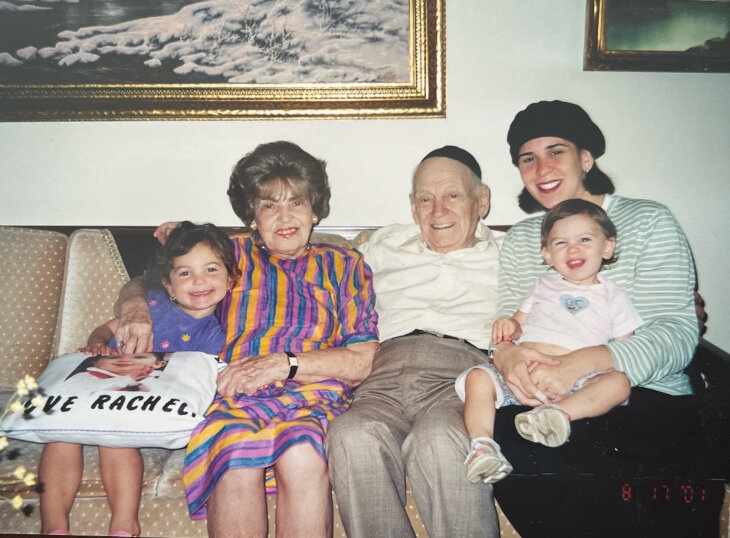
As the years went on, Babi slowly rebuilt her life. She raised her son and supported her husband with care and selflessness. She placed tremendous value on learning Torah at a time when it wasn’t so common to care about daily study. In the cold, winter months she would wake up early to warm their clothes on the heater so “her men'' could learn together each morning in comfort, before going off to work and Yeshiva.
With kindness and grace she devoted herself to her sister Gizi, who never merited to have her own children, including her in every part of her life so she had a family to call her own. It was in their Washington Heights apartment that she had to tell her precious 13-year-old son that he did not need to fast as a firstborn before Passover, because there was another child who came before him.
And it was here that she reunited with the man who took that child from her arms in Auschwitz and, now realizing that he had saved her life, stayed in touch with him and invited him to partake in all of her family celebrations.
Despite trying to move forward, she was never able to fully let go of her past. Where else to turn but her Book of Psalms to find the right words that can capture her desire to transition to a life of goodness and no more sadness: Hafachta mispidi l’machol li – You overturned my pain into dance.”
In her later years she imparted life lessons to us, her grandchildren, who she never imagined she’d see, in her everyday attitude and actions. We knew that every crumb was precious, never to be wasted. Every grandchild and great-grandchild was a miracle, never to be taken for granted. And every milestone was a momentous occasion to participate in and celebrate. There was not one graduation, Visiting Day or Chumash party that she missed. Each time her heart filled with nachas and joy as she experienced the rebirth of her family. She reveled in her husband's Torah learning and scholarship, in her son’s success in medicine and in the beautiful home he built with his wonderful wife, her precious daughter-in-law.
She would thank God for all the blessings and riches she had, with her beloved Psalms in her hand.
She felt her life, in her tiny apartment in Rego Park, Queens, without the servants and fancy serving pieces, was complete. She would thank God for all the blessings and riches she had, and with her beloved Psalms in her hand she would sing: Kos yeshuos esa uv’sheim HaShem ekra – a cup of salvation I raise and in the Name of God I call.”
In 1993 I went off to seminary and, upon my return trip for Passover I wanted to buy something for my Babi. I knew that her old Book of Psalms was battered and ripped and that it was time for a new one. I got her name engraved on the cover and when I presented it to her, the smile on her face and joy in her eyes convinced me that it was the right gift. At that moment she knew that I understood what was most important to her and the legacy she was passing on.
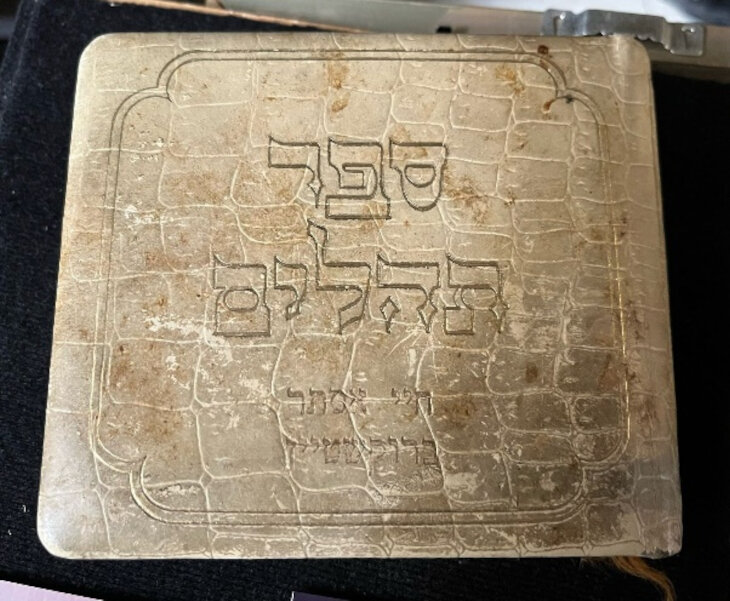 My Babi’s Book of Psalms
I have such vivid memories of my Babi reading from that Book of Psalms, day and night, well into her 90’s. Her connection with God was unflinching, her love for God palpable: “Lehagid Baboker Chasdecha, Ve’emunascha Balaylos -- To declare Your loving kindness in the morning, and Your faithfulness in the night.”
And so, sitting on my shelf for the past 18 years since her death, is my Babi’s precious Psalms, the one that I gifted to her 30 years ago. It’s a symbol of her tenacity, courage, strength, perseverance, profound faith and deep love. And now, since its pages are starting to brown and its letters starting to fade, I keep it in a frame on my shelf to preserve it for longer and safeguard it for many more years. Whenever I walk by the shelf and see it from the corner of my eye, it serves as an inspiration to me. It reminds me that while thank God, my own highs and lows can’t begin to compare with what my Babi endured, I too, like everyone, have good days and more challenging ones. And that no matter what is going on in my life and the lives of those I love, I can find expression like she did, in the Book of Psalms.
Now that I am blessed to have grandchildren who call me their Babi, I look at that time machine on my shelf and feel responsible to not only transmit the physical book to my children and grandchildren, but all the lessons, prayers and tears it has absorbed as well. I try my best to give over the values and messages I was privileged to gain from previous generations, and to be the next link in the unbreakable chain: “Dor l’dor yishabach ma’asecha – generation after generation will praise Your deeds.”
A version of this article originally appeared in Mishpacha Magazine, Pesach 2023












Thank you Rebitzen Goldberg for sharing your grandmother’s incredible story.
I just read your recent article in the Mishpacha magazine about returning to Bushtyno. My mother is from Bushtyno. Her father was the Rav, Dayan & shochet. She remembers the Bruckstein family well. Is your father Alex by any chance?
I’d love to connect with you…
wow!! I’d love to connect as well
my father’s first cousin is Alex
Pls reach out at goldbergmom@gmail.com
Awesome. Beautiful. Hopefully will save
What a nice legacy..I always read stories about survivors..each ond is a miracle ..but your Babi's emuna and yiras shamaim was remsrkable..you look alike . My father kindertransport, my mother escapee from Vienna
Thank you for sharing the story of your beautiful bubbe. Her love and faith are amazing. So many wonderful women as our role models showing us how to live and appreciate what we have. May we never know the need for such courage!
BEAUTIFUL THANK YOU
A beautifully-written tribute to your wonderful Babi. I doubt I could've shown half the grace she did in the face of such unimaginable horrors. Her will to survive, to refuse to let the culture and the songs of your people wither and die, showed true innate courage. Blessings to her memory.
I was deeply moved by this story and will add you and your family to my daily prayer list. I am edified. God bless you!
It was a heartwarming beautiful.story.
What a brave woman..going thru such hell and still praising God.
I was curious is to.why they wanted her to give her child to her MIL?? what was the point to her doing that 🤔
They often killed small children and babies (and sometimes their mothers too), pregnant women, the elderly and the weaker-looking prisoners moments after they arrived at the camps. That's why she never saw her precious daughter and her MIL again. Gut-wrenchingly horrendous, isn't it. THIS is why we must NEVER FORGET.
The article made brief reference to the soldier who saved her daughter by ordering her to hand the child to her mother in law. I was hoping for more information about that.
I think that article meant that the soldier had saved *HER* life, by having her hand the child to her MIL. As the previous poster had mentioned, they would sometimes kill the mothers of the children along with them. There was no hope for the child or the MIL. The man was saving whom he could.
Because tragically, older people and mothers and children were killed right away, and the man knew that to be holding a child was a death sentence, and the older woman would be killed anyway.
I have tears, I have no words.🙏🙏❤️
Thank you for sharing. ✡️
my father talked little about WWII and the 1948 Palestine war. Many of his family died in the camps. I have studied and read as he buried his memories. I cried as I read your story and admire your strength to survive and go on with your life. You have my admiration. Thank you for sharing - ❤️
What an incredibly inspiring story of faith, perseverance and gratitude. May she continue to live her beautiful life to the fullest. Surrounded by the warm embrace of her precious family whom she has embudied with the love of Hashem.
I enjoyed your story of faith. It’s seems when you Praise God in the hardest times he moves mountains!!! PRAISE HIS HOLY NAME!!
Thank you for not letting the world forget the horror and destruction that is possible for one deluded character to reek on the world if they get their delusion smiled upon and encouraged by mindless others! This is a beautuful story of an iron willed soul!
She truly loved God and felt his love. Her family was blessed to have her.
Was she reunited with her daughter?
No, it seems her daughter and mother in law were killed.. because later in America she met + thanked the man who saved her life, by removing her from her daughter. Apparently she understood it was the only thing he could do and couldn't save them both. Of course, I am sure if she knew why, in that moment, why he separated her from her daughter she probably would've protested and gotten them both killed.
What a beautiful testimony to God’s goodness through all the trials and victories. May we never forget!
Very inspiring story and the resilience of the human spirit to be strong in the face of suffering and to rise above it all to a place of blessing. I am in tears reading the story, from Papua New Guinea 🇵🇬 south-west Pacific.
I loved reading this. Tehillim are powerful, mystical, and spiritual. I read another article years ago about someone’s grandmother whose Tehillim pages were tear-stained with her constant prayers. It meant so much to me to read that then, as it does reading this article now.
I just don’t understand and have never understood why the Jewish are not like by so many.
The Jewish desire to change the World annoys everybody else.
No they do not desire to change the world. They desire to believe and live their faith in peace. They do not believe Jesus was the Messiah and they are still waiting for the Messiah to come.They only believe in the Old Testament and the Torah is their Bible, per se.
In a way, we do want to change the world: to make it kinder and more holy - but never by force, only by example.
That is precisely the reason why those who wish to be selfish with impunity try to negate us.
There's always one.
so beautiful. an inspiration.
Your testament to your grandmothers life is beautifully written. I have know many people similar to this-a true honor.
Love is felt in every word
I have read a famous Rabbi state that Tehillim were powerful and one should read them everyday as much as one can. This is a prime example.
Toda
I loved this so much, thank you
Powerful story, made me cry