








 What Two Hebrew Words Reveal About Israeli Democracy
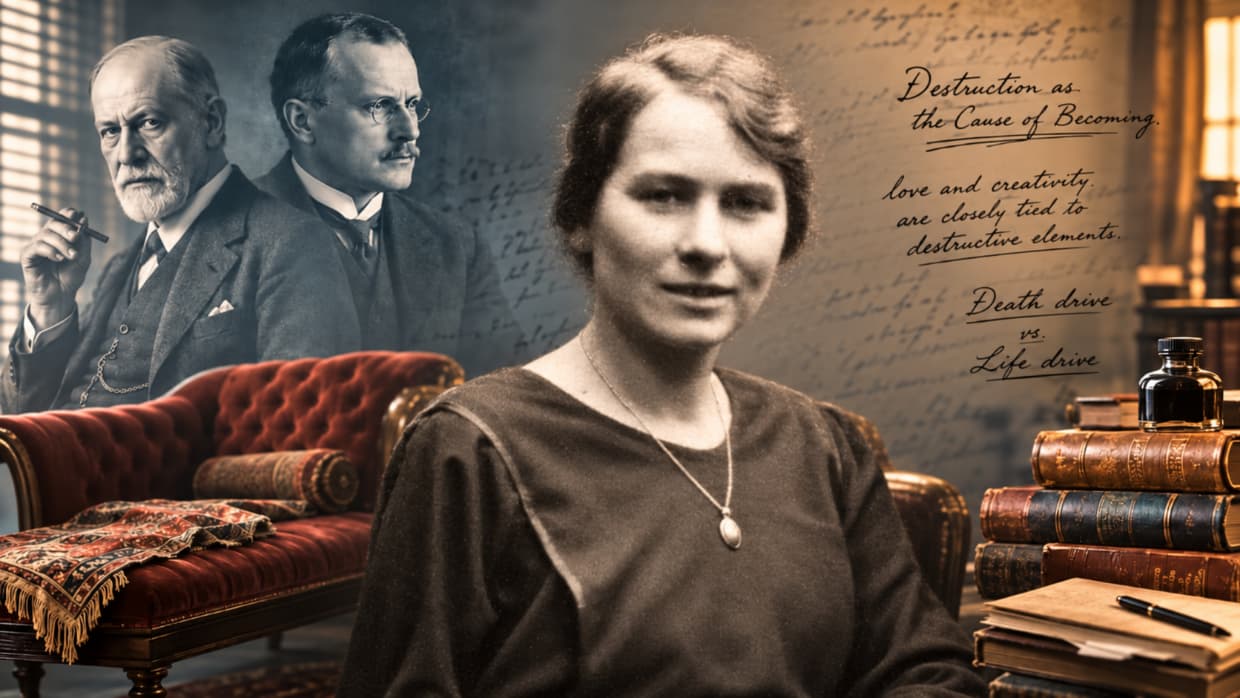






Meet the brilliant Jewish woman who helped invent psychoanalysis, only to be erased by the men who used her ideas.
Sabina Spielrein was 19 years old, locked in a Swiss psychiatric ward, twitching and sticking out her tongue while doctors debated whether she was mad. Within a decade, that same "hysteric" would be publishing groundbreaking psychoanalytic theory, treating her own patients, and quietly shaping ideas that made Sigmund Freud and Carl Jung famous.
Then she vanished from the story almost entirely.
Sabina Spielrein was a forgotten trailblazer. Over her career, she published more than 35 known papers in three languages. She overcame childhood trauma to become a brilliant medical student and one of the earliest architects of psychoanalysis.
Her theories of destruction and creation, language development, and the death drive predated and shaped the work of Freud and Jung. Her contributions were buried for decades beneath male egos, institutional amnesia, and whispers about her complicated entanglement with Jung. Her life ended in the Holocaust, but her legacy finally found its way out of the shadows.
Sabina Spielrein was born in 1885 in Rostov-on-Don, a major port city in southern Russia near the Sea of Azov. It was a culturally mixed, intellectually active city with a significant Jewish community.
Spielrein's maternal grandfather and great-grandfather were both rabbis. She was the eldest of merchant Nikolai Spielrein and dentist Eva Lublinskaya's five children. She grew up in a wealthy, highly educated Jewish family and learned to speak German, Russian, English, and French.
 Sabina (left) with her mother and sister
Marked by early brilliance, she entered a childhood school in Warsaw at age five and learned German and French there. At seven and eight, she spoke of conversing with a guiding "angel" -- visions that biographer Bernard Minder describes as the imaginative exaltations of a gifted, sensitive child.
Returning to Rostov at ten, she entered the girls' gymnasium, studying Latin, music, and biology.
Sabina's home life was as volatile as her mind was brilliant. Her parents relied on harsh discipline and corporal punishment, and clashes with her domineering father often erupted into scenes that lasted for days, one so fierce that her father threatened suicide. Still, she excelled at school, graduating with a gold medal in 1904.
She was very close to her younger sister, Emilia. When Emilia died of typhoid at age six, it unraveled Sabina. She was labeled a "hysteric" in the language of the time, and her psychiatric symptoms led her to Zurich's Burghölzli clinic under Eugen Bleuler and his deputy, Carl Jung.
Jung wrote this assessment after his first meeting with the 19-year-old: "Patient laughs and cries in a strange combination with a compulsive manner. A mass of tics; she rotates her head jerkily, sticks out her tongue, twitches her legs. Complains of a terrible headache. She says she is not mad… she could not stand people or noise."
Jung treated her with abreaction therapy, where suppressed traumatic emotions are released. She stayed at the Burghölzli clinic for nine and a half months, continuing treatment under Jung. He was married and ten years her senior. Jung treated her until her symptoms eased, and in June 1905 she was discharged and moved into a private Zurich residence to rebuild her life. But she kept seeing him as an outpatient for years afterward.
Jung's word association method sparked her interest in medicine, and within months of her recovery she applied to the University of Zurich's medical school.
Between 1906 and 1908, Spielrein and Jung began meeting privately in Zurich, their analytic conversations deepening into a growing intimacy she described as "poetry." Jung began corresponding with Freud, asking his advice about Sabina's case. He hinted at the entanglement in a 1906 letter, describing only "a Russian girl student", to which Freud replied that "I can subscribe without reservations to your remarks on therapy … Essentially, one might say, the cure is affected by love."
 Jung, Spielrein, and Freud
Eventually, the professional boundaries between patient and therapist gave way to an emotionally charged bond. The years 1908 to 1909 marked the most intense period of their affair.
No ashes, no coal can burn with such glow as a secretive love of which no one must know. -- Sabina Spielrein, from her diary, February 22, 1912
Through Jung, Spielrein also entered Freud's orbit. The two men corresponded about her case, and by 1911 she was writing to Freud independently, earning his respect as a serious young scholar whose ideas on destruction and creation influenced them both.
Sabina completed her medical training with remarkable speed. She passed her written exams in December 1910, her oral exams in January 1911, and defended her dissertation on February 9.
Her romantic relationship with Jung ended when she graduated and moved from Zurich to Vienna, where she became the second woman to present before the Vienna Psychoanalytic Society.
 Sabina Spielrein (front row, second from left) began working at the Rousseau Institute in Geneva in 1921
Her research argued that the forces behind love and creativity are closely tied to destructive elements, an idea she fully developed in her 1912 paper "Destruction as the Cause of Becoming." Freud later took up this idea in Beyond the Pleasure Principle (1920), naming the destructive impulse Thanatos, the death drive, in opposition to Eros, the life drive.
Her study earned an encouraging note from Freud: "I fully appreciate your attitude and look confidently to the future." In 1912 she returned to Rostov to lecture on psychoanalysis, where she met Dr. Pavel Sheftel. They married in a synagogue later that year, and their first daughter, Irma Renata, was born in 1913. She published several papers in 1913, including the landmark "Contributions to Understanding a Child's Mind."
At 26, Spielrein completed a groundbreaking medical dissertation, the first in psychoanalysis to document the treatment of a psychotic patient using Freud's method. She followed it with a series of ambitious papers: "Destruction as a Cause of Becoming" (1912), exploring how creation and annihilation intertwine in sexuality, fantasy, and myth, and "Contributions to Knowledge of the Infantile Mind," drawing on her own childhood memories and clinical observations of young boys.
Her later work continued this trajectory: a 1922 study on the origins of children's words "mama" and "papa," and a 1923 French paper tracing parallels between childhood thinking, aphasia (a neurological condition in which a person loses the ability to use or understand language), and unconscious processes.
Her work carried enough weight to be cited in 1936 by Édouard Pichon, one of the most prominent early French scholars of psychoanalysis, a rare distinction for any early analyst, let alone a woman whose work had already begun breaking new ground.
World War I split up her family. Her husband was drafted into the Russian army as a military doctor. Sabina took their daughter to Switzerland, where she worked a series of medical posts.
She and her daughter returned to Russia in 1923 to reunite with her husband, and their second daughter, Eva, was born in 1926. Spielrein found work at Moscow's State Psychoanalytic Institute and at the First Moscow State Medical University, earning a reputation as a respected physician and psychoanalyst specializing in paedology, an emerging field blending pediatrics and child psychology.
Her husband died of a heart attack in 1936.
Her intellectual work continued even as Stalinist policies made psychoanalysis increasingly unsafe. By the late 1930s, the Soviet Union had effectively banned the discipline. Spielrein, once active in the psychoanalytic circles of Zurich and Vienna, was now working in isolation.
In 1941, Sabina and her daughters were among roughly 13,000 Jews rounded up and taken to Zmiyevskaya Balka, a ravine on the outskirts of Rostov.
When the German army invaded the Soviet Union in 1941, Sabina and her daughters were among roughly 13,000 Jews rounded up and taken to Zmiyevskaya Balka, a ravine on the outskirts of Rostov. They were stripped of their clothing and possessions. Nearby, Russian prisoners were ordered to dig enormous trenches. Villagers were told to stay in place for a day because the German army was conducting shooting exercises. In reality, one of the largest mass shootings on Soviet territory was about to take place.
Men, women and children were led to the execution site, then shot kneeling or standing up, and their corpses were thrown into the ditch.
Sabina's fate remained uncertain until 1983, when Swedish scholar Magnus Ljunggren reconstructed the events from eyewitness accounts. Biographer Sabine Richebacher places her death on August 11, 1942, at age 56.
Sabina moved through the epicenters of 20th-century psychology -- Zurich, Vienna, Berlin, Geneva, Moscow -- holding leadership roles and lecturing to audiences that included the most influential theorists of her generation.
Her ideas shaped Jung's and Freud's thinking in lasting ways, pushing them to look more closely at the personal dynamics between analyst and patient. Those dynamics gave rise to new areas of study -- "transference" and "countertransference," where the patient or analyst reacts to the other as though someone from their past has reappeared in their life.
Her relationship with Jung forced Freud to reckon with something uncomfortable: that an analyst's own feelings and personal history can seep into the work. Freud had believed psychoanalysis could exist in a detached scientific vacuum, free of feelings and personal attraction. The Jung-Spielrein relationship made that belief impossible to hold onto.
There's a paradox at the center of her story, one that says as much about the era as it does about her. How does such a defining figure in early psychoanalysis become so thoroughly erased from history?
Jung quietly recast her as a former patient to shield himself from scandal. Freud knew the truth, but chose to protect his protégé and the reputation of the movement.
The hint of impropriety in her relationship with Jung made her easy to push aside. Jung quietly recast her as a former patient to shield himself from scandal. Freud knew the truth, but chose to protect his protégé and the reputation of the movement. In staying silent, he let Jung's version of events stand unchallenged, and let Spielrein's influence slip out of view. Their reputations stayed intact. Hers faded.
Today, scholars credit her with ideas that anticipated the field's most celebrated thinkers. Themes from her work resurfaced in feminist theory of the 1960s, and her early insights into children's language development have held up. "People have increasingly acknowledged that within her work, there were the seeds of ideas that then became much more acceptable and mainstream 50, 60 and 100 years later," John Launer, author of Sex Versus Survival: The Life and Ideas of Sabina Spielrein (2014), said in an interview.
Her legacy is a reminder of how easily the story of a field can be shaped by the people who write it. Sabina's reinstatement as an early architect of the psychoanalytic movement adds clarity and honesty to history.
______________________
Sources













The opposite of war and conflict is not peace, but creativity. Peace is merely a social outcome that emerges once the creative potential of the entire population is fully unleashed. When individuals can channel their constructive creativity outward—leaving no pent-up destructive impulses within—strife naturally fades away.
True; but still a choice that the individual must make. What of individuals who are unaware even of the possibility?
Am I missing something about how this is related to the Sabina Spielrein story?
Eye-opening!
The biggest tragedy is that she and her two daughters were murdered. Had she lived she could have eventually told her own story. She was never really erased as I remember reading about her decades ago.
I knew nothing about this woman of such powerful intellect and insight. What a tragedy that her life has been subjected to such erasure!
Thank you for this informative article. It is tragic how many geniuses are erased from history because of other people’s egos.
Great article about Sabina, and of our legacy. I agree with all the sentiments within, as well.