




 Would You Kill Baby Hitler?

13 min read


6 min read


For 12 years, he's visited his comatose wife every single day. Then one small, unexpected moment revealed something doctors couldn't explain.
Yehuda held on to the hope that his wife would recover, even though she had been in this Jerusalem hospital for almost 12 years. Edna lay in bed with her eyes open, yet it was doubtful that she could see anything. She had once been a concert violinist. Now after a heart attack that left her deprived of oxygen for too long, she was attached to a host of tubes including a ventilator and a feeding tube.
She didn’t respond to people’s voices, to the nurses, to the doctors or to her family. Yehuda was retired from his job as a high school biology teacher, so he came to the hospital every day to be with her.
I was training to be a pastoral counselor, visiting patients to offer some form of comfort. But I couldn’t find any here.
Yehuda had told me his story on previous visits: he and his wife were both been children during the Holocaust. He was hidden for three years in the barn of a Christian family, his father's business partner. Then when he was 10, he escaped and joined the partisans in the Polish countryside, sleeping outside in barns and the woods, helping to fight the Germans. Both of his parents had died in concentration camps.
In the convent, Edna completed the Hebrew words of the Shema for the visiting rabbi. She was rescued and eventually reunited with her mother.
His wife was eight when she was taken to a convent in France and hidden there. Edna had learned how to cross herself, how to say the Lord's Prayer. A few years later, the nuns brought a group of men wearing black hats and suits into the convent dining room. As the children continued their meal, the men walked around the room and recited a Jewish prayer, the Shema, to see which children responded. Edna completed the prayer for one of the men. The Hebrew words for “God is one” returned to her, and she said them out loud. After that, she was rescued and eventually reunited with her mother.
Now she lay in the hospital bed listless, her tongue drooping from her mouth. She was in a vegetative state. Yehuda patted her lips with gauze pads, taking a wet cloth to clean her face and hands. He told me that he gave her injections more skillfully than any of the nurses. He was busy at her bedside, wrapping a blood pressure cuff around his wife’s arm, recording the results on his own legal pad. He nodded, satisfied with the results. Next, he massaged her feet with moisturizing lotion he grabbed from the night table. Then he unplugged the plastic feeding tube from the machine to wash it in the sink and wipe the tube clean.
"You know the nurses here don't really care,” he said. “There's one. She doesn’t take care of my wife correctly. She doesn’t clean the feeding tube properly. I'm so angry at her. I yelled at her but she doesn’t change. So I care for Edna as much as I can. Of course, that's why I don't like going home from here. But they throw me out. The nurses insist that I go home.”
He was here almost every day from 1 to 8 PM. Every day, for the past 12 years.
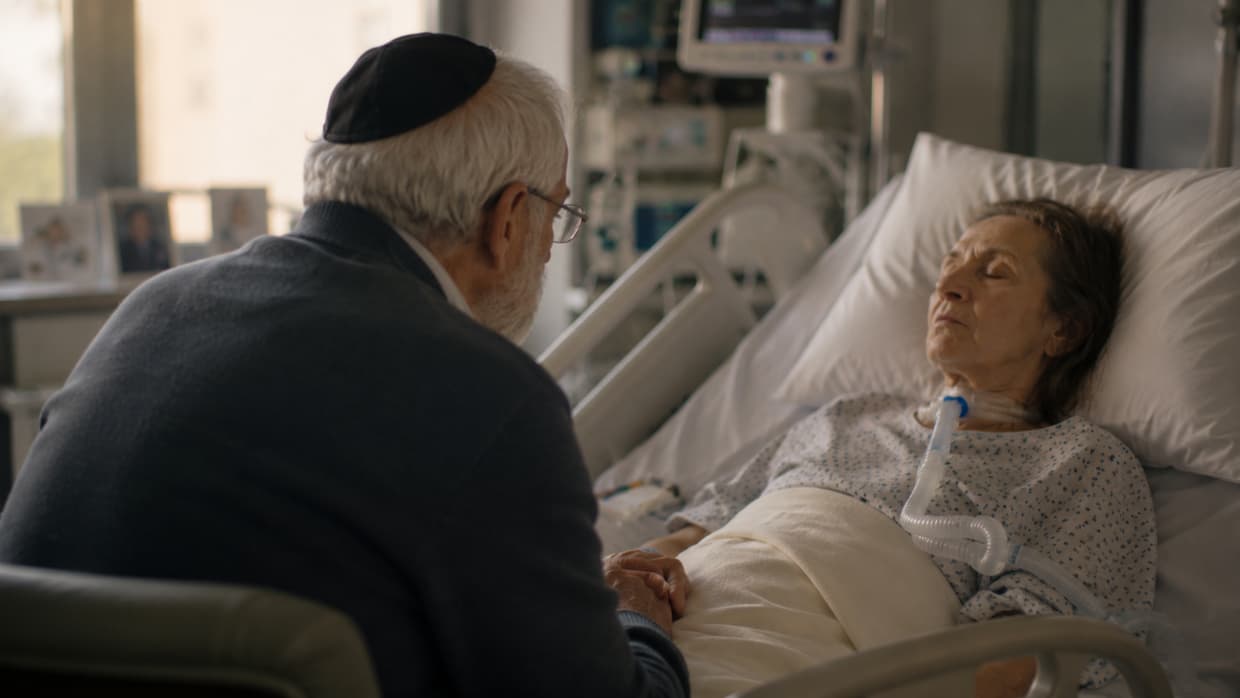
The room was set up like a bedroom, as if he had moved in. He was here almost every day from 1 to 8 PM. Every day, for the past 12 years. He had a blue cloth easy chair he had brought from home, a calendar with photos of the kids and grandkids hung above a small desk. On the wooden table he had brought from home there was a lamp with a small ship inside. On the wall hung a painting of boats, a small TV positioned on brackets.
He told me that their five sons did not approve of him visiting his wife so often. They wanted him to go back to work, to play cards with friends like he used to do, to travel, to do something other than be in this room.
But he told me that this was his job. He would not leave her. He was devoted to Edna. I thought of the way he had lost his parents when he was young, and the way he would not let himself lose his wife. But I agreed with his sons. Maybe it was time for him to stop spending so much time here.
Before I could broach the subject, he told me that he was going home early for a dentist appointment. He smoothed the blanket out over his wife and kissed her on the forehead. Then he bent down and kissed his wife on the lips. And I witnessed something unusual, so unexpected, shocking even. His wife’s lips seemed to close and purse and brush his.
“Is that what I think I saw?” I asked him as he wrapped a scarf around his neck, his body stooped.
“Oh yes,” he said, looking at me. “Go figure. It’s the only thing she can still do. And I don't think it's just a reflex. Maybe it is. But she seems to want to kiss me. I mean she puckers her mouth.”
Her lips pressed together. I couldn’t believe it. She was a person who seemed almost dead, and here she was, kissing.
He bent down and put his lips to hers, and she kissed him again. A small pucker. Light. Gentle. Her lips pressed together. I couldn’t believe it. She was a person who seemed almost dead, and here she was, kissing.
It wasn’t the story of Sleeping Beauty. Edna was not going to wake up. But there was a part of her, I knew it now, that had never gone to sleep. I remembered a verse from the Song of Songs: I am asleep but my heart is awake.
I felt as if that statement included Edna and even my son Koby who was murdered by Palestinian terrorists when he was 13. A person could seem asleep, even dead, but there was always a part of them that was awake—the soul. A piece of eternity, a touch of God, something that could never be destroyed, here in this room, hidden in the bedside kiss.
Excerpted from "Reaching for Comfort: What I Saw, What I Learned, and How I Blew it Training as a Pastoral Counselor."













2. As long as vital signs persist, the soul—along with its subtle body—remains within the physical body and has not departed;
3. The disconnection of consciousness arises from a combination of circulatory blockages in the brain, long-term internal self-isolation, and karmic imprints related to the head from past lives;
4. A vegetative state serves as a buffer period during which the soul is compelled to engage in introspection and clear away repressed emotions;
5. Negative words spoken by family members are fully absorbed by the subconscious, whereas gentle companionship can help unblock the subtle energy flows within the brain;
6. Whether awakens is determined by the extent of the soul's karmic cleansing and the degree of neurological repair in the physical body;
Yes, the soul is always awake. I witnessed a very similar though opposite reaction with Susan, a family member disabled from childhood. Tormented and physically abused by her younger sister, this girl's mind could not report the horrors inflicted on her over decades. When a fall left her comatose, family gathered at her hospital bedside. An EEG showed no brain activity until that abusive sister arrived. Then, against all medical assurances of brain death, those monitors went berserk. It was so unexpected, so profound, it made the gloating abuser scream in fear. Every face turned toward her. Everyone in the room understood what I had been trying to tell them for years. Her abuser stood convicted by those monitors and her own spirit.
what a shocking story....that poor girl
Heartbreaking and heartwarming simultaneously! A husband whose devotion has no bounds and the wife who reciprocates with a kiss that communicates awareness as best as she can.
Heroism may not be dramatic but steadfast daily!
i love what you said about heroism....as small daily acts
Beautiful, wrenching, inspiring story. Thank you, Sherri. Yes, the soul is always awake.
thank you Sara
Very moving; Yes, the soul is higher, spiritual, and much larger than our body! Thank you!
Thank you Sherri. What a beautiful and moving story you have written. Your ability to catch and focus in on the small moments in life that effect us and can change us is amazing. I have chills reading this.
Thank you for a nice article.
However, there is one sentence that troubles me: "It wasn’t the story of Sleeping Beauty. Edna was not going to wake up."
This is something we - and the doctors - are not permitted. No person can take away the hope of healing to full and complete health. G-d is our healer.
you are right, thanks for pointing that out
This story - brought back a spiritual glow of joy - that occurred - the day before my wife died. Though she was also in a coma - & I had only one hour a day to visit after a long drive. I'd massage her legs & read to her the book she'd been reading . But that day - as I spoke to her - I felt her hand lightly squeeze mine. I asked her if she was actually hearing me - to do it again. Which she did - & a third time - before I was forced to go. The next day - she'd had a severe heart stoppage - but was alive. When I arrived back home - as I was going through the gate - I glanced at my watch - EVERYTHING HAD GONE TO ZEROS @ 3 PM.
After I entered the house - I was called - & told I had to come back - as she'd died.
Now - the memory of her hand squeeze - glows again. THANKS!
that is quite a story...i'm glad you remembered your wife squeezing your hand
Thanks Sherri - when I read stories like this. They're just one of - what seem like the many vicarious - even serendipitous loving joyous memory sagas - that G-D - has blessed me with - in my life. Thanks again!
Her soul was kissing her husband. Can anything be sweeter?
Life is so mysterious
Beautiful story. Thank you.
Sherri movingly captures the mysterious intersection between medical science and glimpses of life on the Neshama level. What a blessing to be able to observe both realities and describe them for us in a way which increases hope and faith.
Beautiful story of beautiful souls, Sherri , your words brought tears to my eyes. What a devoted husband and what a miracle how their neshamas connect over and over again. You write beautifully with so much sensitivity.
thank you Debbie
Beautiful moving story Sherri .What a gift to have been part of that lifeforce kiss..
beautiful
Unbelievable! What an inspiring story.
Moving!
My grandfather who had serious dementia for years could also pucker his lips until the very end. The last thing to go is your automatic responses to stimuli, which would include pukering your lips. This does not in anyway mean that you have any functioning cognitive abilities. To try to put meaning where it does not exist is unhealthy in my opinion.
I was raised by two loving parents who taught me, if I don’t have anything nice to say, don’t say anything at all. Too bad you were not the beneficiary of this same lesson.
How would you kiss without your brain telling you to? I totally disagree. I think it's such a special, moving, inspiring story. Tysm for sharing!
Inspiring. Thank you for sharing. And I like thousands more remember your son Kobi.You're a strong Jewish woman!
thank you!!!
This warms my heart. Thank you for sharing this story, so deep and meaningful. Labor of love that transcends everything!
Dear Sherri,
This piece numbed me to the point that the noises outside faded into a distant hum, and I felt myself drawn completely into Yehuda’s world. At one point, the tears simply began to flow.
Something similar happened when I read about your dear son Koby and his friend. I pull inward at such moments, though I remain dimly aware of everything outside me.
An old chavruta once told me that certain things—not objects, but disturbing events—must be placed in a box and put on a high shelf. But some things are simply too immense to fit into a box. Your story of Yehuda and Edna is one of them. Soon, Mashiach will come, HaShem will heal the sick and revive the dead, and our mouths will once again be filled with laughter. Please make it soon, HaShem!
Amen to the prayer to Hashem to bring mashiach soon to heal the sick, revive the dead and fill our mouths with laughter!
amen
Wow Sherri you've done it again that was a beautiful read
thank you so much
Beautiful, I’m going to share this with my niece . Her daughter died one year ago.
please let me know her response
Really a beautiful story about the truth of love and our souls whether in a body or not. Thank you, Sherri!
thank you
Sherri, this article gave me goosebumps. The devotion and commitment you describe is such a selfless and compassionate side of love. In all their pain, I feel some gladness that they can at least share the kiss and the knowing that comes with it. Thank you for highlighting the line from shir hashirim and a little bit of your own journey. Your writing is very inspiring.
thank you Lindsay
The end was a surprise! Thank you Sherri for your sensitivity. Beautifully written!
thank you my dear
This is such a moving article that resonates with all of us. There is heartbreak but also compassion and love.
2 days before my mother in law passed away,she was in a coma.I had flownin from Israel to SA -to be with her.I held her hand and sang to her "No Jew is ever alone.." All of a sudden there was alot of movement and her ratings on the machines[ that she was hooked up to] started to escalate.A Dr. came running in and asked what was going on..I didn't know how to explain that she obviously was excited from the song..
Forgot to note that there was no reaction the 1st time that I came to see her [even though I had come all the way from Israel!!!] This was the 2nd day.