Click here to buy
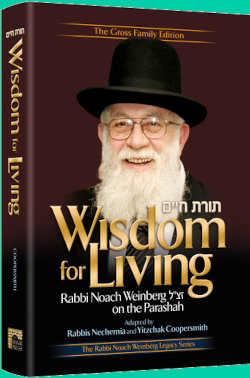
Wisdom for Living
Rabbi Noah Weinberg on the Parashah



6 min read


“The Children of Israel, the whole assembly, arrived at the Wilderness of Zin… Miriam died there and she was buried there. There was no water for the assembly, and they gathered against Moshe and Aharon” (Bamidbar 20:1-2).
The juxtaposition of Miriam’s death and the lack of water is no accident. The Talmud explains that it teaches us that the Jews received water during their entire forty years in the desert from a miraculous well that followed them throughout their journeys, and this well was in the merit of Miriam (Taanis 9a). Therefore, when she died, the miracle ceased and the well dried up.
What did Miriam do to merit this great miracle? The Zohar (Emor 103b) says that Miriam’s reward came from her standing at the side of the Nile River to ensure that her baby brother, Moshe, who was placed in a basket in the river, was saved. “His sister stood from afar, to know what would be done to him” (Shemos 2:4). In the merit of this one act Hashem miraculously provided the Jewish people water for forty years in the desert.
Miriam can be contrasted with another woman who lived at that time: Basya, the daughter of Pharaoh. Basya was actually the one who saved Moshe from the Nile. She saw the basket among the reeds and, as Rashi says, she stretched out her arm, which miraculously became long enough to reach the basket. Then, she raised Moshe as her own son in the palace of Pharaoh. Basya also merited to name Moshe. The Midrash teaches that Moshe had many names; his father Amram named him, his mother Yocheved gave him a name (Shemos Rabbah, 40:4). But the name the Torah itself calls him, the name that he is known by for all of history, is the name Basya gave him: Moshe. Because she saved his life, she merited naming him. But that reward pales in comparison to Miriam’s reward.
Who did a greater act: Miriam, who waited by the water’s edge, or Basya, who plucked Moshe from the water and raised him?
Clearly, saving Moshe's life is a much greater act, with more far-reaching consequences, than merely standing by and waiting to see how he was going to be saved. Why, then, did Miriam's act merit a far superior reward?
The Torah is showing us that the intention defines the act. Basya saw a child and saved him. She had no inkling who this child was destined to become; all she knew was that she saved a Jewish child from being swept away by the river. That act turned her into Moshe’s surrogate mother, and she therefore merited naming him.
Miriam was a prophetess, and she knew that Moshe was destined to be the redeemer who would take the Jewish people out of Egypt. She was not merely waiting by the water. The Talmud says (Sotah 13a):
Miriam prophesied while she was only the sister of Aharon and said, "My mother is destined to give birth to a son who will save the Jewish people." When Moshe was born and the entire house was completely filled with light, her father Amram proceeded to kiss her on her head. He said to her, "My daughter, your prophecy has been fulfilled." But when they cast Moshe into the river, her father proceeded to tap her on her head. He said to her, "My daughter, where is your prophecy now?” And that is the meaning of that which is written, "His sister stood at a distance to know what would transpire with him." She wanted to know what would transpire with the resolution of her prophecy.
Miriam was not merely watching a Jewish child; she was waiting to see what would happen to the future leader of the Jewish people. Basya was acting on behalf of one child, but Miriam was acting to ensure the survival of the entire nation. Miriam's intention transformed her deed into a greater act than Basya's, and that is why the nation was supplied with water in her merit.
We need to examine the intent underlying our actions, because our intent defines the action. This is especially relevant in the realm of prayer.
When you pray, instead of praying only for yourself, broaden your vision and have in mind the entire Jewish people. Pray for everyone you know, for every Jew across the globe. Pray that Hashem give us understanding, return us to His Torah, and forgive us. When we have other people in mind and think about the whole Jewish people, it is a very different quality of prayer. In fact, Chazal built that focus into our prayers by formulating the requests of the Shemoneh Esrei in the plural. But it is our intent that defines our prayers. We can limit our prayers to ourselves, or we can use the same words with a more expansive intent and pray for all Jews.
Our intent can also transform the way we learn Torah. The Mishnah says, "Rabbi Yishmael bar Rabbi Yosi said: One who studies Torah in order to teach is granted the ability to study and to teach. One who studies in order to do is granted the ability to study, to teach, to observe, and to do" (Avos 4:6). If your intent in learning is to also teach, you have a different siyatta d'Shmaya (Heavenly assistance) than one who learns solely in order to learn. One who learns in order to teach is guaranteed by the Almighty that he will know what he has learned and merit to teach it. And one who learns Torah in order to fulfill it is promised much more. But the one who learns just in order to learn merits none of this. The intent makes it a completely different kind of learning.
One who learns Torah lishmah, for its own sake, is guaranteed even more. As the Mishnah says, “Rabbi Meir said: Whoever engages in Torah study for its own sake merits many things; furthermore, the creation of the world is worthwhile for his sake alone. He is called ‘friend, beloved’… the Torah clothes him in humility and fear of God; it makes him fit to be righteous, devout, fair, and faithful. It moves him away from sin and draws him near to merit… the secrets of Torah are revealed to him” (Avos 6:1). He gets it all! He can be learning the same Torah as the person beside him, but because his intent is different, the results are radically different as well.
If you are putting in the many hours of learning Torah already, examine your intent and make sure you are learning Torah lishmah, to know God and be close to Him. You are putting the time into learning anyway. It pays to figure out how to optimize it. The Almighty guarantees tremendous blessing, but it all depends on your intention.