





 Passover and the Crisis of Jewish Identity






14 min read


During the darkest days of Soviet antisemitism, the great non-Jewish composer championed Jews and Jewish culture.
Born into a liberal Catholic family in St. Petersburg in 1906, Dimitri Shostakovich adopted an open-minded view. Prejudice and hatred - especially the antisemitism that permeated Russian society - disgusted him. In his memoirs, he described the tolerance he imbibed from his parents from an early age*.
My parents considered antisemitism a shameful superstition, and in that sense I was given a singular upbringing. In my youth I came across antisemitism among my peers… I never condoned an antisemitic tone, even then, and I didn’t repeat antisemitic jokes that were popular then. But I was much gentler about this unworthy trait than I am now. Later I broke with even good friends if I saw that they had any antisemitic tendencies. (Quoted in Testimone: The Memoirs of Dmitri Shostakovich as related and edited by Solomon Volkov: 1984.)
Shostakovich’s mother played the piano and taught him to play. He quickly distinguished himself as a musical prodigy. While still a child, Shostakovich became a world-class pianist, yet it was composing that truly interested the musical genius.
In 1924-1925 he wrote his first full-scale symphony when he was still a teenager and his powerful work took the world by storm. Entranced by his musical success, Shostakovich composed other pieces, including a comic opera. The Soviet Union was then artistically relatively free and Shostakovich looked forward to a long and successful musical career.
Listen to Shostakovich’s powerful, fresh Symphony No. 1
In his early 20s, Shostakovich began work on a second opera, titled Lady Macbeth of the Mtsensk District. Based on a novella by the Russian author Nikolai Leskov, it tells the story of an adulterous, murderous couple. The opera featured avant-garde music and seemed to carry a social commentary as well: in the final scene, the couple are glimpsed in a Siberian labor camp, imprisoned for their crimes.
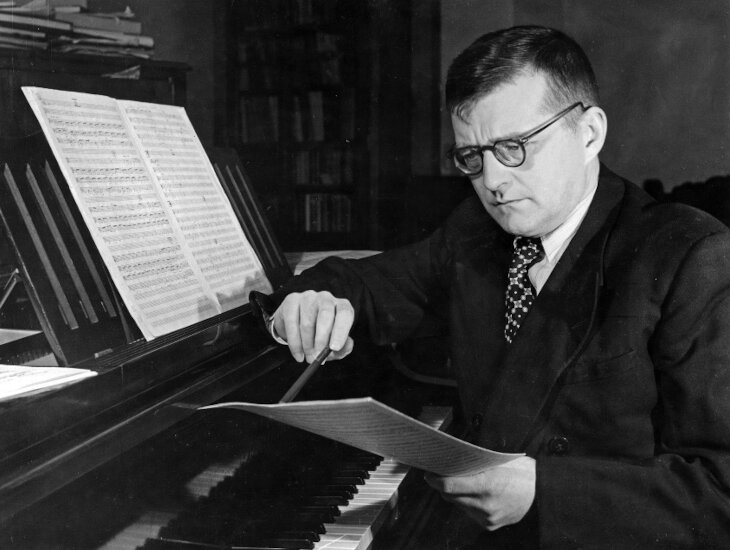
Lady Macbeth of the Mtsensk District was a huge hit and toured for years in Russia. Then, on January 28, 1936, Joseph Stalin, the Soviet Union’s mercurial dictator, came to watch a performance along with the governing Politburo. Two years earlier, Stalin had begun purging his supposed enemies. The Carnegie Hall website writes, “Politicians and military leaders - and also writers, filmmakers, actors, musicians, and others - were arrested on trumped-up charges and subject to interrogation, torture, humiliating public trials, and execution. Those who didn’t immediately pay with their lives were shipped to the Gulag system - the network of Soviet penal labor camps - where more than a million died of hunger and disease.” Many of Shostakovich’s relatives and friends were caught up in the terror, arrested, imprisoned, and killed.
“It’s not enough to love Soviet power,” Shostakovich noted in his memoirs. “It has to love you.” Like Hitler in Germany, Stalin outlawed what he regarded as degenerate or overly western music, including jazz.
Shostakovich was present the evening in the Bolshoi Theater when Stalin arrived and watched helplessly as Stalin and his minions angrily left before the opera concluded. When Shostakovich took a bow at the end of the performance, eyewitnesses described him as “white as a sheet” and glassy-eyed. He braced for what was to come.
Days later, the government newspaper Pravda carried an anonymous review of the opera, which many readers assumed had been penned by Stalin himself. Entitled “Muddle Instead of Music,” the scathing review called Shostakovich’s opera “bourgeois” and warned: “It is a game of clever ingenuity that may end very badly.”
The result was immediate and devastating. Shostakovich’s friends turned on him, writing articles about how terrible his music was and refusing to see him. The Soviet Composers’ Union denounced his opera. Shostakovich remained steadfast in his belief in his self-worth and in the value of his music. “Instead of repenting,” Shostakovich later wrote in a letter to a friend, “I composed my Fourth Symphony.” It was a defiant piece, though he didn’t publish it publicly for decades, afraid of incurring further wrath from Stalin and the Politburo.
Around this time, Shostakovich became acquainted with the music of the Jewish composer Gustav Mahler. Mahler’s richly textured pieces helped Shostakovich invent a way to continue composing without compromising his own musical integrity. As British musicologist Andrew Kirkman has noted, the events of 1936 “forced (Shostakovich) to change his musical language.” Shostakovich created “a new musical language, suitable for ‘official’ use, but also not compromising his identity. He introduced many idioms taken from classical and romantic music. Like Mahler, Shostakovich pieces henceforth displayed a rich depth, and contained both traditionally pleasing melodies to satisfy Soviet censors, in addition to darker musical themes, which allowed Shostakovich to express covert criticisms of Soviet society. (Quoted in Contemplating Shostakovich: Life, Music and Film by Andrew Kirkman: 2012)
Click here to sample Shostakovich’s 4th Symphony:
Shostakovich reverted to composing music that pleased the Soviet authorities. He eventually gained the job of chair of the piano department at the famed Leningrad Conservatoire. He would later recall the horror of the morning of June 22, 1941, when Germany broke its pact with the Soviet Union and invaded the USSR in Operation Barbarossa. “Our fruitful, constructive existence was rudely shattered!” Shostakovich later described.
Within days Shostakovich began composing a new symphony, his Seventh. He worked on it throughout the summer and into the autumn, even after German forces arrived at the edge of Leningrad and laid siege to the city.
The Siege of Leningrad lasted 872 days. By November 1941 Nazi forces completely encircled the city, home to approximately three million people. The entire adult population was mobilized to build anti-tank barriers around the city, preventing Nazi forces from entering the city itself. The populace quickly ran out of fuel and food. In 1942 alone, about 650,000 Leningrad civilians died from starvation, disease and cold.
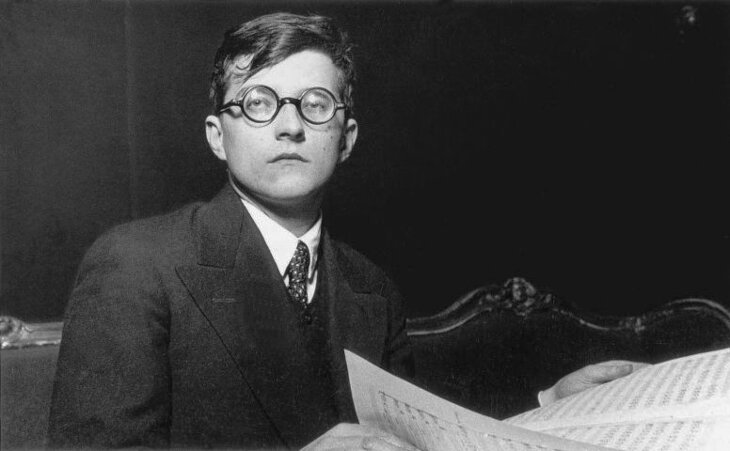
Shostakovich volunteered as a fire warden at night while he worked on his symphony during the day in the early days of the Nazi offense on his city. “I work with an inhuman intensity I have never before reached,” he wrote to a friend. The magnificent new symphony that was being forged during the Nazi assault was a paean to his beloved Leningrad. When Shostakovich finished the second movement, he broadcast his progress on the radio, saying: “I tell you this so that those Leningraders who are now listening to me shall know that the life of our city is going on normally. Remember that our art is threatened with great danger. We will defend our music.”
As historian John Vacha described, in the midst of the Nazi attack on Leningrad, Shostakovich “invited several musicians to his apartment to hear his work (on his 7th Symphony). As he pounded out the piano score, sirens announced the imminence of another air raid. Sending his wife and children to a shelter, he continued playing to Luftwaffe bombs and anti-aircraft fire. As the Red Army defenders stabilized the lines around the city at the end of September, Shostakovich finished the third of his symphony’s four movements.”
Shostakovich was evacuated with his family before the Nazis completely encircled Leningrad and finished his symphony at the end of 1941 in the USSR’s temporary capital city of Kuibyshev. It’s a massive piece, calling for a full orchestra plus harps, a piano, and extra drums and harps. It lasts for nearly an hour and a half, with the first movement itself spanning nearly an hour, an eternity in a symphony. Shostakovich dedicated the symphony to Leningrad. It was first performed with a skeleton orchestra early in 1942, and immediately became a symbol of the city, giving Russians hope that they would prevail over Nazi forces during their darkest hour.
Click here to watch a 1942 recording Shostakovich’s playing some of the themes from his “Leningrad” Symphony on his piano:
The next piece Shostakovich wrote was inspired by stories about Nazi atrocities that were beginning to leak out. Soviet newspapers described how Nazi guards at Treblinka and Majdanek death camps forced Jews to dig their own graves and dance around them before being murdered. In 1943, Shostakovich embarked on an intimate piano trio inspired by these and other Nazi horrors. It was the second piano trip he wrote and is known as Shostakovich’s Piano Trio No. 2.
Click here to listen to this haunting piece:
Shostakovich began to embrace Jewish themes in music, both because he loved the complexity and sound of Jewish music and also because as he aged his appreciation of the Jewish people grew. Particularly as he matured as a composer, Shostakovich appreciated the complexity that Jewish musical forms afforded him. He felt that Jewish themes are able to express both sadness and joy in the same piece. In his memoirs, Shosakovich wrote:
I think, if we speak of musical impressions, that Jewish folk music has made the most powerful impression on me. I never tire of delighting in it, it’s multifaceted, it can appear happy while it is tragic. It’s almost always laughter through tears.
This quality of Jewish folk music is close to my idea of what music should be. There should always be two layers in music. Jews were tormented for so long that they learned to hide their despair… All folk music is lovely, but I can say that Jewish folk music is unique.
It wasn’t only the merits of Jewish music which appealed to Shostakovich: with antisemitism rampant in the Soviet Union, and particularly after the horrors of the Holocaust became known, Shostakovich became overt in his philo-Semitism. “This is not a purely musical issue,” he recorded, “this is also a moral issue.” Shostakovich began to see antisemitism as a sign of a person’s lack of morality overall. He wrote towards the end of his life, “I often test a person by his attitude toward Jews. In our day and age, any person with pretensions of decency cannot be antisemitic. This seems so obvious that it doesn’t need saying, but I’ve had to argue the point for at least 30 years.”
“In our day and age, any person with pretensions of decency cannot be antisemitic. This seems so obvious that it doesn’t need saying, but I’ve had to argue the point for at least 30 years.”
Shostakovich recalled hearing his fellow Russians utter antisemitic slurs. He later explained that he wrote Jewish-themed music in response to this antisemitism.
Anti-Jewish prejudice was never far from the surface in the Soviet Union, but after the establishment of the State of Israel in 1948 it soared to new heights. Soviet official propaganda ramped up its demonization of Jews, along with western-leaning intellectuals. Shostakovich noted that “even before the war, the attitude towards Jew had changed drastically. It turned out that we had far to go to achieve brotherhood.” Shostakovich observed that it seemed that “Jews became the most persecuted and defenseless people of Europe. It was a return to the Middle Ages.”
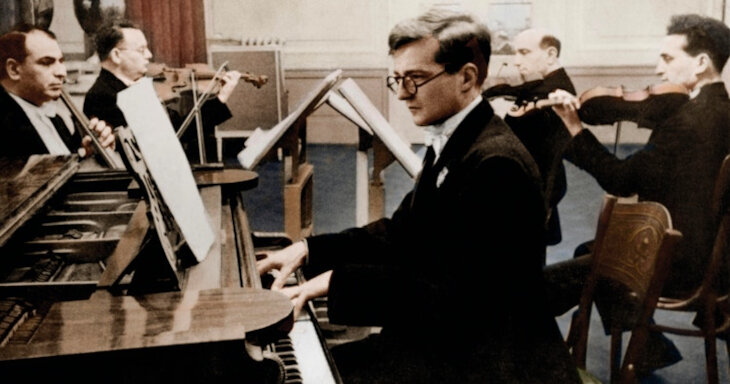
Shostakovich wanted to fight back. “Jews became a symbol for me,” he noted. “All of man’s defenselessness was concentrated in them. After the war, I tried to convey that feeling in my music. It was a bad time for Jews then. In fact, it’s always a bad time for them.”
In 1948, Shostakovich was denounced once more as pro-Western and lost his job at the Leningrad Conservatory. That same year, the Soviet Yiddish theater star Solomon Mikhoels was murdered on Stalin’s orders. Mikhoels was the father-in-law of one of Shostakovich’s best friends, the composer Mieczyslaw Weinberg. Shostakovich viscerally realized that the Soviet repression of artistic freedom targeted Jews especially harshly. He began writing a cycle of Jewish songs in protest, basing them on a Yiddish book he found in a used book store called Jewish Folk Songs, edited by Y. M. Sokolov.
The songs run the gamut of human emotion, from “Lament for a Dead Child” and “Song of Misery” to “Happiness” and “The Young Girl’s Song.” Even using the Yiddish language in his songs, instead of Russian, was a provocative gesture at the time. Shostakovich knew these songs couldn’t be heard publicly and wrote them purely for his own enjoyment. It was only after Stalin’s death in 1955 that they were performed at last.
Click here to hear Shostakovich’s Jewish Folk Songs:
Shostakovich became the Soviet Union’s foremost composer after Stalin’s death, but he was a frustrated genius, forced to censor himself and his music to please the Communist Party. Much of his work was done to provide the score for Soviet propaganda films. In 1960, during a period of relative artistic freedom in the Soviet Union, Nikita Khruschev offered Shostakovich the job of Secretary General of the Soviet Composers’ Union. Shostakovich could have power to liberalize and shape Russian music, at last, and escape the dreary film work with which he’d filled his time. Bit it came with one catch: he had to join the Communist Party.
After deliberating for months, Shostakovich accepted the position and joined the Party. It was a decision that his son Maxim later said rendered him distraught and suicidal, and that he told his wife Margarita he felt he’d been blackmailed into declaring himself a Communist.
In the midst of this turmoil, Shostakovich visited Dresden while working on yet another film. The visit inspired him to embark on another major composition which would provide a criticism of the Holocaust. His String Quartet Number 8, written in Germany, evokes themes from Shostakovich’s previous war commentaries and reprises a theme he called his “Jewish theme” in the second movement, which the music critic Eric Bromberger described as “shriek(ing) out above the sounds of battle.”
The five movements in the 8th String Quartet are played together, without pauses between the movements. The piece is also deeply personal: Shostakovich embedded his initials in the piece’s first movement: DSCH for Dimitri SCHostakovich. (The piece was written using German musical notation, which depicts E-flat as “Es” and B as “H”.)
Click here to listen to Shostakovich’s String Quartet No. 8:
Babi Yar is the name of a ravine outside of Kiev. Between 1941 and 1943, Nazi forces - often with the aid of enthusiastic locals - murdered 100,000 people, mostly Jews, in Babi Yar and dumped their corpses in the ravine. In one two-day period alone, September 29-30, 1941, approximately 34,000 were Jews were murdered there.
Twenty years later, in 1961, Soviet authorities increased artistic freedom slightly in a brief period that became known as the “Thaw.” A young Russian, non-Jewish poet, Yevgeny Yevtushenko, visited Babi Yar during that period and wrote a powerful poem about the profound evil of that place, and the shameful silence of the Russian people and Government in ignoring this atrocity.
Yevtushenko’s resulting poem Babi Yar was published in a prestigious Soviet literary magazine in 1961. It mentions other Jewish victims of antisemitism, including Anne Frank and Alfred Dreyfus and lambasts the “dear Russian people” as having “dirty hands” and engaging in Jew hate, despite the Soviet Union’s ostensible equality of all citizens.
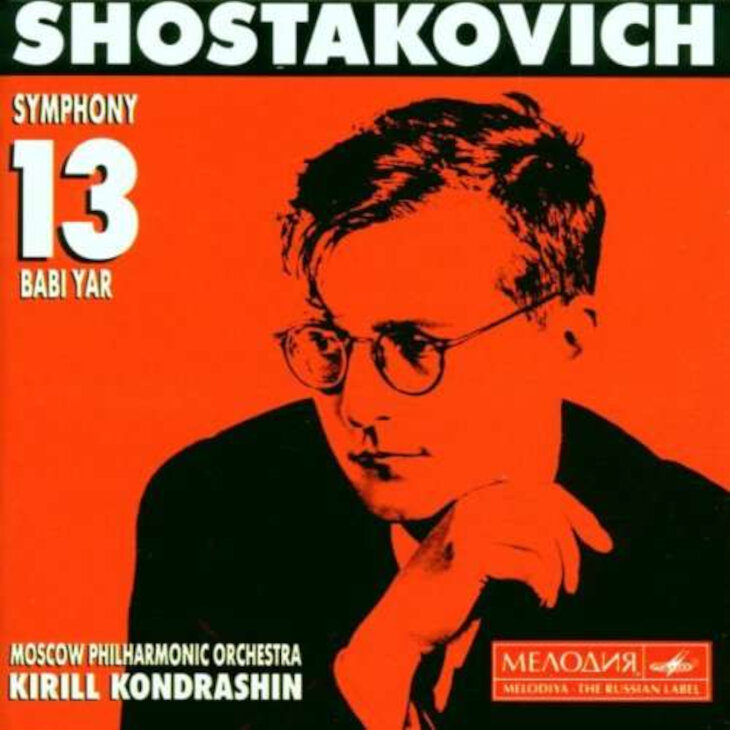
As soon as he read Yevtushenko’s powerful poem, Shostakovich began composing a musical expression of the work. His 13th Symphony, Babi Yar calls for a full orchestra plus a massive male choir.
Carnegie Hall describes this towering work: “Form its foreboding opening toiling bell to its hushed final notes, ‘Babi Yar’ grips the listener with its intense orchestral writing, sardonic humor, and moments of tenderness. Shostakovich’s music soars, snarls, bites, and thills with every measure.”
To hear Babi Yar, Shostakovich’s 13th Symphony, click here:
Shostakovich passed away in Moscow in 1975. His musical legacy endures as a powerful testament to a principled composer who insisted on bringing attention to Jewish suffering and to Soviet antisemitism.
My 16-year-old son, a classical music fan, suggested that I write this article. Not long ago, my son and I were at a Shabbat meal with an elderly scholar who told us he’d known Shostakovich and even worked as Shostakovich’s translator when the composer visited the United States. Eagerly, my son asked this guest what Shostakovich was like. Thinking back, the translator said simply: he was a very, very nice man. He was courteous and polite to everyone.: Shostakovich took the time to speak with every person who crossed his path, from fellow musicians to humble cab drivers. It was this incredible empathy which enabled him, a privileged Russian, to feel his fellow Jewish citizens’ pain.
*There is some controversy over whether Shostakovich wrote his memoirs himself, or if his friend Solomon Volkov, a journalist, penned the large portion of the work.










Thanks for this wonderful article. I got to know Shostakovich's music in my teens, particularly his symphonies and studied how Western conductors, such as Leonard Bernstein had a completely different interpretation to Russian conductors, to the extent that you'd think they were reading from a different score.
I remember reading "Testimony" in 1988, just before I made aliya and it had a great impact upon me. It made me understand how Shostakovich was forced to rewrite his 4th symphony. (not that I'd ever want to agree with Stalin, but the revised version was a lot better IMO).
One thing perhaps you should have included is the moving story of one of Shostakovich's Jewish students, namely Veniamin Fleishman (page 173), who was murdered by Stalin because he didn't like his music.
The Russians were NOT lover's of Jews by any means. However, their contribution to the defeat of the Third Reich and Germany can never be overstated. They did this because Hitler double crossed the Russians when they jointly agreed to take over Poland. However, without Russia, the probability of defeating the Third Reich would have been very slim.
As a huge Shostakovich fan I thought this was an excellent overview of a very complicated life highlighting his extensive connections with Jews. He was a fascinating man who in many ways was quite ordinary but above all a musical genius. His life and career coincided with much of the rise and fall of the Soviet Union, which adds the drama that increases our interest. Very well done.
Ms. Miller, this essay, like his music, is a masterpiece!
(Then again all your articles are.)
So glad to read this article and listen to Shostakovich's music. I enjoyed listening to Shostakovich before this, and am enlightened now hearing these pieces. The man was affected by the anti-semitism and was a beacon of light.
Fascinating! I had no idea that Shostakovich was sympathetic toward Jews. He was a courageous man!
Wonderful article! I grew up listening to Shostakovich’s music.
Great article. Some of his compositions have a very strong Jewish "taste". I know he was not Jewish, but either the influence of some of his teachers (Steinberg) - or unknown Jewish heritage must have been very influential and inspirational for him
Who knows if his family had hidden Jewish heritage, in Russia people used to hide if they were Jewish, now the Russians are complaining the Ukrainians are anti Semitic in reality both countries are anti Semitic Stalin( may his name be erased) had a problem with Jews
The violín of Rotschild, a documentary about an opera by a Jewish pupil of Shostakovich and how he kept it safe so it would not be lost. https://en.m.wikipedia.org/wiki/Rothschild%27s_Violin_(opera)
Ira
The comment above fails to mention that the opera, Rothschild’s Violin, is based on a short story by the Russian author Chekhov. It was left with a piano score when the composer Fleischman was killed during the defense of Leningrad. Shostakovich, no doubt because he recognized the work’s musical values, but also in homage to his deceased pupil, orchestrated his student’s piano score. The opera, known as ‘’Rothschild’s Fiddle’’ has had at least one cd recording in the West, and I think there is also a recording made in Russia (USSR). I haven’t checked so I don’t know if these or any other CD remain available but you can probably find the opera on YouTube.