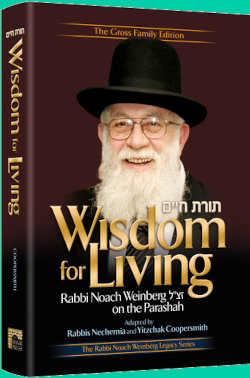
Click here to buy
Wisdom for Living
Rabbi Noah Weinberg on the Parashah






"And there was no other prophet who arose in Israel like Moshe, whom Hashem knew face to face." (Devarim 34:10)
In Israel no one arose like Moshe, but among the nations there did arise a prophet like Moshe. Who was that? Bilaam. (Sifrei, Devarim 357)
In this week's parashah we meet Bilaam, the non-Jewish prophet, who was hired by Balak to curse the Jewish people. But Hashem thwarted his plan, and despite all his efforts, his curses were transformed into great blessings.
Despite his status as a prophet, Bilaam was no tzaddik. The Mishnah casts him as the polar opposite of Avraham Avinu: "Whoever has three particular traits is counted among the students of Avraham, and whoever has three other traits is among the students of Bilaam. He who has a good eye, humility, and contentedness is a student of Abraham, while he who has an evil eye, arrogance, and greed is a student of Bilaam" (Avos 5:22). Bilaam also advised Balak to use the women of Moav and Midian to entice the Jewish people to worship idols (Sanhedrin 106a).
Chazal ask: "Why did God bestow His Shechinah on such a wicked non-Jew? The answer is so that the nations of the world would not say, 'Had we had prophets we would have repented.' So He assigned them prophets..." (Bamidbar Rabbah 20:1). If not for Bilaam, the nations of the world would have had a legitimate complaint. "It's not fair," they would have said. "You sent the Jewish people a prophet like Moshe, who guided them and taught them. If you would have sent us a prophet like Moshe, we would have been just as good!"
Therefore, the Almighty sent them Bilaam, who prophesied on the same level as Moshe. And what happened? Moshe led the Jewish people to God, while Bilaam tried to curse the Jewish people, and in doing so destroyed his own people. This was God’s answer to the nations: "See what happens when I give you a prophet! So stop your excuses."
But that wouldn’t put an end to the discussion, for the non-Jews could answer back and say, "You sent the Jewish people Moshe Rabbeinu, an incredible tzaddik who was a humble yet powerful leader. But for us you selected someone like Bilaam? Is that fair? Hashem, couldn't you have found someone better than the evil Bilaam? Why not someone like Iyov, who, according to some opinions, was a righteous non-Jew?" (Baba Basra 15b)
In choosing a prophet for the nations, the Almighty had one crucial condition. Even though this prophet would be given Moshe Rabbeinu’s level of prophecy – the ultimate, transcendental clarity of knowing God – he must still choose to remain a non-Jew and not join the ranks of the Jewish people. If he were to convert and become a Jew, that would undermine the entire goal of giving the nations a prophet.
So the Almighty searched high and low and found Bilaam, a non-Jew who, while having the ultimate knowledge of the awesome, loving Creator of the universe, would still refuse to merge with Him by becoming a Jew. This refusal would eventually cause him to attack the Jewish people and destroy himself.
We can understand why Bilaam couldn’t have converted. But why did he have to be so evil? Couldn’t he have remained neutral?
There is no neutral when it comes to Torah. Chazal teach, “If a person is worthy, the Torah is an elixir of life (sam chaim), and if not, it is a death potion (sam hamaves)” (Yoma 72b). The Almighty’s Torah is the path to full clarity, the repository of the deepest wisdom in the universe. If you learn it and apply it, it gives you strength and meaning. If you don’t, those same words of Hashem can destroy you.
How do we understand this? Bilaam was given the sam chaim, the elixir of life, the ultimate gift of connecting with the Almighty. Despite receiving this gift, he refused to make a covenant with Hashem, deciding not to partner with God and His people. That decision itself was a rebellion, and in order to justify his choice, Bilaam had to denigrate the Jewish people and become an enemy of the good they represented. He had to actively oppose them, even seek to destroy them, in order to remain resolute in his decision to reject God and walk away from the ultimate truth. That is why Bilaam became a rasha, an evil person, despite being a prophet.
This type of rebellion is not to be confused with a typical ba’al teshuvah who, at the beginning of his process of teshuvah, is still committing numerous transgressions while taking on the performance of some mitzvos. The inconsistent, imperfect level of observance of a ba’a teshuvah does not signify a Bilaam-style refusal to follow the path of God. The baal teshuvah says, “Yes, the Torah is true and I want to observe it, but I’m weak, I’m not ready to give up my Saturdays and lobster. I wish I had the strength to do it all.”
The baal teshuvah has discovered the sam chaim, the gift of life, and is growing step by step. The Torah was not given to angels; it takes time. He has a long way to go, but over time he will get there. He is not saying, “I cannot accept the reality of Shabbos. I refuse to keep kosher. This is something I do not want to do.” He is just struggling with the Torah’s sudden demands. Eventually, his Torah learning will give him greater clarity and empower him to change. And the Almighty has an infinite amount of patience for him.
“For the righteous one will fall seven times and arise, but the wicked will stumble into evil” (Mishlei 24:16). Good people not only can fall – they will fall, but the key is that they strive to get up and keep growing. They are on the path, despite the inevitable setbacks. But the rasha, the evil man like Bilaam, is down for the count. He has decided not to get up, but to remain firmly entrenched in his detachment from God.
We are all weak and imperfect, but what differentiates us from Bilaam is that we are working toward success. . The righteous man can fall seven times – he is depressed, he quits, he is frustrated and angry – but he gets up! You want to climb that mountain and reach the pinnacle, without compromising. Be careful not to put up a wall or filter that shields you from any aspect of the truth, like Bilaam, because that will only lead to self-destruction.
Clarity or death. Life is a difficult trip; we have our weaknesses. But as long as we remain honest and strive to grow we will never become an enemy of good, for we will be attached to the sam chaim, the elixir of life.