







 The Macklemore Mess: What Pink Got Right and Everyone Else Got Wrong



5 min read





Twenty-five years later, four survivors relive the day terror came to New York City.
The Twin Towers of the World Trade Center symbolized the success of the Western values that Americans held dear: freedom, equal business opportunities, and the pursuit of happiness. Not surprisingly, they became a target for Islamic terrorists out to destroy Western civilization.
The first terror attack on the World Trade Center took place on February 26, 1993. Simon Swidler, who had worked for over two decades for the New York Stock Exchange, was at work on the 30th floor of the South Tower. “I felt a rumble, the building shaking,” he recalls. “Then the electricity went out. You could not take the elevator. So, thousands of people were stumbling down the emergency staircase in the dark.”
Fortunately, Simon had a flashlight, because “somehow I passed the store that week, it looked like a good price, I bought it. It was very useful!”
Simon lit the way for himself and for the people around him. Later, he found out that six people were killed and over a thousand injured when a rental truck filled with over a thousand pounds of explosives blew up in the parking lot under the North Tower.
Within weeks, the FBI captured several Islamic terrorists behind the attack. The mastermind of the operation, Ramzi Yousef, was captured two years later. In an interrogation, he revealed that his plan had been to topple the North Tower onto the South Tower, thus destroying both.
Yousef’s plan failed and he is currently serving a life sentence. However, his uncle, Khalid Sheikh Mohammed, determined that the next attempt would succeed. He was the mastermind behind the 9/11 attack on the Twin Towers.
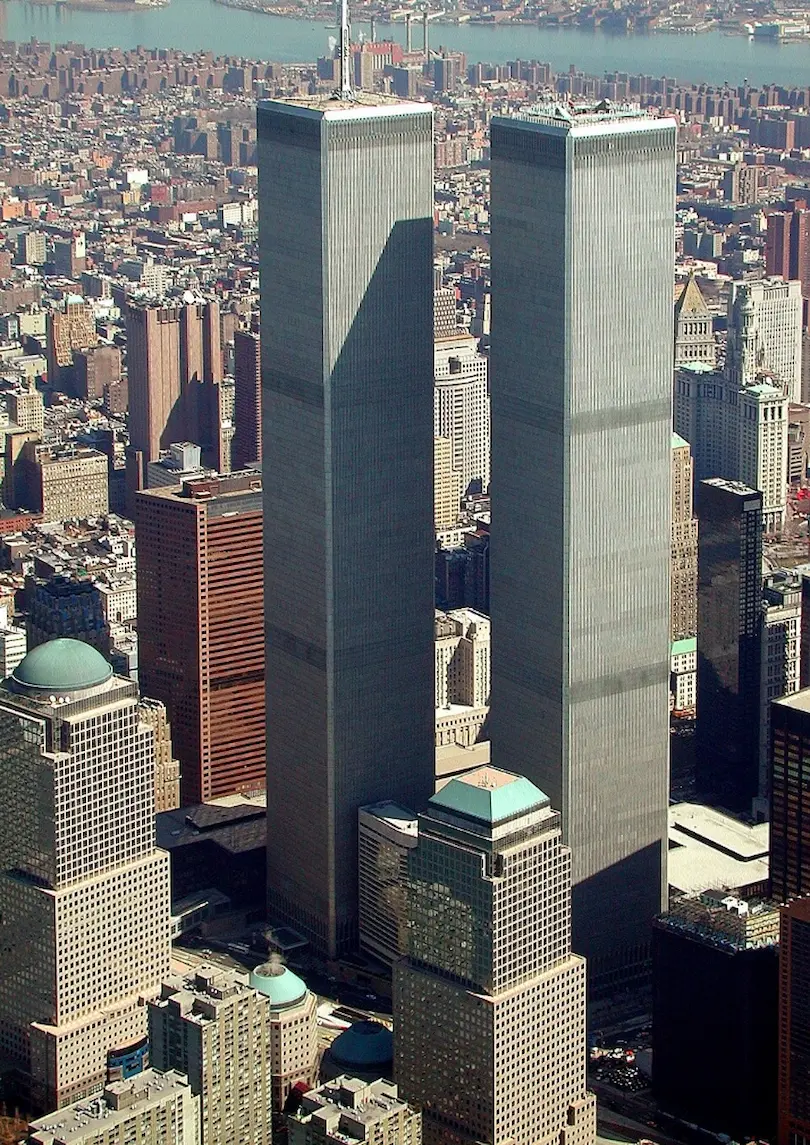 World Trade Center, March 2001, Jeffmock, Wikimedia Commons
The morning of Tuesday, September 11, 2001, was “a beautiful day,” recalls Batshevah Reznik, who lived in Brooklyn at the time. “Perfect weather, not a cloud in the sky.”
The streets of New York were full of people hurrying to work. Kira Sirote, who lived in Israel and was in New York on her biannual business trip, had taken the subway from her parents’ home on Long Island to her office at 100 Wall St, a few minutes’ walk from the Twin Towers.
Kira was supposed to fly back to Israel the following day. She decided “to come into the city a little early and go shopping for a bit, buy gifts for my husband and children.” She debated between going to the Warner Brothers store, located in the World Trade Center, and the Century 21 store across the street. Fortunately for her, she chose Century 21.
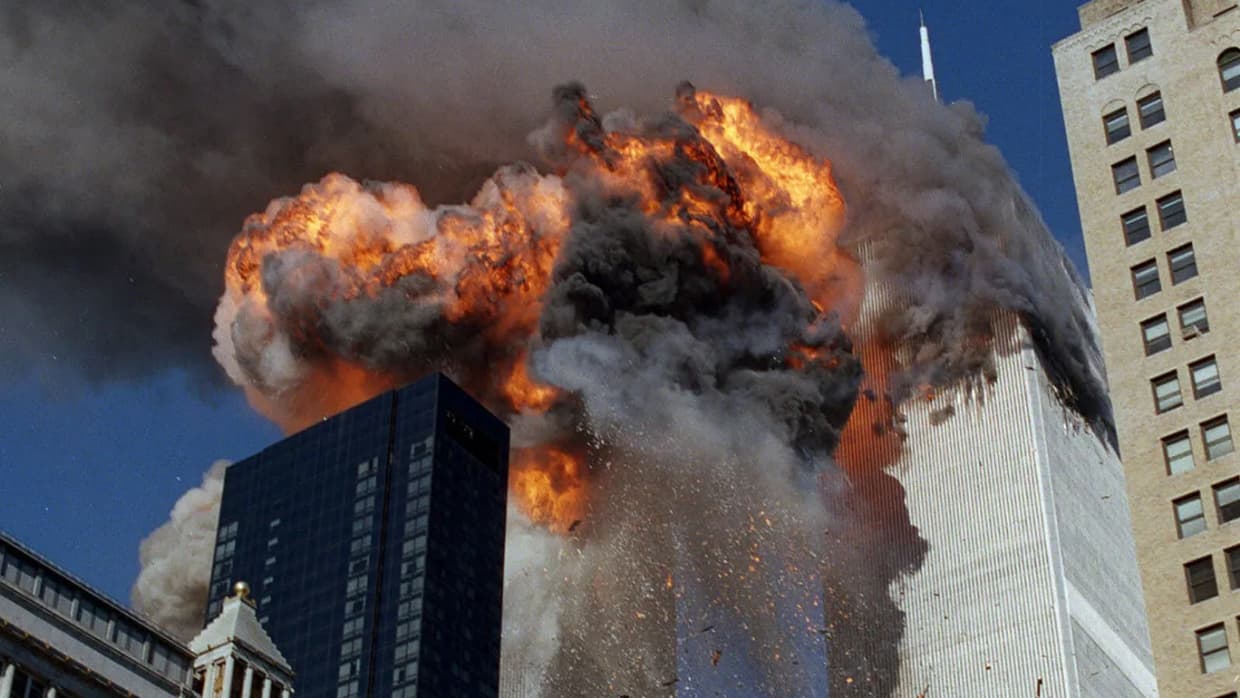
She recalls, “I was shopping, and all of a sudden, I heard thunder, which was strange on a clear day. I looked out the window and saw a fireball in the World Trade Center. And then I saw stuff falling from the sky.” Coming from Israel in the midst of the Second Intifada, Kira’s immediate thought was that it was a terror attack.
At the time, she didn’t know that five terrorists hijacked a Boeing 767 airplane, on its way from Boston to Los Angeles, and flew it into the North Tower. It was 8:46 a.m.
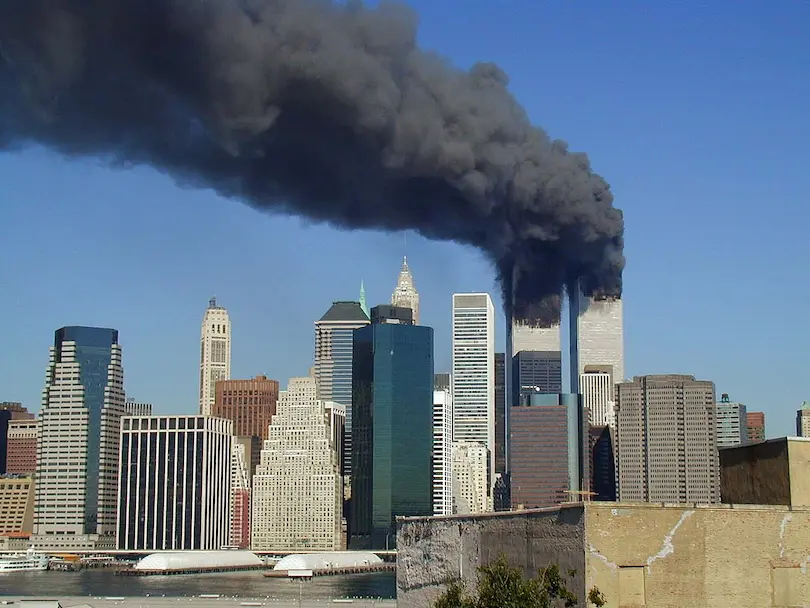 Plumes of smoke billow from the World Trade Center after the September 11th attacks (Michael Foran, Wikipedia)
Meanwhile, Simon was still trying to get to work. “I would have been at my desk normally by 8:30,” he says. “That morning, when I got to the platform to catch the 7:14 train, an announcement came over the loudspeaker saying, a branch has fallen onto the railroad tracks, the 7:14 train is canceled, take the next train. I took the next train and I was cursing my luck for coming late to work.” Little did he know that the fallen branch might have saved his life.
By the time Simon got to the World Trade Center subway station, “there was a strange sight. People were streaming away from the building.” No one knew what was going on, but a guard told Simon to go across the street.
Meanwhile in Brooklyn, Zushie Rimler, a member of the Hatzalah Volunteer Ambulance Services, received an emergency call. “Our Hatzalah unit left Brooklyn as soon as the first plane crashed,” he recalls. “While enroute the second plane crashed and at that moment, we all knew that this was no accident.”
This was the second Boeing 767, also on the way from Boston to Los Angeles, hijacked by five terrorists and flown into the South Tower at 9:03 a.m.
From the rooftop of her workplace in Brooklyn, Batshevah saw the airplane hitting the South Tower. “The explosion was indescribable,” she recalls. Batshevah realized that she could have been there. Just recently, she had applied for her dream job in that area and was very upset when she didn’t get the job. She continues, “And then all the phones went dead. My parents, who lived in Houston at the time, thought that I was gone.”
Meanwhile, Zushie’s Hatzalah ambulance followed a fire truck through the standstill traffic. “Many firemen and police officers started jumping into our ambulance to catch a ride to the scene, until we were as packed as a rush hour subway car,” he says.
When the Hatzalah team realized they would be unable to reach the designated staging area, “we stopped our ambulance two blocks north and walked our stretcher and equipment down to the scene,” recalls Zushie. “When we arrived, both buildings were burning. As we were walking towards the towers it appeared that there was debris flying from the windows. When we got closer, we could see that this wasn’t debris, there was a steady stream of people coming out of those windows. I don't know if they were jumping or falling, all I know is that there were many, many people. The scene was horrific. The details are too graphic to repeat.”
Simon describes what he saw from across the street: “Aside from the smoky conditions on the upper floors, I saw fluttery things falling from [the North Tower]. People around me said, those are people jumping. Then the second plane hit my building!”
He continues, “The debris from that impact was falling onto the street, including where I was standing. The whole crowd took off. I was knocked down. I think a lot of people were knocked down, because it was a panic and a mob reaction. I escaped by running as fast as I could.”
Meanwhile, at 9:37 a.m. a third hijacked plane, Boeing 757, enroute from Washington, D.C. to Los Angeles, hit the Pentagon, the headquarters of the U.S. Department of Defense. 59 passengers and crew and 125 people inside the building were killed on impact.
The fourth plane, also Boeing 757, enroute from Newark to San Francisco, was hijacked around 9:30 a.m. By then, the passengers had already heard about the previously hijacked planes used as weapons, and they decided to fight back. It is unknown what the terrorists’ intended destination was, but after a group of passengers attempted to take control of the cockpit, the hijackers crashed the plane into a field in Pennsylvania. The 40 passengers and crew were killed. No one else was at the impact site.
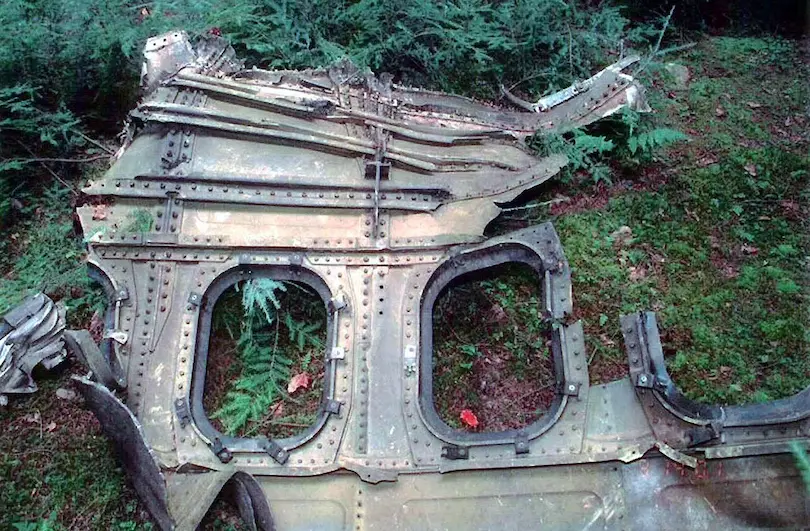 Photograph of an airplane part found at the scene in Somerset County, Pennsylvania, where Flight 93 crashed.
The Hatzalah members, meanwhile, were trying to figure out what they could do to help. Zushie recalls, “Us fifteen Jewish volunteers were grouped with another ten/fifteen emergency workers, and the Fire Department assigned a lieutenant over our group. We were getting ready to enter the South tower, when the lieutenant received word over his radio that two FDNY personnel had died as a result of the falling victims. Being that we didn’t have proper helmets the decision was made that we would remain positioned about fifty feet away from the tower with the plan being that the few hundred firemen who had just entered the buildings would bring the patients out to us for treatment.”
A supervisor from the Fire Department was uncomfortable with the Hatzalah group joining the firefighters. She sent them across the street. Zushie says, “We started walking with our equipment, when suddenly we heard an indescribable noise, like the roar of a jet engine. Everyone started running away from the noise, afraid that a third plane was coming. Some guys managed to run all the way across the street to the Financial Center, but I never made it that far. My back was to the towers, and I had no idea what was happening. It started getting darker and darker, things were falling and I was getting hit again and again.”
The South Tower had collapsed at about 10 a.m. Desperate for some kind of cover, Zushie crawled under a car. “It was so dark, and thick dust was filling the air fast,” he recalls. “We couldn't see anything, and it felt like someone had taken my face and buried it in a sandbox, every breath filled my lungs with sand. I was sure I was going to die. I remember screaming Shema Yisrael, praying for my family, and thinking, I came here to help people, but now who will take care of my family?"
He continues, “Once things stopped coming down, there was this eerie silence. There was no screaming, no sirens, just total quiet. It was extremely hard to breathe. Every attempted breath filled your lungs more and more with sand. I tried using my shirt to filter the air, but it was also just covered and full with that toxic dust.”
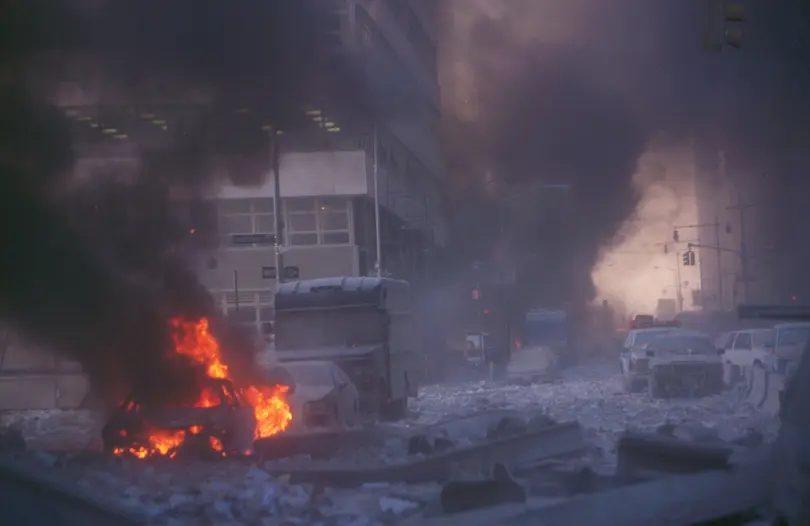 9/11 after the collapse of the Twin Towers. Anonymous. Courtesy of the Prints and Photographs Division. Library of Congress., Public domain, via Wikimedia Commons
Zushie thought that he was the sole survivor when he heard “a sound of someone else coughing and struggling to breathe.” Stumbling toward the sound, he was overjoyed to find his own brother Yitzchak, also a Hatzalah volunteer.
“We were coughing and gagging,” Zushie says. “We started walking in the direction we had come from, barely able to see, just trying to feel our way. We walked back to where we had been stationed originally, before the supervisor from the fire department had sent us away. The chunks of steel and concrete that we found there were insurmountable. We could not even climb over them to get out. Had we been standing there, we would have likely been crushed.”
“As time went on, the dust slowly began to settle, turning the air from black to gray,” recalls Zushie. “We saw a light, started walking towards it, and realized that it was coming from the front of a fire truck. Once we approached the truck, we saw that all the firemen inside had been crushed.”
They kept walking, rescuing a firefighter along the way. Another firefighter was wounded and unable to come with them. They had no choice but to leave him behind, something that “haunts me continuously,” says Zushie.
As they got farther away from the World Trade Center, “it was becoming lighter. We walked until we reached the Hudson River. We found a bench and put the fireman down.” It was then that Zushie realized he was bleeding from his head. Surrounded by dead bodies, Zushie didn’t think his injury was top priority.
Rescuers began evacuating people from the riverbank by boat. “It was only then that we were told that the South Tower had collapsed,” recalls Zushie. “We started helping people over the seawall and onto the boats, including the fireman that had come with us. Suddenly we heard that same loud sound again, but this time we knew that it was another collapse.” The North Tower collapsed at about 10:30 a.m.
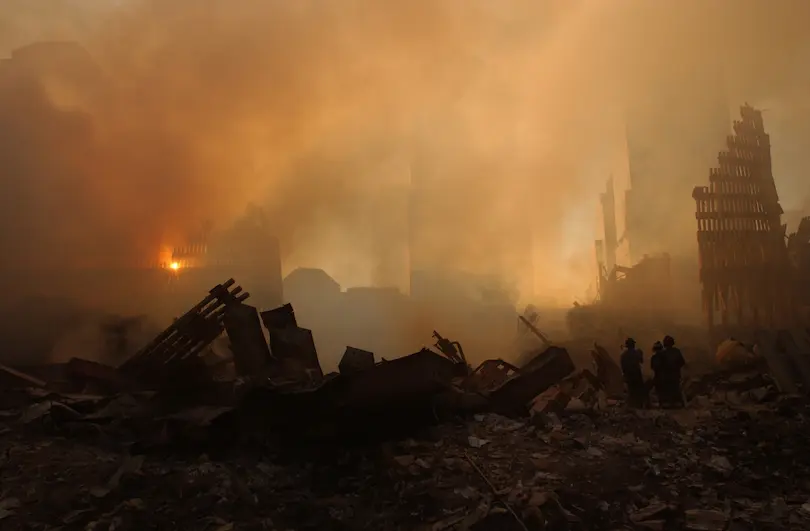 The sun streams through the dust cloud over the wreckage of the World Trade Center Photo by Andrea Booher/ FEMA News Photo (FEMA Photo by Andrea Booher/Released)
A police officer ordered the brothers onto a boat. They were taken to Liberty State Park in New Jersey. Zushie says, “When we got off the boat, I was feeling dizzy. After a short while, I started feeling somewhat better, and kept thinking of all the people who needed help, and that we can’t just leave them there to die.”
When Zushie returned to Manhattan, “everything was covered with white soot,” he recalls. He couldn’t even see the bodies anymore. He also couldn’t treat the wounded because his equipment had been destroyed. Instead, he helped with evacuating “anyone able to walk” from the area.
When Zushie arrived at the triage center at Chelsea Piers, his fellow Hatzalah volunteers were concerned about him. He says, “My lungs were hurting, and I looked like I was on the verge of collapsing. They wanted to take me to the hospital, but I assumed the hospitals would be packed, so I declined.” Instead, he was taken to his doctor's office together with several other volunteers. Miraculously, all the Hatzalah members survived 9/11.
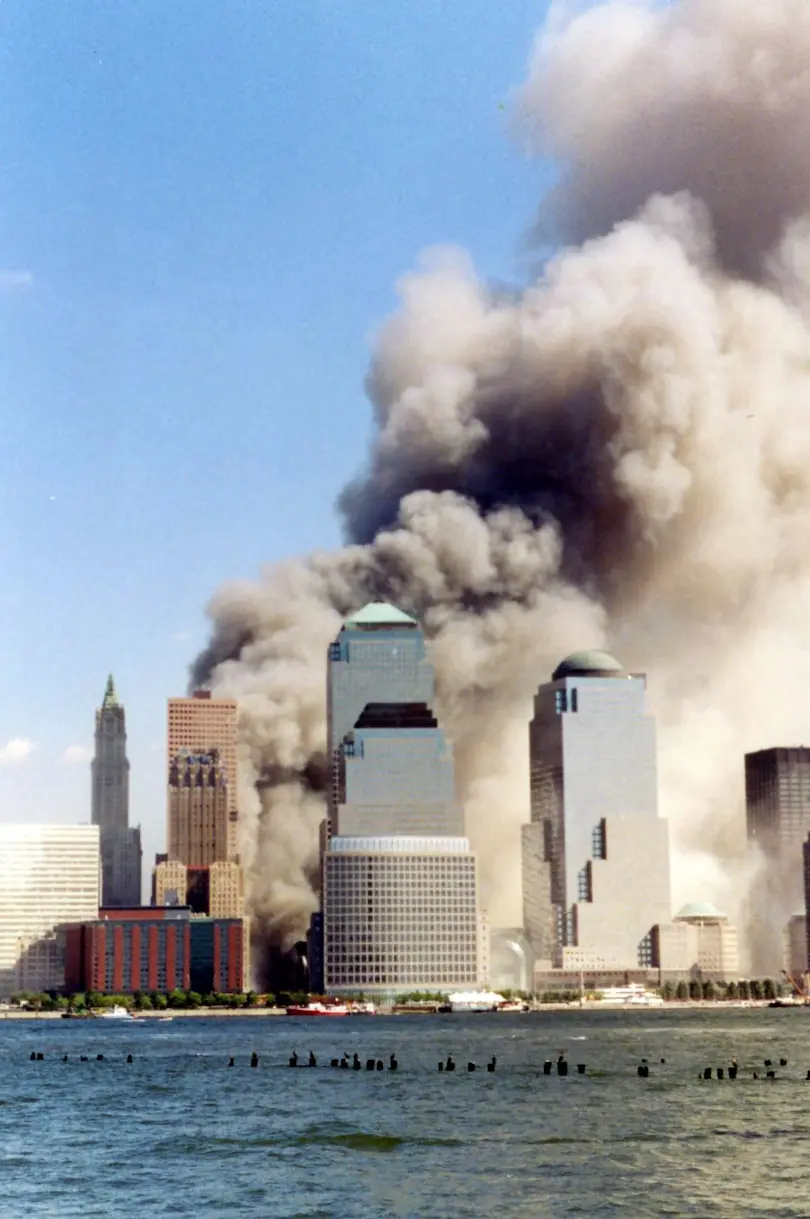 Shortly after the collapse of the Twin Towers. Wally Gobetz, CC BY 2.0 <https://creativecommons.org/licenses/by/2.0>, via Wikimedia Commons
Simon, meanwhile, kept running. He recalls, “On the way, I saw dropped shoes, cell phones, debris of all kinds, but there was nobody standing still, everybody was running. I reached Broadway and forced my way into a store that was closing because they weren't going to stick around to find out what was going on. I said, I have to call my wife, and you have to let me use your phone. This was at a time when cell phones were still pretty new, and I didn't have one.”
He managed to reach his wife, “and all I was able to say is, I don't know what's going on, the world is going crazy, but I am okay.” Simon reached the main building of the Stock Exchange, on Wall St, and went inside for shelter. When the towers collapsed, “You could hear the rumble and feel the earthquake underneath where we stood. They call it pancaking: the buildings collapsed vertically, not like a tree falling. And it was the shock of a lifetime to see those buildings come down.”
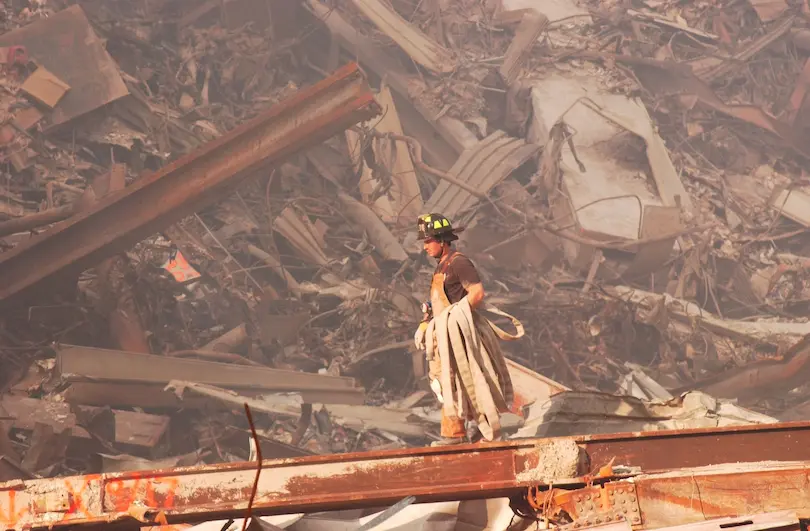 New York City, N.Y., September 16, 2001 -- FEMA Urban Search and Rescue teams work to clear rubble and search for survivors at the World Trade Center. Photo by Andrea Booher/ FEMA News Photo (FEMA Photo by Andrea Booher/Released)
Meanwhile, at Kira’s office, the management decided to send everyone home. Kira didn’t think it was a good idea. “If people are panicking in the subway, it’s much more dangerous than anything we could do in the office,” she says. But everyone else was worried that their building was also going to be attacked.
Both Simon and Kira had to walk over the Brooklyn Bridge to catch a train home. “That was quite the experience,” recalls Kira. “We were walking on burnt paper. The ash ruined my shoes. There were lots of people walking there. I remember somebody being pushed in a wheelchair. When we got to the Brooklyn side, people were standing there giving out water.”
Rescue workers continued searching the area, hoping to find pockets of air where survivors might be trapped. Thousands of people participated in the rescue effort. By the afternoon of September 12th, 18 people were found alive. From then on, the rescue operation slowly shifted to recovery. Human remains, as well as personal belongings found in the rubble, were analyzed for DNA. While some victims were identified and declared dead, most were not identified for years. Some have still not been identified. The total death toll at the site was 2,753. Out of them, 441 were first responders who had rushed to help.
The recovery and cleanup operation continued until May 2002. For months, Lower Manhattan was covered in debris. “Silver and gray particles were floating everywhere,” recalls Simon. Though the area was deemed safe and people were allowed to return to work two weeks later, “the surfaces were still coated with dust,” says Simon. “A lot of people got sick from breathing the air, especially the firemen who had the duty of digging into the ashes. A lot of them got lung disease or cancer. I myself came down with cancer about 10 years later.”
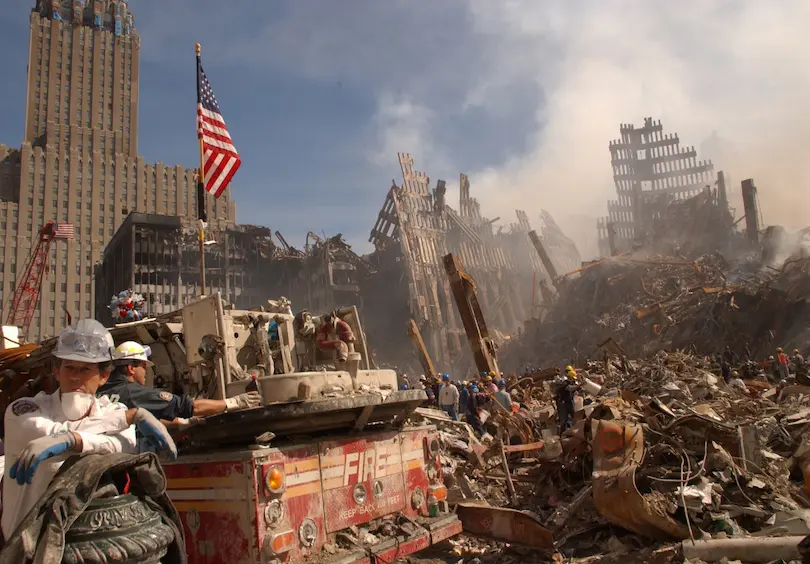 New York, N.Y., September 13, 2001 -- Urban Search and Rescue teams inspect the wreckage at the World Trade Center. Photo byAndrea Booher/ FEMA News Photo (FEMA Photo by Andrea Booher/Released)
Fortunately, Simon recovered. Zushie developed asthma as a consequence of his 9/11 experience and is currently managing it with medication.
In the months following the attack, the atmosphere had changed.
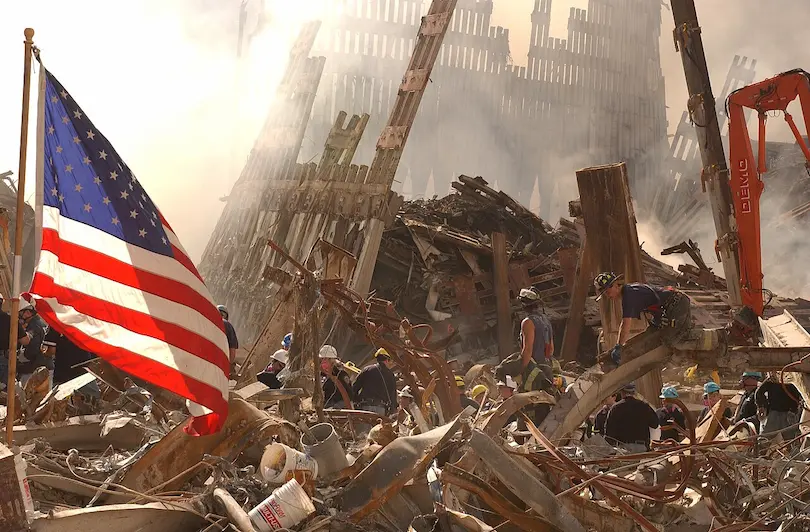 New York, NY, September 19, 2001 -- Rescue workers climb over and dig through piles of rubble from the destroyed World Trade Center as the American flag billows over the debris. Photo by Andrea Booher/ FEMA News Photo
Kira says, “The following time that I went back to New York, people were making eye contact in the subways, which they didn't used to do. They were much more together, it was much more like, we got through this, we can do this, we can do anything, we're there for each other.”
For many Americans, 9/11 was a wakeup call. For Jewish Americans, especially those who have spent time in Israel, it brought the realization that Islamic terror had spread past Israel and into the Western world.
Simon recalls that at that point, three of his children were living in Israel, and his wife had been eager to make aliyah and join them there. “I was dragging my heels,” he says. “We led a comfortable life in America. But after 9/11, I changed my mind.” When his children, living through the Second Intifada, were calling him, anxious to find out if he was okay, “this was upside-down,” says Simon. “This means that there is no place that's safe, that the danger is everywhere. And so, what am I doing here? We made our 5-year plan, and we made aliyah in 2007.” They currently live in Jerusalem.
Many survivors feel that God had spared their lives when, for whatever reason, they were late to work that day. Batshevah’s disappointment at not getting her dream job quickly turned to gratitude. “If something is not working out, do not get upset,” Batshevah says. “We don’t see the whole picture. The Almighty has His ways. We need to trust that it’s for the best.”
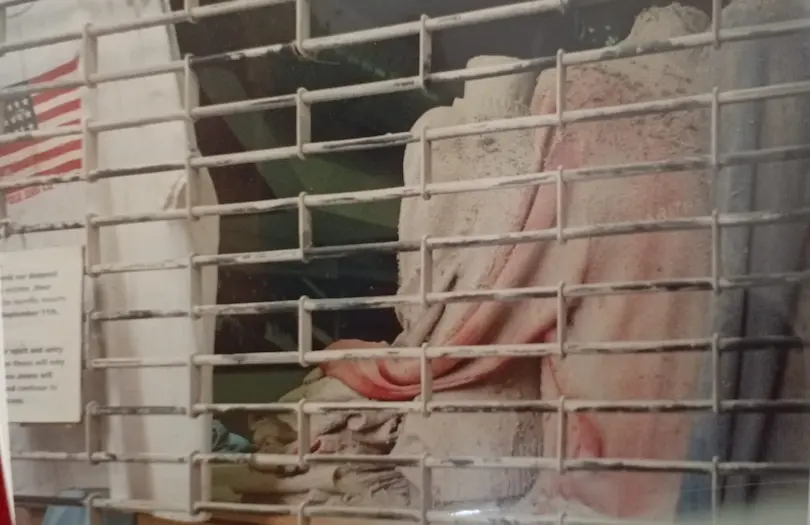 Store window in New York City shortly after 9/11. Credits: Yehudit Singer-Freud
The survivors feel that it is important to remember 9/11: its heroes, its victims, and the hatred of Western civilization that led to it. “New York has always been a very special city,” concludes Kira. “God willing, it'll survive what it's going through now, also.”








While it’s mentioned tangentially, I am sorry that you didn’t talk to Pentagon survivors. It was a terrible day in the Greater Washington region as well.
People outside New York City don't realize that we thought more planes were coming and that we would all possibly die that day.
I was in mid-town and walked 30 flights down and several blocks to a friend's apartment overlooking the 59th Street Bridge. I sat up all night watching thousands walk across the bridge in the dark hoping to somehow get home in distant Queens locations. Many who crossed the bridge tried to hitch hike home, but others walked 4 or 5 hours to reach their loved ones who had no idea where they were until they got home. This after they had already walked many hours from downtown locations.
I wonder if anyone realizes that some people who were late for work because they were saying slicot in shul
I remember seeing in the early press releases that "The Jews" planned this as they did not come to work that day. Very few understood the explanation that we were saying slichot during that time and therefore very late to work.
I was in fifth grade in Brooklyn during 9-11. From Brooklyn my class watched scraps of papers flying by and the sky seemed darker. At the time we didn't really understand what happened or why. The feeling of togetherness after 9-11 between all Americans is hard for today's generation to imagine. I remember going on a school bus to Tashlich (symbolically casting your sins into water) that year and counting how many American flags there were - there were hundreds! My grandfather who worked in Manhattan walked across the Brooklyn Bridge and no one knew if he was okay until he got back - pre cellphone days.
Thank you for writing this article. My son in law who is a Hatzoloh member was called when the Twin Towers came down. He was interviewed and his experience was included in a book written shortly after this destruction. He saw how people were jumping down from the Towers. Two of the Islamists who destroyed the Twin Towers resided in my neighborhood in Kensington Brooklyn. However, the young of people of today don't realize how terrible the situation was. Also, the former President allowed Muslims to infiltrate our country. My neighborhood has three mosques. PS 179 on Avenue C between East 2nd Street and East 3rd Street is full of Muslim children. Every morning there is a parade of women wearing a hijab taking their children to school.
Good piece about the horror that day!
I am absolutely positive that one of the reasons the terrorists chose that day for the attack was because of the date - 9/11. Every day when we Americans call for help, we call 911. As a former New Yorker, I remember trying to call my brother z"l who lived in Brooklyn and could see the Twin Towers from his home. I couldn't get through and I was panicking thinking that he might have gone into the city and was caught or, G-d forbid, was in or near the Towers. Thank G-d, he was all right, but he shared that at least in Brooklyn, some of the debris from the Towers drifted across and 'snowed' on Brooklyn, too. I will never forget that day.
I was one of the first responders that day from NJ. It is a day never to be forgotten by any of us. I thank all of the police officers, firefighters, paramedics and EMT’s I worked next to. I hope those that we lost are resting in peace knowing that they did all they could to save others lives
Thank you for your service.
Thank you for writing this. What scares me is that the younger generation of Americans has no recollection of 9/11, openly supports Hamas, and doesn’t realize the danger of radical Islamist ideology.