
Click here to buy
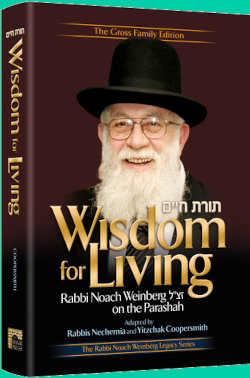
Wisdom for Living
Rabbi Noah Weinberg on the Parashah



9 min read


Rabbi Yochanan said: There were three crowns (that adorned the utensils of the Beis Hamikdash) – the crown of the Golden Altar, (the Mizbeiach Hazahav), the crown of the Ark (the Aron), and the crown of the Table (the Shulchan).
The crown of the Altar: Aaron merited and took it. (Rashi: This represents the crown of priesthood, which was given to Aaron and his descendants.)
The crown of the Table: David merited and took it. (Rashi: The Table’s abundance and majestic opulence represents the crown of kingship, which was given to King David.)
But the crown of the Ark (Rashi: which represents the crown of Torah) is still at rest. Anyone who wants to take it may come and take it. Lest you say it is inferior to the other crowns, the Torah states: “Through me, kings will reign (Mishlei 8:15).”
(Yoma 72b)
The crown of the Ark represents Keter Torah, the crown of Torah. The Talmud says that this crown is still available to each and every one of us. How do we attain it? Is it really available to everyone, even if we are not all blessed with the intelligence, diligence, and patience required to become a talmid chacham, a Torah scholar?
The Rambam mentions these three crowns given to the Jewish people, and writes, in reference to Keter Torah: "The crown of Torah is resting, standing, and ready for each Jew, as it is written: 'The Torah that Moshe commanded us is the inheritance of the Congregation of Yaakov' (Devarim 33:4). Whoever wants it may come and take it” (Hilchos Talmud Torah 3:1).
The Rambam uses three words to describe Keter Torah: "resting," "standing," and "ready." No word of the Rambam is extra; each term comes to teach us something. "Resting" means Torah is waiting here just for you. There are no obstacles to attaining it, and you do not need to fight anything or anyone to get it.
"Standing" means that Torah is not going anywhere. It is not running away, but it will not come to you, either. It will sit still until you come to get it.
"Ready" means that the Torah is custom-made and ready for you. It fits you like a glove, without any adjustment or changes required. It is your inheritance: It is rightfully yours, and your stake of ownership is as valid as any other Jew’s.
The Rambam is teaching us that Torah is accessible, attainable, and custom-made for you. There is nothing stopping us from getting it. But there is one caveat, found in the crucial final sentence above: "Whoever wants it may come and take it." The key to attaining the crown of Torah is to genuinely want it. Torah has to be your sole focus, your burning desire, and you have to pursue it passionately, with every fiber of your being. If you want it that badly, then you are guaranteed to get it, regardless of your raw intelligence and capabilities.
Greatness in Torah is almost entirely dependent upon our efforts. If we put in the necessary effort, the resultant understanding is a gift from Hashem. As the Talmud says, “One who says I searched and did not find, do not believe him… and one who says I searched and did find, believe him. This is referring to understanding the words of Torah” (Megillah 6b). The Almighty promises that anyone who sincerely puts in the effort to understand Torah is guaranteed to “find” it.
Finding something is not a direct outcome of one's efforts. It implies stumbling across something that appears out of the blue. This is an apt description of learning, since our attaining Torah – and other spiritual accomplishments – is a gift from Hashem. The Almighty gives it to us, but our effort is the means by which we earn this blessing.
If we lack understanding in Torah, it is not because Hashem does not want us to have it. It is because we have not made the right effort to get it.
Yes, acquiring Torah may be a slow process, but if we remain committed, we are guaranteed to succeed. Every drop of effort makes a difference. Torah will eventually change us, even if we do not yet see the impact of the ongoing process.
Even the least gifted student in a yeshiva can reach staggering heights, as illustrated by the story of Rabbi Eliezer ben Hyrcanus (Pirkei d'Rabbi Eliezer 1).
Eliezer, the son of Hyrcanus, was an unlearned farmhand who worked for his father. One day, while plowing on the mountain, he stopped and began to cry.
Rabbi Eliezer’s father, Hyrcanus, one of the talmidei chachamim of his generation, asked his son, “Why are you crying? If it’s too hot up on the mountain, I’ll move you down to the plain.” So Eliezer ben Hyrcanus began to plow in the plain, and soon after began to cry there, too.
“My son, why are you crying?” Hyrcanus asked.
“I want to learn Torah.”
“Learn Torah? Come on, son, you are 28 years old! It’s time you got married and started a family. Your children can learn Torah.”
But Eliezer ben Hyrcanus would not stop crying. He cried until Eliyahu Hanavi came to him and asked, “Eliezer, why are you crying?”
“I want to learn Torah.”
“Very well,” Eliyahu replied. “Go to Jerusalem and seek out Rabban Yochanan ben Zakkai.”
So Eliezer went to Rabban Yochanan ben Zakkai and cried before him.
“Why are you crying?” Rabbi Yochanan ben Zakkai asked.
”I want to learn Torah.”
“Did your father not teach you Krias Shema, Birkas Hamazon, and tefillah?”
“No.”
“Then come and I will teach you.”
And so, Rabban Yochanan ben Zakkai, the gadol hador, taught Eliezer Krias Shema, Birkas Hamazon and tefillah. Then he said, “Very good, Eliezer. We succeeded, and now it’s time for you to return home.”
Hearing this, Rabbi Eliezer ben Hyrcanus cried again. “Why are you crying?” Rabban Yochanan ben Zakkai asked.
“I want to learn Torah.”
“Okay, I will teach you more Torah.”
Meanwhile, because his son had refused to work the fields, Hyrcanus cut him out of his inheritance.
Rabban Yochanan ben Zakkai taught Eliezer more Torah – some Chumash and Mishnah. After this, Rabban Yochanan said, “Eliezer, it is time for you to go.”
But Eliezer cried, “I want to learn Torah!”
And so it continued – until one day, when Rabbi Eliezer ben Hyrcanus was sitting and learning in the back of the beis midrash, and his father, Hyrcanus, walked in unexpectedly. Rabban Yochanan ben Zakkai told Rabbi Eliezer to move to the front and recite his Torah aloud, and Rabbi Eliezer stood up and taught Torah that had not been heard since Sinai.
When Rabbi Eliezer finished, Hyrcanus was beaming with pride. “Eliezer,” he said, “at first I wanted to give my all property to my other sons and not to you, but now I am going to give everything I have to you and you alone!”
“My father,” replied Rabbi Eliezer, “if I wanted gold and silver, I would have stayed in the field plowing. All I want is Torah.” And Rabbi Eliezer ben Hyrcanus eventually became the gadol hador, and the rebbi of Rabbi Akiva.
This is a powerful story, but one that raises many questions.
1. How could it be that Hyrcanus, himself a talmid chacham, did not teach his son the basics of Torah? Even the simplest Jew teaches his son Krias Shema, Birkas Hamazon, and tefillah.
Furthermore, Hyrcanus was a multimillionaire. He could have hired the best teachers in the world to teach his son!
2. Why did Eliezer ben Hyrcanus cry? He was a grown man. Let him speak up for what he wants!
3. Hyrcanus was very wealthy – why did he care whether his son worked or not?
4. Why did Hyrcanus make his son do the menial labor of plowing? He could have hired 100 workers to plow and had his son do more honorable work, such as that of a foreman.
5. Why did Eliyahu Hanavi tell Rabbi Eliezer ben Hyrcanus to go to the leading rabbi of his generation, Rabban Yochanan ben Zakkai, to learn Krias Shema? Any milkman or talmid in the beis midrash could have taught him that!
6. Once Eliezer finally got to Rabban Yochanan ben Zakkai, why did he cry? Speak up!
7. Rabban Yochanan ben Zakkai heard a 28-year-old man say, “I want to learn Torah.” Why would he assume that he had not yet learned Krias Shema?
8. Why didn’t Rabban Yochanan ben Zakkai know why Rabbi Eliezer was crying after he told him to return home after teaching him Krias Shema? Of course he was crying! All he had learned was Krias Shema, Birkas Hamazon, and tefillah!
There is only one answer that can explain all of these difficulties: Rabbi Eliezer ben Hyrcanus had a head made of straw. He was extremely dim-witted.
Of course, Hyrcanus had gotten his son a teacher! He certainly hired the very best teacher there was.
But even the best teacher could not get Krias Shema into that thick head of Rabbi Eliezer ben Hyrcanus. So what is a father supposed to do with such a dimwitted son? Make him a foreman? No way. Give him a plow, so that at least he will do something productive.
Rabbi Eliezer cried. He wanted to learn! But his father told him: "We’ve tried everything, son. Forget it." The only option left was to approach the leading rabbi of the generation. Only someone with such genius would stand a chance of getting through to Eliezer. That was why Eliyahu Hanavi told him to go to Rabban Yochanan ben Zakkai.
So Rabban Yochanan ben Zakkai struggled to teach Eliezer, and he accomplished what no one else was able to do: He taught Eliezer Krias Shema, Birkas Hamazon, and tefillah.
Great, you’ve got the basics. Now go home! But when Eliezer cried for more, Rabban Yochanan ben Zakkai decided to take a chance. Since it had worked before, maybe he could teach him more. And this student, who was considered least likely to succeed, went on to become Rabbi Eliezer ben Hyrcanus, the leader of his generation, demonstrating that even the slowest of the slow can become the gadol hador.
What was the secret behind his success?
He wanted Torah so badly that he was willing to cry for it.
No matter what our limitations, each of us has the potential to become great in Torah. It is our birthright. Our precious inheritance is waiting for us; all we have to do is truly want it.