 Unsafe at MIT



10 min read


GOOD MORNING! Miami Beach in the first half of the 20th century was very different from the city we know and love today. The founders and early developers of Miami Beach (e.g. Carl Fisher) only sold to gentiles. In those days, Jews were not permitted to own property or live above Fifth Street, nor were Jews welcome in any of the oceanfront hotels.
This sort of discrimination was not uncommon; blacks were also not permitted to live in Miami Beach, and in fact were prohibited from even being in Miami Beach past sundown without a work permit. Although these covenantal restrictions were officially lifted in 1949, this attitude persisted for decades with many hotels having signs that said, “No dogs, no blacks, no Jews” and “Always a view, never a Jew.”
Murray “Moshe Chaim” Berkowitz, a survivor of the German Nazi hell known as Auschwitz, came to Miami Beach in the 1950s and over the next few decades owned and operated a series of hotels that catered to a Jewish clientele. He was a driving force in the development of the Miami Beach Jewish community, including the founding of Talmudic College of Florida in 1974 (which I currently run). He served as chairman of the school’s board until his passing in 1997, and the school was renamed in his honor: Talmudic University – Yeshiva V’Kollel Beis Moshe Chaim.
Mr. Berkowitz had a very special connection with Nobel Laureate Eli Wiesel. They had grown up on the same street in Sighet, a small town in the Carpathian Mountains of Romania, and had lived only a few doors down from each other.
After being liberated from Buchenwald by the allies in 1945, Eli Wiesel moved to France, studied at the Sorbonne, and became a journalist. He then wrote his famous trilogy: Night (1961 – dealing with death, God, and the loss of innocence), Dawn (1962 – exploring survival and aftermath), and Day (1963 – exploring the emotional and spiritual burden of those who survived the Holocaust). In 1986, he was awarded the Nobel Peace Prize, with the committee calling him a “messenger to mankind.”
He was awarded a Doctor of Laws, honoris causa, from Talmudic University in 1979 and was that year’s guest speaker for the school’s annual Scholarship Dinner. During his speech he told the following story: As the allies were drawing in ever closer, it became clear that the Germans were losing the war. Seeing the writing on the wall, the Nazi guards at Buchenwald began trying to ingratiate themselves to the inmates. Sensing this cosmic shift, the prisoners debated how to respond.
They were divided into three groups: The first group wanted revenge; to murder all the Nazis – as recompense for the atrocities, for the loss of their families, etc. They felt that retaliation was the only meaningful response. Remarkably, they felt this way without any weapons and almost no physical strength. The second group wanted only to get away; leave Germany, forget what happened, rebuild their lives, and never set foot on German soil again. They argued that nothing good could come from staying and that survival itself was the only response – not any political or moral struggle. The third group, the one Wiesel identified with, believed the central duty after liberation was to remember and to let the world know what happened. In their view, the task was not revenge or mere survival, but bearing witness: Telling the world about what happened, defending human rights, and trying to prevent future genocides.
He went on, saying how when the American Third Army freed Buchenwald, “there was no joy in our heart – only pain,” and that the survivors “did not sing; we did not celebrate.” Previous discussions about what to do were put on hold as they were far more interested in the tables of food that were being laid out. He then added that the first thing they did was gather and pray the afternoon Mincha service “and we had just enough strength to recite the Kaddish.” Kaddish is the prayer that is said memorializing the dead. They wanted to bring the past into the present and remember those they had lost.
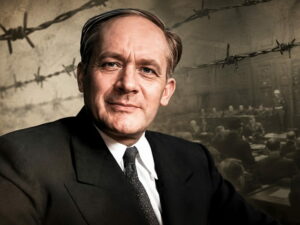
Dr. Victor Frankl, another Holocaust survivor, was a medical doctor (he was both a neurologist and a psychiatrist) who became one of the most famous thinkers of the 20th century. Today he is remembered for being a leading psychotherapist who, after the Holocaust, founded the concept of logo-therapy; therapy focused on finding meaning in life. Unsurprisingly, his most famous work is titled Man’s Search for Meaning, which has been translated into fifty languages and has sold over sixteen million copies.
In his book, Frankl describes his experiences in the Nazi concentration camps, but more than his travails, he writes as a psychologist about what provided him with the strength to survive. He writes that prisoners who gave up on life and hope for a future were inevitably the first to die. They died more from the lack of something to live for than the lack of something to eat. By contrast, Frankl kept himself alive by thinking of his wife, and dreaming of lecturing about how his experiences reinforced what was already a central part of his thesis before entering the camps – that the primary motivational force of every person is a search for meaning.
Shortly after arriving at Auschwitz, Frankl was stripped of his most precious possession – a manuscript that was his life’s work, which he had hidden in his coat pocket and viewed as his “mental child.” Realizing that the odds of his survival were small, “no more than one in twenty-eight,” he had what he describes as “perhaps his deepest experience in the concentration camps.”
“I had to undergo and overcome the loss of my mental child. And now it seemed as if nothing and no one would survive me; neither a physical nor a mental child of my own. So I found myself confronted with the question whether under such circumstances my life was ultimately void of meaning.
“When I arrived I had to surrender my clothes and, in turn, I inherited the worn-out rags of an inmate who had already been sent to the gas chamber [...]. Instead of the many pages of my manuscript, I found in a pocket of the newly acquired coat one single page torn out of a Hebrew prayer book, containing the most important Jewish prayer, the Shema Yisroel.
“How should I have interpreted such a ‘coincidence’ other than as a challenge to live my thoughts instead of merely putting them on paper?”
This little scrap of paper providentially coming into his possession became the cornerstone of the rest of his life.
This is reminiscent of another remarkable incident that, for space considerations, I will reduce to the essential facts. One of the most well-known builders of Jewish schools and communities in the 20th century was Rabbi Yosef Shlomo Kahaneman aka “the Ponevezer Rov.” Shortly after the war, Rabbi Kahaneman travelled to Europe to gather Jewish orphans and take them home to Israel.
In one orphanage, the priest in charge told Rabbi Kahaneman that there were no Jewish children there. Undeterred, Rabbi Kahaneman stood in front of all the orphans and called out in a booming voice the Shema prayer and immediately young children, who’d last heard those holy words years before as their parents tucked them into bed each night, began crying and calling out “Mama! Mama!” Rabbi Kahaneman triumphed and reclaimed many orphans and brought them to Israel. Their remembrance of this essential prayer ultimately led them to new lives in Israel where they could reclaim their Jewish ancestry.
We find an astonishing parallel to these stories in the Babylonian Talmud (Sanhedrin 63b). After the massacre of the Jewish population by the Roman army around 70 CE, when they sacked Jerusalem and destroyed the Second Holy Temple, those who were left began to die of starvation. The Talmud records that “Elijah the Righteous” met a starving orphaned child who had lost his very large family and asked him if he wanted Elijah to give him the secret to living. “Sure,” replied the child. Elijah then told him to recite the Shema prayer every day. For Jews tortured and massacred for three millennia, the last words on their lips has been the Shema prayer.
According to the Talmud (Pesachim 56a), the Shema prayer was the answer of the twelve tribes to their father Jacob who was worried that after his death they might abandon the ways of the patriarchs. In other words, the Shema was a testament to their commitment to promoting the unity of the Almighty as their father, grandfather, and great-grandfather had done. Bringing forth this message to new generations is the key to honoring the past and creating a mission for the future.
Elijah the Righteous (as well as Eli Wiesel and Victor Frankl) understood that the biggest issue facing someone who has lost everything is the dispossession of all; the will to live. A person needs to understand that the only meaningful response to surviving catastrophes is to bring the past into the present. In this way the past isn’t lost and the future feels possible. This mission gives a survivor a reason to live – to preserve the past and keep it alive for future generations.
We have run out of space for this week, so I will leave you with something to think about. The Malbim, an acronym for Meir Leibush ben Yechiel Michel (1809–1879), was a very influential figure in the 19th century and is well-known for his works on biblical commentary. He quotes in his work Eretz Chemda, a “midrash pliah – baffling teaching.” This week’s Torah portion begins with the Almighty commanding the Israelites to build a Tabernacle, and the Midrash attributes this command; “as is written, Shema Yisroel (Hear O Israel).” Malbim asks, “What is going on here, how are these two concepts (the building of the Tabernacle and the Shema prayer) related?” (Look for the answer in next year’s edition of Shabbat Shalom on Parshat Terumah!)

This week's Torah reading is an architect’s or interior designer’s dream portion. It begins with the Almighty commanding Moses to tell the Jewish people to donate the materials necessary for the construction of the Mishkan, the portable sanctuary.
The Torah continues with the details for constructing the Ark, the Table, the Menorah, the Tabernacle (the central area of worship containing the Ark, the Menorah, the Incense Altar, and the Table), the Beams composing the walls of the Tabernacle, the Cloth Partition (separating the Holy of Holies, where the Ark rested, from the remaining Sanctuary part of the Tabernacle), the Altar, and the Enclosure for the Tabernacle (surrounding curtains forming a rectangle within which was approximately 15x larger than the Tabernacle).

Instead of asking where was God, ask where was man?
– Sonia Weitz, poet and Auschwitz survivor
Dedicated to my two children,
Ben and Aviva,
whom I love unconditionally.
Lots of love, Mom