






 In Poland, Even Winnie-the-Pooh Has a Holocaust Story

9 min read
9 min read
4 min read


8 min read


From bustling midnight grocery runs to digging up First Temple ashes, life in Jerusalem is anything but ordinary.
I moved to Jerusalem from London, Ontario, 40 years ago. People often ask me how I can live in Jerusalem, especially now.
I understand the question. From far away, Jerusalem often looks like a place of tension, conflict, sirens, arguments, ancient grievances, and breaking news. All of that exists. I would be dishonest if I pretended otherwise.
But it is not the Jerusalem I experience every day.
Here are ten reasons why I am still amazed that I get to live here.
During the war, I was on a Zoom call with a colleague from the American Midwest as I rode my bike home late at night.
She asked me what Jerusalem felt like at a time like this. Instead of trying to explain it, I turned my camera around.
It was 11 p.m. on a weekday, during a war, and the city was bursting with life. Hundreds of people were making their way toward the Western Wall. Machane Yehuda, the outdoor fruit and vegetable market that transforms after hours into a nightlife scene of restaurants, music and bars, was packed. Families were out. Young people were milling around, music playing. The streets were full.
My colleague was speechless.
I don’t mean that the war did not take a toll. It did. Everyone knew someone who was serving, someone who was wounded, someone who was displaced, someone who did not come home.
 But Jerusalem has a way of carrying grief without surrendering to it. Life here continued because people understood exactly what was at stake.
To live in Jerusalem is to know that joy itself can be an act of courage.
New York calls itself the city that never sleeps. I beg to differ. I recently went to a Jerusalem grocery store at 12:30 in the morning specifically to avoid the crowd. Yes, it was open.
What a mistake. The place was packed.
Lines, noise, baby carriages, teenagers, people comparing yogurts as if this were a matter of national security, and two men having an intense debate over which hummus was acceptable to bring home.
At 12:30 AM, on a Tuesday.
The city does not sleep. It just changes shifts.
Babies are everywhere. In restaurants, on buses, in shul, in the shuk, on hiking trails, in strollers being pushed up impossible hills by parents who somehow look both exhausted and radiant.
In many cities today, children seem to be treated as an interruption to adult life. In Jerusalem, they are one of the main points of life.
 Playing hockey in Jerusalem
Young couples here do not wait until everything is perfectly arranged before they start building families. They do it in small apartments, with second-hand furniture, borrowed cribs, help from grandparents, and a level of confidence that can seem irrational until you realize it is one of the secrets of Jewish survival.
Jerusalem has an Old City, and it’s one of the youngest places I know.
Yes, there are missiles. Yes, there have been terror attacks. Yes, this is the Middle East and no one confuses Jerusalem with a quiet village in Switzerland.
But the daily experience of walking around Jerusalem is far safer than most outsiders imagine.
Ten-year-olds walk their younger siblings to school. Teenagers take buses across the city. Families sit outside late at night. People leave strollers at the entrance to stores. You can walk through neighborhoods at all hours when, in other major cities, you would be carefully checking who is behind you.
The headlines tell you one truth about Jerusalem. The streets tell you another.
On a single block in Jerusalem, you can hear Hebrew, English, Arabic, French, Russian, Yiddish, Spanish, and a few languages you can’t identify.
You see Jews from every corner of the world: Ashkenazi, Sephardi, Mizrachi, Ethiopian, Yemenite, Russian, American, French, British, Moroccan, Persian, Iraqi, and more.
You also see Muslim families, ancient Christian communities, Armenian clergy, African pilgrims, tourists from Asia, priests in robes, soldiers in uniform, yeshiva students in black hats, women in jeans, men in knitted kippahs, and someone from Brooklyn explaining to someone from Bnei Brak why his kugel recipe is superior.
And if you really want to understand how absurd the apartheid accusation is, just hop on a bus or the light rail, or visit a Jerusalem hospital. You will see Jewish and Arab doctors, nurses, patients, surgeons, pharmacists, technicians, and families moving through the same hallways, being treated in the same rooms, and caring for one another in ways that never make the news.
It should not work. And some days, it barely does. But somehow, everyone makes room. Not always gracefully or quietly. But they do.
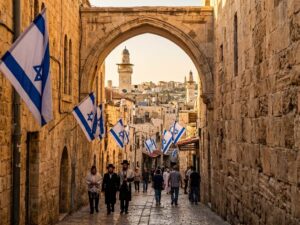
In Jerusalem, Jewish history is something you walk through on the way to buy milk. You are submerged in it.
You pass streets named for prophets, rabbis, kings, poets, soldiers, and dreamers. You hear political arguments that feel like they could have started in the time of the Mishnah and will probably not be resolved until the Messiah comes. You see archaeological digs next to coffee shops, ancient stones beneath new apartment buildings, and schoolchildren on field trips standing in places their ancestors once stood.
The Jewish story is not sealed behind glass here. It is unfolding right before your eyes.
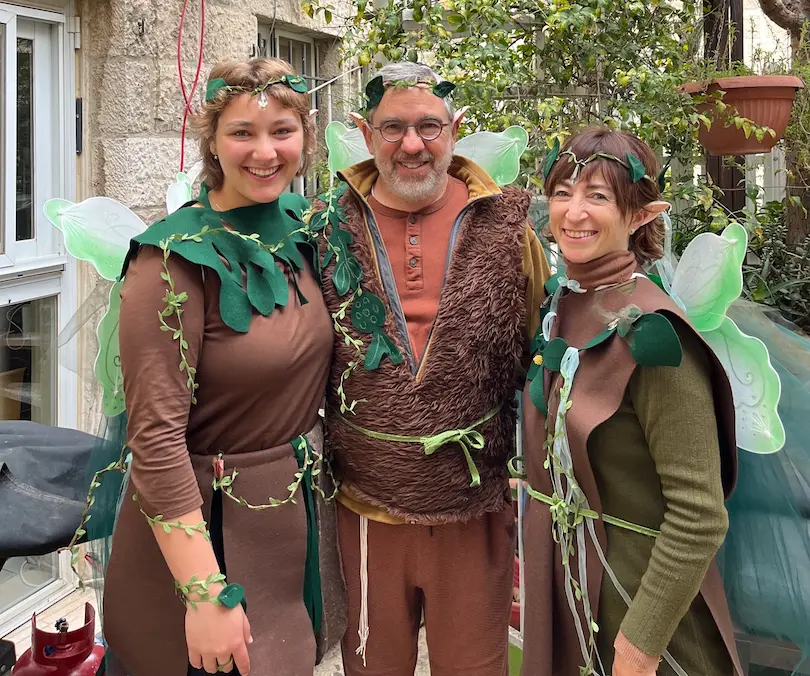 Celebrating Purim in the Jewish Quarter
Living in Jerusalem means living with responsibility. History presses in and the world watches. It is also a tremendous privilege. Living here feels that you are actively participating in writing the next chapter of the Jewish story.
You don’t have to be a mystic or even particularly religious to feel God’s presence here. Watch the sky turn gold over the city or walk the streets of the Old City on Shabbat, and something in you goes quiet.
Jerusalem has a way of making a person ask larger questions. What am I part of? What did my grandparents dream of? What will my children inherit? What is worth sacrificing for? What does it mean to belong to a people with such a long memory?
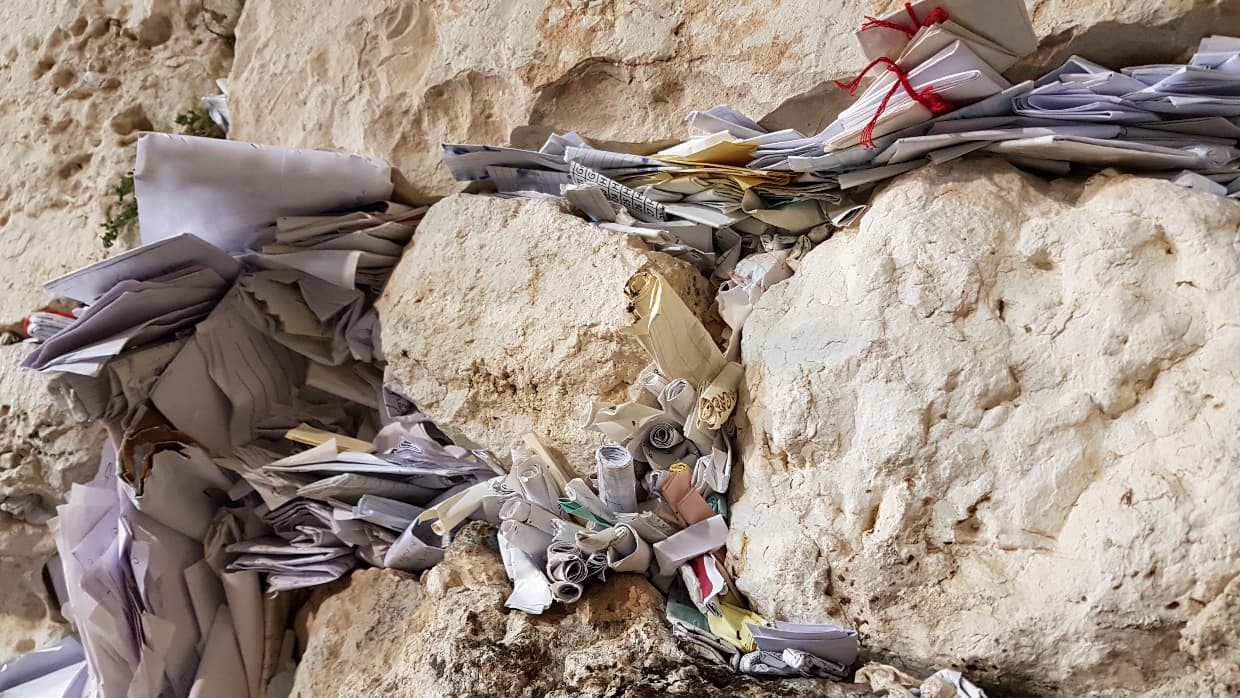
I have walked to the Kotel, the Western Wall, at all kinds of hours and in all kinds of moods.
Sometimes I go with visitors, sometimes for prayer, and sometimes because I need to be reminded of something I cannot quite name.
The walk itself prepares you. The stones, the narrow streets, the descent through the Jewish Quarter, the sudden opening of the plaza, and then the Wall itself.
It’s familiar but never ordinary.
The Kotel stands there, carrying more tears, prayers, longing, gratitude, and Jewish stubbornness than any stone wall should be able to hold.
Jerusalem food is not fancy but it’s amazing.
It is fresh pita, hot from the oven. It is the smell of rugelach in Machane Yehuda. It is olives, tehina, roasted eggplant, tomato salad, fresh cheese, and strong coffee.
The fruits and vegetables taste different here, sweeter, brighter, more alive.
My wife volunteers at the City of David excavations, one of the most extraordinary archaeological sites in the world. The City of David is the ancient core of Jerusalem, just south of the Old City walls, where archaeologists are uncovering layer upon layer of civilization from thousands of years of Jewish history.
Every week, my wife digs.
Recently, she’s been working in the ash layer from the destruction of the First Temple, the devastation Jews still mourn every year on the Ninth of Av. More than 2,500 years later, she is literally digging in the ashes of that day, holding in her hands the remnants of Jewish life interrupted by exile.
Almost every week, she finds something – an oil lamp, a jewelry bead, a stone fragment that was part of somebody’s home thousands of years ago.
In most places, history is something you read about. Here, my wife holds it in her hands.
I love living here because Jerusalem is where my people’s past speaks, where our present burns with life, and where the future is being born every day.











Wow, how true, I envy you. Jerusalem is my life we were there 3 years ago and I can't wait to get back. You are so right when you walk in certain places you feel awe and a joy which I never felt anywhere else. You are soooo blessed.
and why i wish wish wish i could get back to Jerusalem!
YES, thank G!d!
And that's why I didn't want to one home after each trip. Wish I could be back there now. But I also know, from cousins and friends who live in Israel, that the living now "ain't easy."
100% true. Cried while reading this! thank you
I've lived in Jerusalem since 2014 and you've nailed it. I recently moved from the Greek Colony to Nachlaot and the vibrancy is everywhere, yes, even during war.
World class article. So true of everything described. Jerusalem is truly a beacon of light to the world -- and sadly the world doesn't know it yet.
Wow, wow, wow, wow. Spectacular. Tysm for sharing.
P.S. There is apartheid. In Arab villages. Where if a Jew ends up there by mistake, he or she would be lynched to death (G-d forbid).
A Jew who wanders in to an Arab village by mistake has a 1% mortality rate. Their chances of being alive 24 hours later are maybe 1%. An Arab wandering into a Jewish neighborhood? They're there every single day in every capacity. And they feel as safe as can be.
Oh, yes, of course, those baby killing Jews.
Let's not forget them.
To say it's the opposite of the truth is an understatement. Let's leave it there.
Sorry to get side-tracked.
Gorgeous article.
Amen to every word. What an awesome city we live in !
Born in the US - never in a position to even visit Israel. Busy life raising 7 children as a homemaker, last one handicapped with autism. A husband ill in his last years. Working as a waitress, caregiver for my autistic one, pre-school teacher. No time - no extra $$. So here I am still in California, retired. I touch Jerusalem everyday with heart and claim it my city with hope and prayers waiting for Mosheich to bring us there. B’H’
Lucky you! And lucky me for living in Israel!
Beautiful and totally true!!!
This article by Rabbi Shore says it all. Great story and so informative that I want to share with all my friends who keep putting off coming here. Thank you.
Boy I needed that! The lift people are coming today to take our goods to Jerusalem! The house is a wreck, I’m thinking of the children and grandchildren I’m leaving behind here in the States… and I read your 10 things and said yes. YES!! Exactly and more! Thank you!
But the never-ending futile horn-honking????
Loved
You brought tears to me eyes. I too live in Jerusalem, made aliyah 4 years ago from NJ and couldn't have said it better. May we merit Jerusalem rebuilt very soon.