




 Indigenous Peoples Call Israel the World's Greatest Decolonization Story

8 min read
8 min read



10 min read


For thousands of years the Jewish People have been having a love affair with this ancient, eternal city.
The city of Jerusalem is mentioned by that name 669 times in the Hebrew Bible. The Torah usually refers to the city as “the place that the Lord, your God, will choose.”1 The first mention of the city occurs when Melchizedek, the monotheistic king of the city of Shalem, greets Abraham and blesses him.2 Later, Abraham offers his son Isaac to God on Mount Moriah and calls the place “Yireh,” meaning “will see” alluding to the idea that this will be a place where God will “see and be seen.”3
According to the Sages4, God created the name Jerusalem as a hybrid of “Yira” and “shalem” producing “Yerushalem” which is how it is written in the Bible and is the origin of the English transliteration, Jerusalem. Together it means “peace will be seen.” The pronunciation in Hebrew is, Yerushalayim, giving the city a Hebrew plural ending as though it is describing two cities. Commentaries point out that there is a “heavenly Jerusalem above” that is the spiritual twin of the earthly Jerusalem below.5
It is clear that Jerusalem plays a central role in the Bible. What is the relationship of the city of Jerusalem and the Jewish people?
The Jewish people's relationship with the city of Jerusalem is something similar to a couple deeply in love. When they are apart, they cherish artifacts that remind them of that love, and they observe remembrances, anniversaries and special occasions that mark milestones in the relationship.
This is also true of the Jewish people and Jerusalem. Every time a traditional Jew eats bread, or products of wheat, barley, rye, spelt or oats, or eats one of the blessed fruits of the land of Israel – figs, dates, pomegranates, and grapes, they will say a special blessing afterwards. In that blessing there is a special mention of the city of Jerusalem and of the land of Israel: “Have mercy, Lord our God, on Israel Your people, on Jerusalem Your city, on Zion the abode of Your glory, on Your altar, and on Your Temple. Rebuild Jerusalem, the holy city, speedily in our days, and bring us up to it and make us rejoice in it, and we will bless You in holiness and purity.”
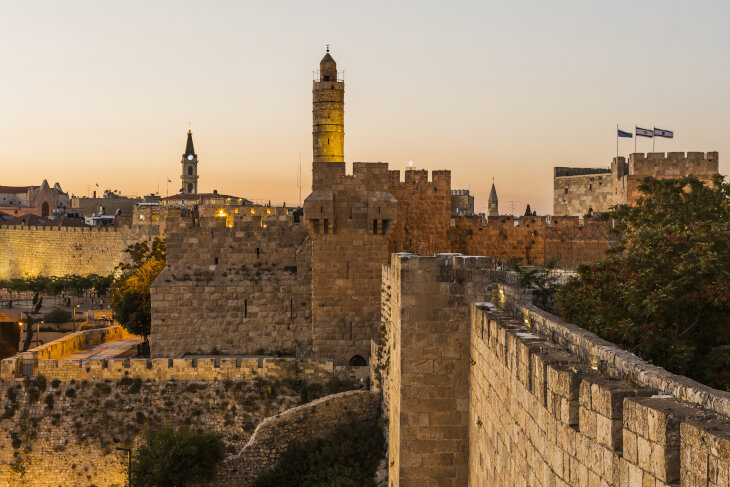
Jerusalem is extravagantly and lavishly praised in Rabbinic literature: “Jerusalem is the light of the world, and who is the light of Jerusalem? The Holy One, Blessed Be He.”6 “Jerusalem is the city that joins together all the Jewish people.”7
“Ten measures of beauty came down to the world; 9 were taken by Jerusalem, one by the rest of the world.”8
Every time we pray, three times a day, we face Jerusalem and recite in our central prayer, known as the Amidah, a special blessing about the city of Jerusalem: “Rebuild the city of Jerusalem, the holy city, speedily in our days.”
At Jewish weddings the groom breaks a glass cup under the chuppah,9 the wedding canopy, to commemorate of the destruction of Jerusalem of the incompleteness of Jerusalem’s redemption in order to fulfill the vow that the Jews made thousands of years ago. “If I forget you, O Jerusalem, let my right hand forget its skill. Let my tongue adhere to my palate, if I fail to recall you, if I fail to elevate Jerusalem above my foremost joy.”10
Traditionally, when Jews build homes they leave a square on the wall unpainted or unsurfaced as a commemoration for the city of Jerusalem.11 There are numerous fast days in the course of the Jewish year, most of them revolving around Jerusalem. The 9th of Av, Tisha B’Av, mourns the destruction of the first and second temples in Jerusalem; the 17th of Tammuz commemorates the breaching of the walls around Jerusalem; and the 10th of Tevet marks the beginning of the Babylonian siege of Jerusalem.12
We are continuously reminded of Jerusalem in our calendar, in our prayers, in our blessings, when we eat and when we get married. Even when a Jew dies there is a custom amongst many to include in the burial some soil from the land of Israel.13 Many Jews throughout the centuries have, as their last wish, been buried in the land of Israel, especially near Jerusalem. One of the most famous Jewish cemeteries in the world is the Mount of Olives cemetery in Jerusalem where some of the greatest scholars, righteous people, Rabbis and philanthropists are buried.14

Jerusalem features prominently in the poetry and songs of the Jewish people. Whether in the poems of Yehuda Halevi, “My heart is in the East and I am at the end of the West,” and other Rabbis of medieval Spain who wrote hundreds of poems about the land of Israel and the city of Jerusalem15 or in the zemirot, the beautiful songs that we sing at the Shabbat table every week, there is a focus on the praise and longing for the city of Jerusalem. In modern times the beautiful song “Jerusalem of Gold” by Naomi Shemer is world-famous, and the songs of Rabbi Shlomo Carlebach about the city of Jerusalem are sung in synagogues and youth groups around the world.
When the Israeli author Shmuel Yosef Agnon received his Nobel Prize in literature, the king of Denmark asked him where he was travelling to after the Nobel Prize ceremony. Agnon replied, “I am going to Jerusalem.” One of his friends corrected him and commented that Agnon was about to embark on a worldwide lecture tour immediately after the ceremony. Agnon responded, “It is true I have a lecture tour, but wherever a Jew is going he is always going towards Jerusalem.”
When King Solomon built the first temple in Jerusalem in his inaugural speech he stated that wherever the Jews would be throughout the world and throughout history they would always pray to God via the holy city of Jerusalem.16 and indeed when Daniel the prophet was in Babylon he prayed at the windows of his house that faced the city of Jerusalem17 and synagogues all over the world face Jerusalem.18 Like many observant Jews, I have an app on my phone that always gives me the direction toward Jerusalem, no matter where I am in the world.
We end the prayers of Yom Kippur, the Day of Atonement, and we end the Passover Seder, with the phrase, “Next Year in Jerusalem.”
Through thick and thin Jews maintained a presence in Jerusalem after the Romans destroyed the Temple there were still Jews who remained there. They stayed under Byzantine persecution, and when the Crusaders arrived they banned Jews from the city and burnt to death those who remained in their synagogue. When Saladin conquered the city from the Crusaders, he allowed Jews to return. Indeed, Jews did return, over and over again. Nachmanides, the great sage from Spain, settled in Israel in his old age and established a synagogue in an abandoned building in Jerusalem. Yehuda Levi left Spain and attempted to reach Jerusalem, but, as the legend has it, he was trampled to death by the horse of an Arab at the gates of Jerusalem.
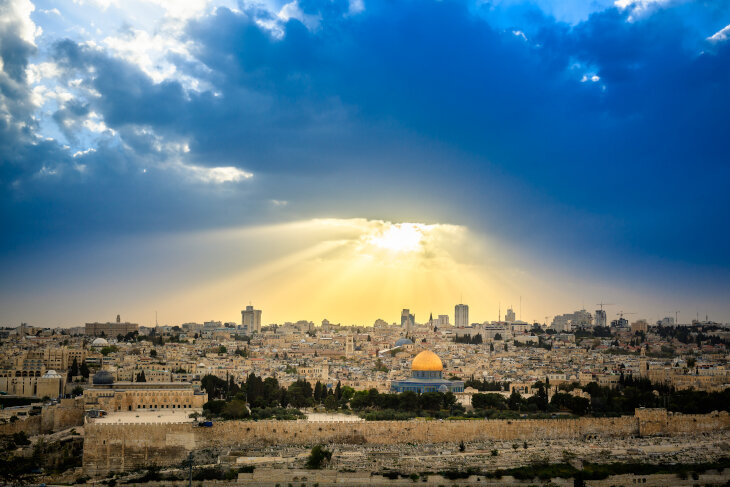
Jews continued to seek out Jerusalem. Kabbalists and refugees from the Spanish Inquisition arrived in the 15th and 16th centuries. Hasidic masters and their followers, and students of the Gaon of Vilna arrived in the 18th and 19th centuries. Jews escaping pogroms in Russia and Ukraine in the 19th and 20th centuries also came to Jerusalem. Secular and religious Zionists came the 20th century and established the first neighborhoods outside the walls of the old city - Nachalat Shiva and Meah Shearim.
The great philanthropist, Sir Moses Montefiore, a Sephardic Jew from England and one of the richest people in the world, established the Mishkenot Shaananim neighborhood and built the famous Montefiore windmill in that area. Initially, people had to be paid to live there because they were scared to live outside the walls of the old city, and today less than a century later, apartments in that neighborhood which has a beautiful artists’ quarter and is close to the magnificent King David hotel, sell for many millions of dollars.
When the state of Israel was established even more Jews came to Jerusalem and Jerusalem once again became the capital of the Jewish state as it was under King David, King Solomon and King Hezekiah. In 1967 during the Six Day War after Jordan joined in the attack on Israel, the IDF managed to repel the Jordanian forces from east Jerusalem and once again reunited Jerusalem. Once again, as in the days of Jeremiah, Ezekiel and Isaiah, the Jews were back in the ancient city of Jerusalem and Mount Moriah, the site of the temple was in Jewish hands.
There has been a proliferation of scholarship in Jerusalem. Hundreds of yeshivahs and seminaries exist in Jerusalem attracting students from all over the world. There are universities, colleges, research institutes, museums and publishing houses in the holy city. Once again, the verse in Isaiah has been fulfilled, “From Zion shall come forth the law, and the word of God from Jerusalem.”19
Since the Six-Day War, Jews have been celebrating the 28th of the Hebrew month of Iyar, when the whole of Jerusalem came back into Jewish hands, as what we call Yom Yerushalayim, Jerusalem Day. There are special prayers recited, parades, concerts, laser shows on the walls of the Old City, and, of course, BBQs.
Not by coincidence, the 28th of Iyar is mentioned in the Code of Jewish Law as being the yahrzeit, the anniversary of the death, of Samuel the prophet.20 It was Samuel, the Talmud tells us, who informed King David of the precise location where the temple would be built in Jerusalem,21 and it was Samuel who made the famous statement “and the eternal One of Israel will not lie.”22 The Hebrew phrase, Netzach Yisrael, can be translated as the Eternal One of Israel, meaning God – “God does not lie.” It can also be translated as the “eternity of the Jewish people is not a lie;” and it can be also mean “the victory of the Jewish people is not a lie.”

The Talmud tells us that the word netzach is also another name for the city of Jerusalem23 - because Jerusalem is the city of God, the city of eternity and the city of victory. More than any other city, it embodies the eternity of the Jewish people and their connection to their homeland, Israel. It’s the city with which the Jewish people have had a love affair for thousands of years.












💕 💕
What I don't u nderstand is why do we on Yom Kippur after Neilah and at the end of the Pesach Seder say L'Shonah Habow Yerusalyim when Jerusalem has been our for ober 50 years now
Refers to the restoration of the Temple and Temple services. Until then we have not fully returned.
Thank you for the education about Israel.
From the River to the Sea,
Israel shall always be!
"AM ISRAEL CHAI ♥"
After Hadrian,mach shemo,stamped out the Second Jewish Revolt (132-135 CE),,he re-founded Jerusalem as a pagan city,Aelia Capitolina and Jews were barred from living there-presumably forever.
Well mighty Emperor Hadrian,your eternal empire is long gone. Your home country (Italy) is an unimportant state. And your mighty,supposedly invincible legions don't terrify anyone these days. But we Jews DO exist. And, yup, Jerusalem is again the capital of a restored Jewish state-a state that you were sure you had destroyed forever back in 135 CE.
As the old Yiddish saying goes. "A mensch tracht und Gott lacht."
Nobody is ever going to take Jerusalem away from us!